Hormonal IUD timeline: insertion, bleeding, and follow-up
The IUD’s bleeding changes and its start of contraceptive protection follow different timelines, so confirm guidance for your specific device and situation.
After placement, spotting, irregular bleeding, or cramps can happen, and bleeding may stay irregular during the first 3 to 6 months; no single pattern is guaranteed. Contraceptive protection may begin right away or require 7 days of backup, depending on the device, cycle timing, and circumstances. Plan postpartum placement with a clinician, since timing matters too. 1 2
Before placement: confirm the details that change the plan
“Levonorgestrel IUD” covers more than one device. Before your appointment, confirm its name and ask when its contraceptive protection starts for your situation. For Mirena and Kyleena, the US prescribing information says that if the device is placed within the first 7 days of your menstrual cycle, backup contraception isn’t needed. If it’s placed later, use a barrier method or avoid vaginal sex for 7 days. Guidance can differ when switching from another contraceptive method, so don’t assume the same rule applies to every situation or device. 1 2
If you’re planning placement after childbirth or a pregnancy loss, confirm the timing with your clinician. Mirena and Kyleena labeling describes placement immediately after childbirth, after the placenta is removed, or interval placement after at least 6 weeks or when the uterus is fully involuted. These are product-specific instructions, not a rule to apply to every device or circumstance. Ask how the timing affects your plan and whether backup contraception is needed. 1 2
It may also help to ask the clinic what placement involves and what pain-relief options are appropriate for you.
Placement day: keep the two timelines separate
The insertion appointment is the start of the device’s use, but bleeding changes don’t tell you when contraceptive protection begins. Follow the backup instructions for your exact device and timing even if you have no bleeding, spotting, or cramps after placement. 1 2
For Mirena and Kyleena, the product instructions say irregular or prolonged bleeding, spotting, and/or cramps may occur during the first few weeks. If symptoms are severe, or continue in a way that concerns you, report them to your healthcare provider. 1 2
First weeks through month six: expect change, not a schedule
The first few months can be less predictable than the longer-term pattern. With Mirena and Kyleena, bleeding and spotting days may be higher and bleeding may be irregular during the first 3 to 6 months. With Kyleena, the product information says that bleeding and spotting days usually decrease afterward, although bleeding can remain irregular. That describes a common pattern, not a promise about what your periods will do. 1 2
Follow-up: match the check to your symptoms
Ask the clinic what follow-up it recommends for your device and circumstances. A routine ultrasound isn’t automatically needed for everyone: in a prospective study of 52-mg IUD users, the device was out of position on a six-week ultrasound in 28 of 448 participants (6.3%). Among participants with favorable bleeding and no pelvic pain, it was out of position in 3 of 165 (1.8%). The study was conducted in the Netherlands and doesn’t settle every follow-up question, but it supports discussing ultrasound when bleeding is unfavorable or pelvic pain is present rather than assuming every user needs a scan. 3
If bleeding or pain is severe, persistent, or not what you expected, contact your healthcare provider instead of treating it as a routine adjustment without checking. A change in bleeding pattern is not, by itself, a way to tell whether you’re protected against pregnancy. Keep using the backup method for the period specified in your device’s instructions, and ask the clinic if you’re unsure whether those instructions apply to you. 1 2 3
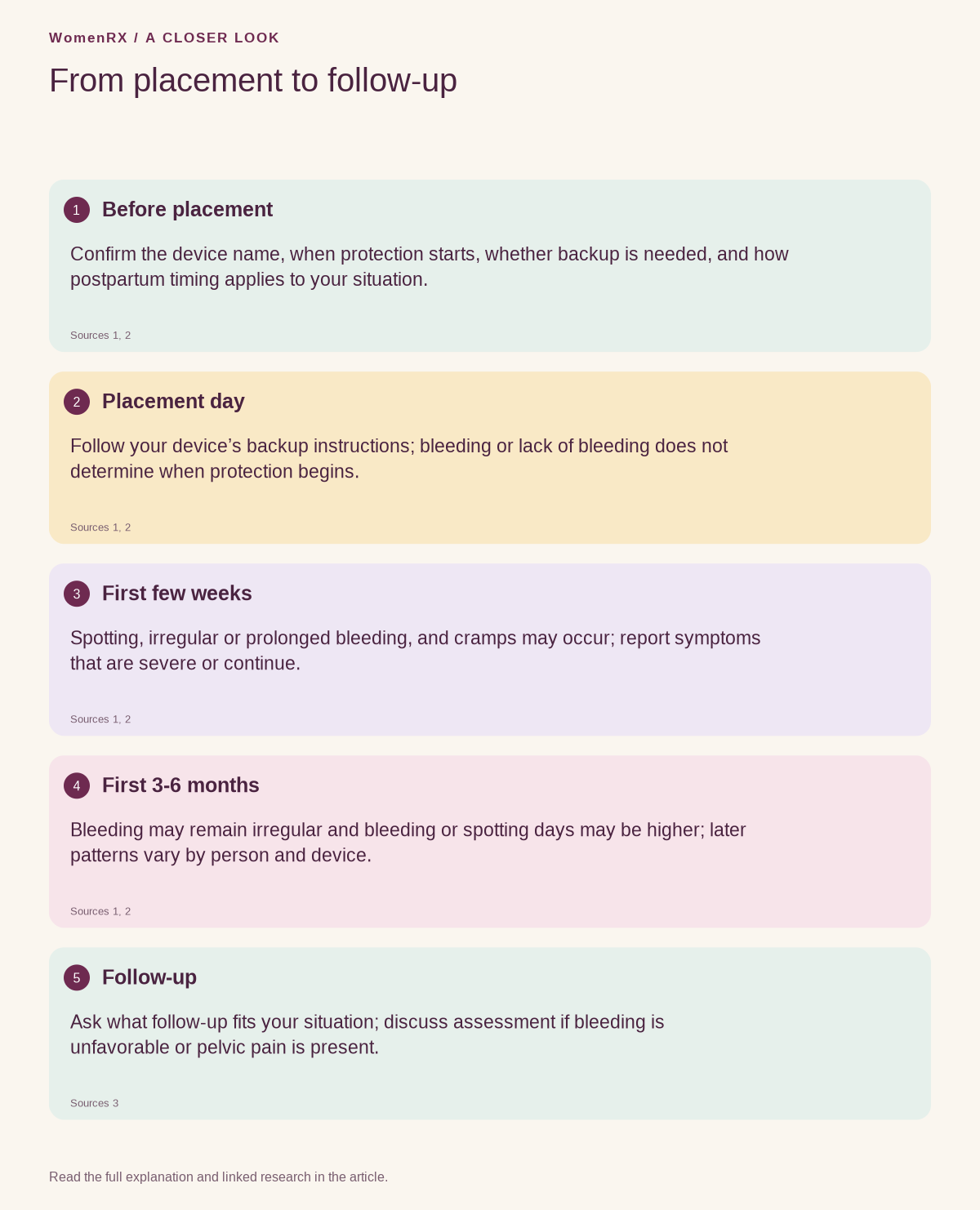
From placement to follow-up
Before placement: Confirm the device name, when protection starts, whether backup is needed, and how postpartum timing applies to your situation.12
Placement day: Follow your device’s backup instructions; bleeding or lack of bleeding does not determine when protection begins.12
First few weeks: Spotting, irregular or prolonged bleeding, and cramps may occur; report symptoms that are severe or continue.12
First 3-6 months: Bleeding may remain irregular and bleeding or spotting days may be higher; later patterns vary by person and device.12
Follow-up: Ask what follow-up fits your situation; discuss assessment if bleeding is unfavorable or pelvic pain is present.3
Read the figure as text
Bleeding changes and contraceptive protection have separate timelines. Use the device-specific instructions for backup and ask about follow-up if symptoms concern you.- Before placement: Confirm the device name, when protection starts, whether backup is needed, and how postpartum timing applies to your situation.12
- Placement day: Follow your device’s backup instructions; bleeding or lack of bleeding does not determine when protection begins.12
- First few weeks: Spotting, irregular or prolonged bleeding, and cramps may occur; report symptoms that are severe or continue.12
- First 3-6 months: Bleeding may remain irregular and bleeding or spotting days may be higher; later patterns vary by person and device.12
- Follow-up: Ask what follow-up fits your situation; discuss assessment if bleeding is unfavorable or pelvic pain is present.3
More questions, answered
Will my periods stop after a hormonal IUD?
They may change, but stopping isn’t guaranteed. Kyleena’s product information describes fewer bleeding and spotting days for many users after the first 3 to 6 months, while bleeding may remain irregular. Don’t count on a specific bleeding pattern to judge contraceptive protection. 2
Does everyone need an ultrasound after insertion?
Not necessarily. A prospective study of 52-mg IUD users found a low rate of malposition among participants with favorable bleeding and no pelvic pain; the researchers concluded routine ultrasound wasn’t necessary for that group. Discuss an assessment if you have unfavorable bleeding or pelvic pain. 3
Sources you can check
- MIRENA (LEVONORGESTREL) INTRAUTERINE DEVICE [BAYER HEALTHCARE PHARMACEUTICALS INC.] | US prescribing information and patient instructionsAccessed 2026-09-25Return to first citation
- KYLEENA (LEVONORGESTREL) INTRAUTERINE DEVICE [BAYER HEALTHCARE PHARMACEUTICALS INC.] | US prescribing information and patient instructionsAccessed 2026-09-25Return to first citation
- Is 2-dimensional transvaginal ultrasonography necessary 6 weeks after insertion of the levonorgestrel 52-mg intrauterine device?van der Heijden PAHH, Geomini PMAJ, Ketel I, Veersema S, Bongers MY. · AJOG global reports · 2022Return to first citation