What a Levonorgestrel IUD Does for Birth Control and Bleeding
A levonorgestrel IUD prevents pregnancy and can reduce heavy periods, but bleeding changes still deserve the right explanation.
A levonorgestrel IUD releases hormone mainly in the uterus. It helps prevent pregnancy partly by making it harder for sperm to pass through the cervix, and it changes the uterine lining. The 52-mg Mirena is also FDA-labeled to treat heavy menstrual bleeding for up to five years for people choosing an IUD for contraception. It won’t explain or treat every cause of unusual bleeding. 1 2
Two effects, one device
A hormonal IUD is a small device placed inside the uterus. It releases levonorgestrel, a progestin hormone. Its main practical roles are preventing pregnancy and, for some devices, reducing heavy menstrual bleeding. Those effects are related, but they are not the same promise: contraception is one purpose, while relief from heavy periods depends on the device and the reason for the bleeding.
For example, the US prescribing information for the 52-mg Mirena includes treatment of heavy menstrual bleeding for up to five years for women who choose intrauterine contraception. That labeling is specific to Mirena; don’t assume that every levonorgestrel IUD has the same bleeding-related indication. 1
How levonorgestrel helps prevent pregnancy
Levonorgestrel IUDs work locally in the reproductive tract. The precise way the hormone produces contraceptive effectiveness has not been conclusively demonstrated. The Kyleena prescribing information describes evidence suggesting several contributions: thicker cervical mucus that impedes sperm, effects on sperm survival or ability to fertilize an egg, and changes to the uterine lining. These are proposed mechanisms, not a claim that one single action explains the device’s full effect. 2
The hormone also changes the endometrium, the lining that builds up and sheds during a menstrual cycle. These local effects help explain why a levonorgestrel IUD can both prevent pregnancy and reduce menstrual blood loss. The exact biological process behind the reduction in bleeding is not fully settled; research has examined changes in the lining and its blood vessels. 3 4
What to expect from bleeding
Bleeding may be irregular or include spotting during the first months after insertion. This can happen even when the longer-term goal is lighter periods. A review of levonorgestrel IUD use describes irregular bleeding as a common early effect, and research on counseling for users also identifies irregular bleeding and cramping during the first six months as expected concerns. Individual patterns vary. 4 6
Over time, bleeding may become lighter or stop. That change can be useful if heavy periods are the problem, but it isn’t a guarantee of a predictable cycle or no bleeding at all. If bleeding is persistent or unusual before insertion, the Mirena and Kyleena prescribing information says to assess for possible problems such as polyps or endometrial cancer before placing the device. In other words, the IUD’s potential to reduce bleeding is not a substitute for working out why bleeding is abnormal. 1 2
When the tradeoff may fit
A levonorgestrel IUD may be worth discussing if you want contraception and would also welcome lighter periods. Mirena’s US labeling specifically includes heavy menstrual bleeding as a treatment use when the person also chooses it for contraception. A narrative review also describes levonorgestrel IUDs as an option for heavy bleeding, while noting that treatment choices depend on the person and the underlying problem. 1 5
If you’re considering one mainly for heavy bleeding, the useful question isn’t only “Will it make my period lighter?” It’s also “Has the cause of this bleeding been assessed, and is this particular IUD appropriate for my situation?” Heavy bleeding can have different causes; an IUD’s effect on the uterine lining does not mean it treats each cause. For persistent or uncharacteristic bleeding before insertion, the product labels call for assessment to exclude endometrial problems rather than assuming the device will resolve the symptom. 1 5
And if your main goal is avoiding pregnancy, the possible bleeding changes are a separate part of the decision. Some people welcome lighter periods; others find early spotting or cramping disruptive. Knowing that the first months may look different from the longer-term pattern can help you weigh those tradeoffs without expecting the device to control every aspect of your cycle. 4 6
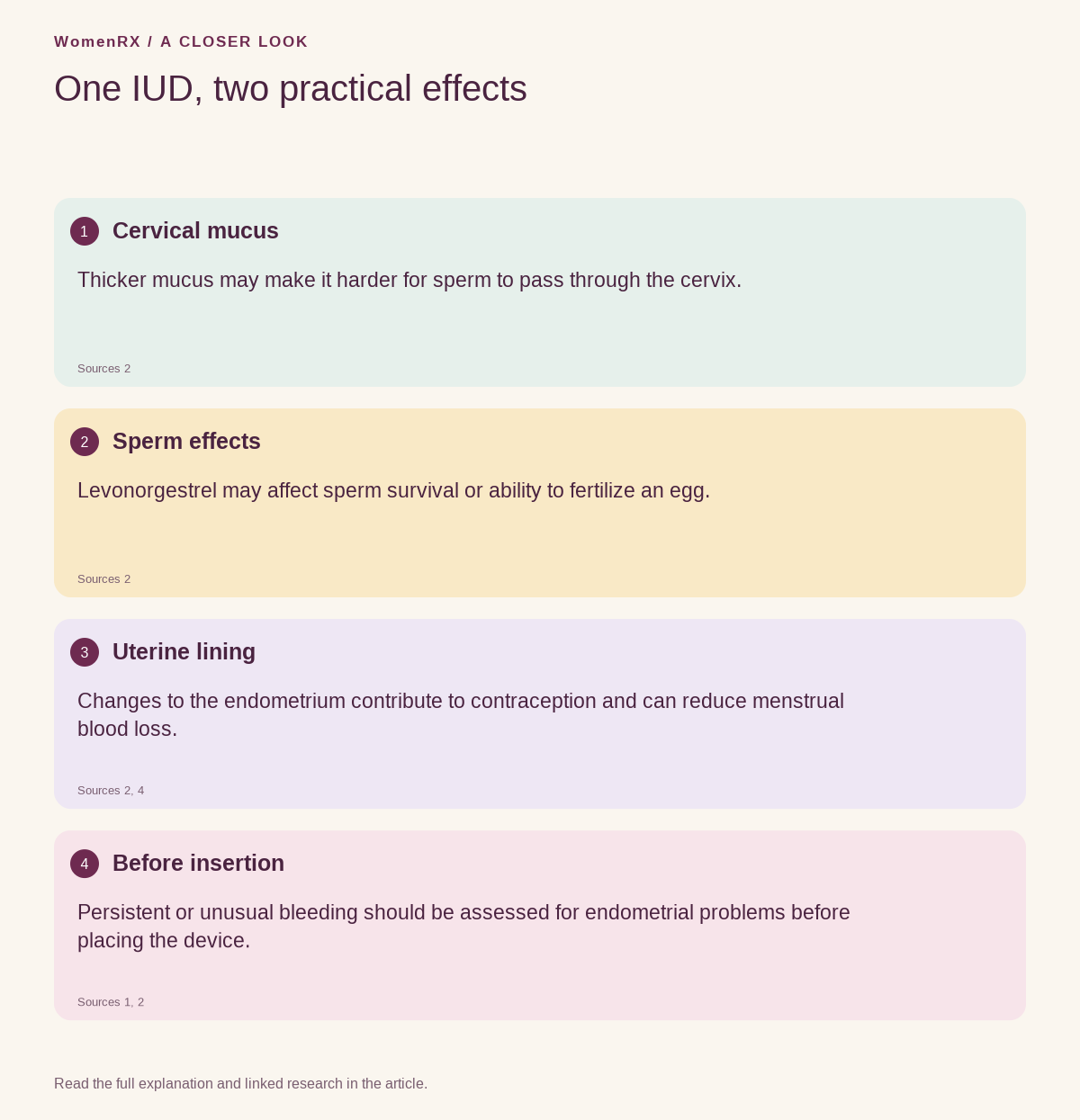
One IUD, two practical effects
Cervical mucus: Thicker mucus may make it harder for sperm to pass through the cervix.2
Sperm effects: Levonorgestrel may affect sperm survival or ability to fertilize an egg.2
Uterine lining: Changes to the endometrium contribute to contraception and can reduce menstrual blood loss.24
Before insertion: Persistent or unusual bleeding should be assessed for endometrial problems before placing the device.12
Read the figure as text
The hormone acts in the reproductive tract: some effects help prevent pregnancy, while changes to the uterine lining can reduce menstrual blood loss.- Cervical mucus: Thicker mucus may make it harder for sperm to pass through the cervix.2
- Sperm effects: Levonorgestrel may affect sperm survival or ability to fertilize an egg.2
- Uterine lining: Changes to the endometrium contribute to contraception and can reduce menstrual blood loss.24
- Before insertion: Persistent or unusual bleeding should be assessed for endometrial problems before placing the device.12
More questions, answered
Does a hormonal IUD treat every cause of heavy bleeding?
No. Mirena is labeled to treat heavy menstrual bleeding, but the prescribing information also says persistent or uncharacteristic bleeding should be assessed for possible endometrial problems before insertion. The device’s potential to reduce bleeding does not establish why bleeding is happening or mean it treats every cause. 1
Can bleeding be irregular after insertion?
Yes. Spotting or irregular bleeding can occur during the first months, and cramping may occur too. Bleeding often changes over time, but patterns vary from person to person. 4 6
Sources you can check
- MIRENA (LEVONORGESTREL) INTRAUTERINE DEVICE [BAYER HEALTHCARE PHARMACEUTICALS INC.] | US prescribing information and patient instructionsAccessed 2026-09-25Return to first citation
- KYLEENA (LEVONORGESTREL) INTRAUTERINE DEVICE [BAYER HEALTHCARE PHARMACEUTICALS INC.] | US prescribing information and patient instructionsAccessed 2026-09-25Return to first citation
- Vascular effect of levonorgestrel intrauterine system on heavy menstrual bleeding: is it associated with hemodynamic changes in uterine, radial, and spiral arteries?Şahin H, Güngören A, Sezgin B, Ün B, Şahin EA, Dolapçioğlu K, Bayik RN. · Journal of obstetrics and gynaecology : the journal of the Institute of Obstetrics and Gynaecology · 2021Return to first citation
- The levonorgestrel intrauterine system: the benefits of reduced bleeding.Cameron IT. · The European journal of contraception & reproductive health care : the official journal of the European Society of Contraception · 2001Return to first citation
- Utility of the Levonorgestrel-Releasing Intrauterine System in the Treatment of Abnormal Uterine Bleeding and Dysmenorrhea: A Narrative Review.Bianchi P, Guo SW, Habiba M, Benagiano G. · Journal of clinical medicine · 2022Return to first citation
- The first 6 months: developing a user-informed anticipatory counselling video about the levonorgestrel intrauterine system.Gilmore K, Ojanen-Goldsmith A, Callegari LS, Godfrey EM. · BMJ sexual & reproductive health · 2018Return to first citation