Hormonal vs. Copper IUDs: What Changes for Your Period?
In studies of specific devices, bleeding patterns differed: one low-dose levonorgestrel IUD had fewer bleeding days than a particular copper IUD by year three, while a study of a 52-mg levonorgestrel IUD found more spotting in the first 90 days.
A levonorgestrel (LNG) IUD releases a progestin; the copper IUD is hormone-free. Their bleeding patterns can differ, but results depend on the exact devices and when bleeding is measured: LNG IUDs may bring early irregular bleeding or spotting, while a small three-year trial found less bleeding with one LNG model than with one copper model later on. Check each product’s duration and postpartum guidance. 1 2 3 4 5
Start with what matters most to you
If you’re choosing between an LNG IUD and a copper IUD, two useful questions are whether you want a method that releases a progestin and how a change in bleeding might fit your life. An LNG IUD releases levonorgestrel, a progestin. A review describes the copper IUD as hormone-free. 2 3
For periods, there isn’t one simple rule that every LNG IUD makes bleeding lighter from the start. The pattern can vary with the device and over time. If your periods are already heavy, bleeding history deserves a close look in the decision: Mirena, one specific LNG IUD, is indicated in the US for heavy menstrual bleeding for up to five years in people who choose it for contraception. 1
Bleeding is a timeline, not a single prediction
In the first months, irregular bleeding or spotting can be part of using an LNG IUD. Kyleena’s US prescribing information says bleeding and spotting days may be higher and patterns irregular during the first three to six months; later, bleeding and spotting days usually decrease, though bleeding may remain irregular. 2
The first 90 days can look different depending on what is counted. In a US prospective cohort, participants using a 52-mg LNG IUD reported more days with any bleeding and more spotting days than participants using a copper T380A IUD. The study included 137 participants who provided enough daily reports, from 230 enrolled, so it describes those participants and those specific devices rather than predicting every user’s experience. 5
In a separate, single-center randomized trial of 106 women, researchers compared a 13.5-mg LNG IUD with a Nova T copper IUD. At month 36, the LNG group had fewer median bleeding days and lower reported bleeding intensity; 40% had no bleeding, compared with none in the copper group. These results apply to the particular devices and trial participants, not every LNG and copper IUD. 4
Taken together, the studies show why it helps to ask about both the first months and the longer-term pattern. They don’t support a single promise about what your bleeding will be like. If you have heavy periods, ask how the specific products you’re considering compare and whether treating heavy bleeding is one of your goals.
Compare the details of the exact products
“IUD” covers products with different hormone amounts and different labeled durations. For example, the US label for Mirena says it should be removed by the end of its eighth year for contraception, but replaced by the end of its fifth year if it is still being used to treat heavy menstrual bleeding. A 2016 review described copper IUD use for up to 10 years. That gives you a duration comparison to ask about, not a current labeled duration for every copper device. Check the current product information for the IUD you’re considering and the reason you’d use it. 1 3
Also ask what follow-up to expect and what to do if bleeding is persistent or unusual for you. Mirena and Kyleena prescribing information says irregular bleeding or spotting is common in the first months, and advises evaluation before insertion when bleeding is persistent or uncharacteristic. 1 2
Include life stage and plans in the conversation
If you’re recently postpartum, timing may depend on when the IUD is placed. The Mirena and Kyleena labels describe placement immediately after the placenta is delivered or interval placement after at least six weeks or when the uterus is fully involuted. These are product-specific instructions, so ask about the device being considered and your circumstances. 1 2
Your menstrual history and future pregnancy plans can help shape the discussion, too. Consider whether your current bleeding is heavy or painful, how you’d feel about spotting or irregular periods, and how long you want contraception to fit into your plans. You don’t have to choose based on a single headline about hormones or bleeding. Ask for the product name, its current labeled duration, and what bleeding pattern is typical for that specific device.
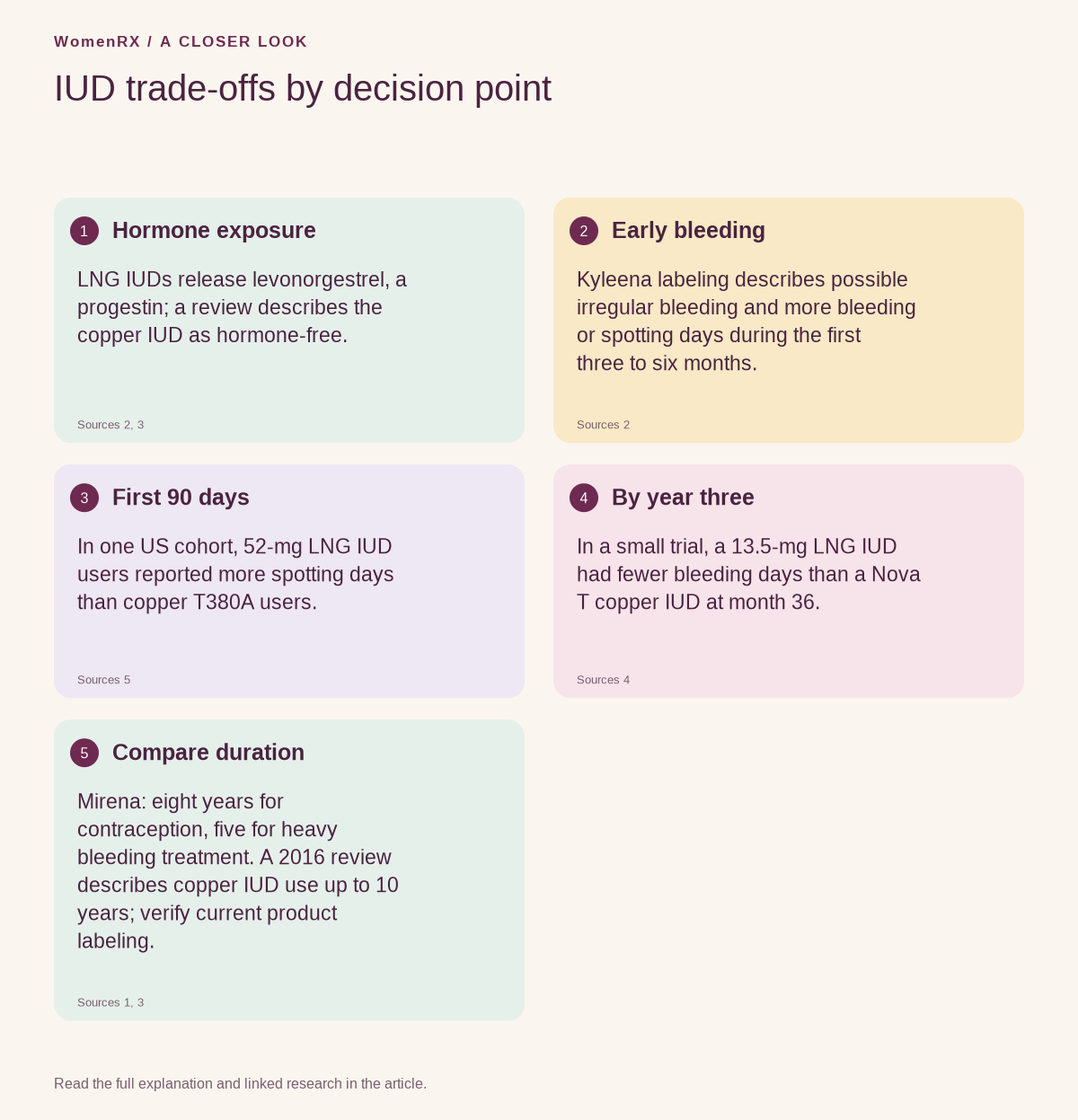
IUD trade-offs by decision point
Hormone exposure: LNG IUDs release levonorgestrel, a progestin; a review describes the copper IUD as hormone-free.23
Early bleeding: Kyleena labeling describes possible irregular bleeding and more bleeding or spotting days during the first three to six months.2
First 90 days: In one US cohort, 52-mg LNG IUD users reported more spotting days than copper T380A users.5
By year three: In a small trial, a 13.5-mg LNG IUD had fewer bleeding days than a Nova T copper IUD at month 36.4
Compare duration: Mirena: eight years for contraception, five for heavy bleeding treatment. A 2016 review describes copper IUD use up to 10 years; verify current product labeling.13
Read the figure as text
These comparisons highlight differences supported for the named products and studies; bleeding results depend on the device and the time period measured.- Hormone exposure: LNG IUDs release levonorgestrel, a progestin; a review describes the copper IUD as hormone-free.23
- Early bleeding: Kyleena labeling describes possible irregular bleeding and more bleeding or spotting days during the first three to six months.2
- First 90 days: In one US cohort, 52-mg LNG IUD users reported more spotting days than copper T380A users.5
- By year three: In a small trial, a 13.5-mg LNG IUD had fewer bleeding days than a Nova T copper IUD at month 36.4
- Compare duration: Mirena: eight years for contraception, five for heavy bleeding treatment. A 2016 review describes copper IUD use up to 10 years; verify current product labeling.13
More questions, answered
Can an LNG IUD make periods irregular at first?
Yes. Kyleena’s prescribing information says irregular bleeding and spotting, sometimes with more bleeding or spotting days, can occur during the first three to six months; bleeding days usually decrease later, though bleeding may remain irregular. 2
Are all hormonal IUDs approved to treat heavy periods?
Don’t assume so. Mirena is indicated for heavy menstrual bleeding for up to five years in people who choose it for contraception. Check the current labeling for any other IUD you’re considering. 1
Sources you can check
- MIRENA (LEVONORGESTREL) INTRAUTERINE DEVICE [BAYER HEALTHCARE PHARMACEUTICALS INC.] | US prescribing information and patient instructionsAccessed 2026-09-25Return to first citation
- KYLEENA (LEVONORGESTREL) INTRAUTERINE DEVICE [BAYER HEALTHCARE PHARMACEUTICALS INC.] | US prescribing information and patient instructionsAccessed 2026-09-25Return to first citation
- Emergency Contraception.Batur P, Kransdorf LN, Casey PM. · Mayo Clinic proceedings · 2016Return to first citation
- Bleeding profile and safety of a levonorgestrel 13.5 mg intrauterine device versus Nova T copper 380 mm2 intrauterine device: Results of a 3-year, single-center, randomized phase 4 study.Perelló-Capó J, Estadella-Tarriel J, Gich-Saladich I, Bailón-Queiruga M, Llurba-Olivé E, Calaf-Alsina J. · Contraception · 2023Return to first citation
- Bleeding and Cramping in the First 90 Days After Copper or Levonorgestrel Intrauterine Device Placement.Nippita S, Modest AM, Westhoff CL, Castaño PM, Oviedo J, Rivlin K. · Perspectives on sexual and reproductive health · 2026Return to first citation