How Do Hormonal and Copper IUDs Prevent Pregnancy?
Both types prevent pregnancy for years without a daily task, but they work differently and can affect your periods in opposite ways.
A copper IUD releases copper in the uterus, interfering with sperm transport and fertilization. A hormonal IUD releases levonorgestrel; it thickens cervical mucus, making it harder for sperm to enter the uterus, and may also affect sperm and the uterine lining. Both are highly effective, reversible choices. Copper may make periods heavier, while bleeding generally becomes lighter over time with a hormonal IUD.413
Two ways to make pregnancy unlikely
An IUD is placed in the uterus and works continuously while it remains correctly positioned. You don’t have to remember a pill or take action before sex. With typical use, fewer than one in 100 IUD users becomes pregnant in the first year. Both copper and hormonal IUDs can be used whether or not you’ve given birth.3
The difference is what each device releases. The copper IUD, Paragard, contains no hormones. Copper released into the uterus interferes with sperm transport and fertilization of an egg. Its prescribing information also describes a possible effect on implantation, but interference with sperm and fertilization is the clearer way to understand its principal action. It does not stop the ovaries from releasing an egg each month.4
Hormonal IUDs release levonorgestrel, a progestin. They thicken cervical mucus, which makes it harder for sperm to pass into the uterus. Effects on sperm survival and the uterine lining may also contribute, though exactly how those actions work together has not been conclusively established. A hormonal IUD acts mainly within the uterus; it does not reliably stop ovulation.12
Your period may be the deciding difference
If your periods are already heavy or difficult to manage, the bleeding tradeoff deserves as much attention as the pregnancy protection. With a copper IUD, periods can become heavier or longer, with spotting between them. These changes are common in the first three to six months and generally decrease with continued use, though they can remain bothersome.43
A hormonal IUD often has the opposite longer-term pattern. Spotting or irregular bleeding is common at first, but bleeding generally decreases over time; some users have very light periods or no bleeding. This isn’t identical across products. For example, Mirena’s prescribing information says approximately 20% of its users have no periods by one year, while Kyleena’s reports approximately 12%. Those figures come from separate product studies, not a head-to-head comparison.312
For example, if avoiding hormones matters most to you and your periods are manageable, copper may be appealing. If you’d welcome lighter bleeding and can tolerate an unpredictable adjustment period, a hormonal IUD may fit better. Mirena is also indicated to treat heavy menstrual bleeding in women who choose it for contraception; that treatment indication does not apply to every hormonal IUD.4312
How long they last, and what happens when plans change
These are long-acting methods, not permanent ones. The current US product information specifies up to 10 years of pregnancy prevention for Paragard, up to eight years for Mirena, and up to five years for Kyleena. The duration depends on the particular device, so it’s worth knowing which one you’re considering. Mirena’s separate indication for treating heavy menstrual bleeding lasts up to five years.412
You don’t have to keep an IUD for its full lifespan. A healthcare provider can remove it if you decide you want to try for pregnancy or switch methods, and pregnancy can occur soon after removal. If you don’t want to become pregnant, plan the switch before removal so there isn’t a gap in contraception.412
Placement matters, especially after childbirth
An IUD can be placed after childbirth, including immediately postpartum. That convenience comes with a tradeoff: expulsion, when the IUD partly or fully comes out, is more likely with postpartum placement than with placement later. Breastfeeding at the time of placement is also associated with a higher risk of the IUD going into or through the uterine wall. These risks are reasons to discuss timing and follow-up, not reasons to assume an IUD is off the table after birth.314
Once placed, an IUD needs to stay in position to protect against pregnancy. If you think it has come out, can feel the device rather than just its threads, or notice a change in the threads, use backup contraception and have its position checked. Seek prompt care for severe pain or fever shortly after placement. If you think you’re pregnant with an IUD in place, get assessed promptly, particularly if you have abdominal pain or unusual bleeding, because a pregnancy that occurs with an IUD may be ectopic.14
Neither type protects against sexually transmitted infections. Condoms can help reduce that risk alongside an IUD.3
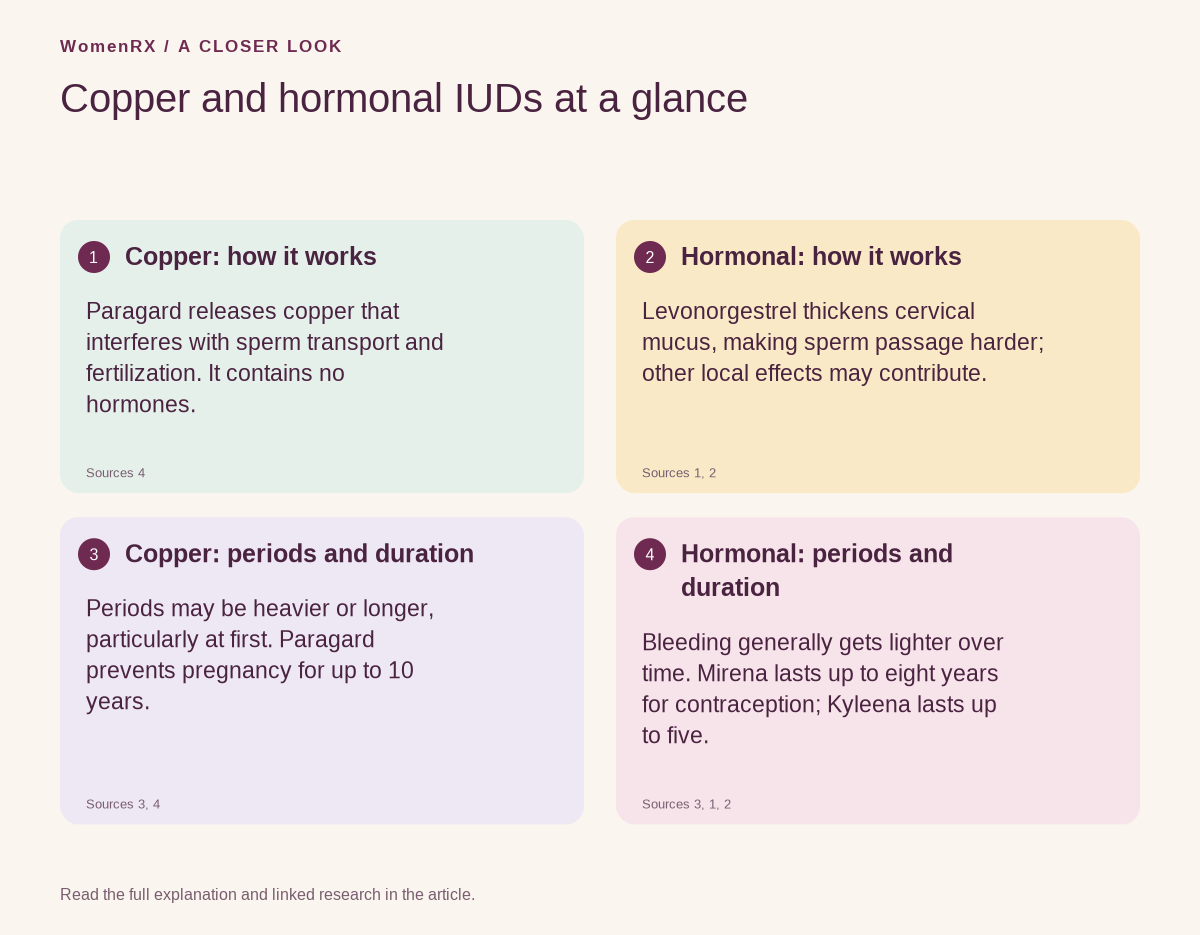
Copper and hormonal IUDs at a glance
Copper: how it works: Paragard releases copper that interferes with sperm transport and fertilization. It contains no hormones.4
Hormonal: how it works: Levonorgestrel thickens cervical mucus, making sperm passage harder; other local effects may contribute.12
Copper: periods and duration: Periods may be heavier or longer, particularly at first. Paragard prevents pregnancy for up to 10 years.34
Hormonal: periods and duration: Bleeding generally gets lighter over time. Mirena lasts up to eight years for contraception; Kyleena lasts up to five.312
Read the figure as text
Compare what each type releases, what tends to happen to bleeding, and how long specific US devices prevent pregnancy.- Copper: how it works: Paragard releases copper that interferes with sperm transport and fertilization. It contains no hormones.4
- Hormonal: how it works: Levonorgestrel thickens cervical mucus, making sperm passage harder; other local effects may contribute.12
- Copper: periods and duration: Periods may be heavier or longer, particularly at first. Paragard prevents pregnancy for up to 10 years.34
- Hormonal: periods and duration: Bleeding generally gets lighter over time. Mirena lasts up to eight years for contraception; Kyleena lasts up to five.312
More questions, answered
Will I need backup contraception right after placement?
That depends on the device and when it’s placed. No additional pregnancy protection is needed after copper IUD placement. With a levonorgestrel IUD, backup may be needed for seven days depending on menstrual-cycle timing or postpartum circumstances. Ask about the plan for your placement rather than assuming the two types start working on the same schedule.3
Sources you can check
- MIRENA (LEVONORGESTREL) INTRAUTERINE DEVICE [BAYER HEALTHCARE PHARMACEUTICALS INC.] | US prescribing information and patient instructionsAccessed 2026-09-25Return to first citation
- KYLEENA (LEVONORGESTREL) INTRAUTERINE DEVICE [BAYER HEALTHCARE PHARMACEUTICALS INC.] | US prescribing information and patient instructionsAccessed 2026-09-25Return to first citation
- CDC: Intrauterine contraception and copper IUD bleedingAccessed 2026-09-25Return to first citation
- Paragard: complete current US product informationAccessed 2026-09-26Return to first citation