How Condoms, Pills, and IUDs Prevent Pregnancy
These methods act at different points, from blocking sperm to suppressing ovulation, and they differ in upkeep, bleeding changes, and STI protection.
Condoms block sperm, while combined birth control pills primarily suppress ovulation. Progestin-only pills differ by formulation. Hormonal IUDs such as Mirena have mainly local effects that make it harder for sperm to reach an egg; copper IUDs interfere with sperm transport and fertilization. Most birth control methods don’t protect against sexually transmitted infections (STIs).13478
The most useful comparison isn’t simply hormonal versus nonhormonal. Ask where the method acts, what you have to do to keep it working, and whether you also want a change in bleeding or STI protection. A method can be convenient for pregnancy prevention and still leave another need unmet.13
Barriers work at the moment sperm could enter
An external condom collects sperm and helps keep it from entering a partner’s body. An internal condom also blocks sperm. A diaphragm or cervical cap covers the cervix and is used with spermicide; a sponge covers the cervix and contains spermicide. Unlike a pill or an IUD, these methods depend on use around sex.13
Condoms have a second job. Correct, consistent use of external latex condoms reduces the risk of HIV and other STIs. Internal condoms can also provide some STI protection, although the evidence is more limited. A lambskin condom may help prevent pregnancy but may not protect against STIs. Diaphragms, sponges, and spermicides aren’t substitutes for condoms when STI protection matters.36
Using a barrier without hormones doesn’t guarantee you’ll have no side effects. For example, condoms can irritate or slip, and spermicide can cause irritation. That may matter if you’re weighing a hormone-free option against how it feels and works in everyday use.2
Pills act on ovulation or cervical mucus
Combined pills contain estrogen and a progestin. Their primary contraceptive action is inhibiting ovulation, so there’s no egg for sperm to fertilize. Patches and vaginal rings also contain estrogen and a progestin. All three require ongoing use: pills are taken regularly, while patches and rings are changed on their respective schedules. Missed pills or other use errors are a major reason combined methods fail in everyday life.367
A progestin-only pill isn’t just a combined pill minus estrogen. For norethindrone and norgestrel pills, the effect on cervical mucus is central, and ovulation isn’t consistently stopped. Taking these pills at approximately the same time each day matters. Drospirenone progestin-only pills work primarily by suppressing ovulation. These distinctions are why it’s better to know which pill you mean than to assume every progestin-only pill works alike.7
IUDs work continuously, but not in the same way
Both hormonal and copper IUDs are placed in the uterus by a clinician and provide reversible pregnancy prevention without something to use before each act of sex. Fewer than one in 100 IUD users becomes pregnant during the first year of typical use. Neither type protects against STIs.35
A levonorgestrel-releasing IUD works mainly through local effects. For Mirena, proposed actions include thickening cervical mucus so sperm have difficulty passing through it, interfering with sperm survival or movement, and changing the uterine lining. Its precise combination of contraceptive actions hasn’t been conclusively established, and it doesn’t consistently stop ovulation.4
A copper IUD contains no hormones and doesn’t stop the ovaries from releasing eggs. Copper released in the uterus interferes with sperm transport and fertilization; its product information also lists possible prevention of implantation. That’s a different action from Mirena’s proposed progestin effects.8
Bleeding can make the choice feel less abstract. With Mirena, spotting and irregular bleeding may increase at first, then bleeding days usually decrease; some users stop having periods. Copper IUD users may have spotting or heavier or longer bleeding, particularly in the first several months, which often decreases with continued use. Neither pattern is a promise about what will happen to you.45
Match the method to the job it needs to do
For example, if remembering a daily pill would be difficult, an IUD removes that daily task; if STI protection matters, a condom can be used alongside another contraceptive method. Typical-use estimates illustrate why routine matters: in the first year, the CDC estimates pregnancy in about seven of 100 combined-pill, patch, or ring users, compared with fewer than one of 100 IUD users. Those are group estimates, not predictions for an individual.356
Life stage can change which questions feel most pressing. After childbirth, breastfeeding is contraception only under the specific conditions of the lactational amenorrhea method: no return of periods, full or nearly full breastfeeding, and less than six months since delivery. Once any condition no longer applies, another method is needed to prevent pregnancy. Fertility-awareness methods involve identifying fertile days and avoiding sex or using a barrier then; pregnancy rates vary across those methods.3
If a condom breaks or no method was used, emergency contraception is a separate, time-sensitive option rather than a routine method. The CDC describes emergency contraceptive pills and the copper IUD as options after sex.3
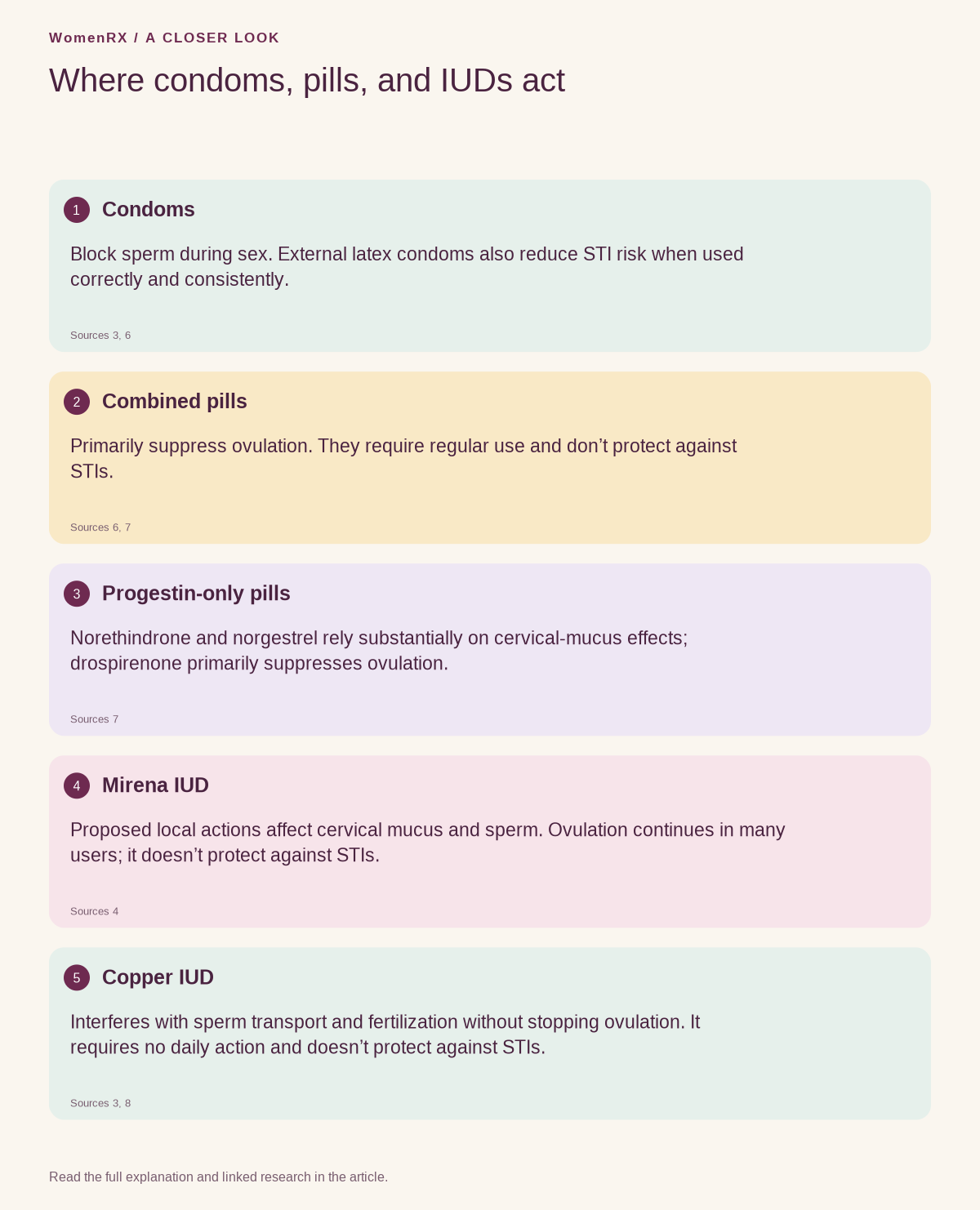
Where condoms, pills, and IUDs act
Condoms: Block sperm during sex. External latex condoms also reduce STI risk when used correctly and consistently.36
Combined pills: Primarily suppress ovulation. They require regular use and don’t protect against STIs.67
Progestin-only pills: Norethindrone and norgestrel rely substantially on cervical-mucus effects; drospirenone primarily suppresses ovulation.7
Mirena IUD: Proposed local actions affect cervical mucus and sperm. Ovulation continues in many users; it doesn’t protect against STIs.4
Copper IUD: Interferes with sperm transport and fertilization without stopping ovulation. It requires no daily action and doesn’t protect against STIs.38
Read the figure as text
Compare the point where each method acts, along with its routine and STI protection.- Condoms: Block sperm during sex. External latex condoms also reduce STI risk when used correctly and consistently.36
- Combined pills: Primarily suppress ovulation. They require regular use and don’t protect against STIs.67
- Progestin-only pills: Norethindrone and norgestrel rely substantially on cervical-mucus effects; drospirenone primarily suppresses ovulation.7
- Mirena IUD: Proposed local actions affect cervical mucus and sperm. Ovulation continues in many users; it doesn’t protect against STIs.4
- Copper IUD: Interferes with sperm transport and fertilization without stopping ovulation. It requires no daily action and doesn’t protect against STIs.38
More questions, answered
Does a hormonal IUD have to stop ovulation to work?
No. Mirena acts mainly in the uterus, and ovulation continues in many users. Its proposed contraceptive actions include making cervical mucus harder for sperm to pass through and interfering with sperm movement or survival.4
Can I use condoms with another birth control method?
Yes. Condoms can add STI protection when used with a method chosen for pregnancy prevention, such as a pill or IUD. External latex condoms reduce STI risk when used correctly and consistently; most contraceptive methods don’t provide STI protection on their own.36
Sources you can check
- Birth Control | Contraception | Contraceptives | MedlinePlusAccessed 2026-09-25Return to first citation
- Office on Women's Health: Barrier contraception side effectsAccessed 2026-09-25Return to first citation
- CDC: Birth control methods, barrier methods, fertility awareness and breastfeedingAccessed 2026-09-25Return to first citation
- MIRENA (LEVONORGESTREL) INTRAUTERINE DEVICE [BAYER HEALTHCARE PHARMACEUTICALS INC.] | US prescribing information and patient instructionsAccessed 2026-09-25Return to first citation
- CDC: Intrauterine contraception and copper IUD bleedingAccessed 2026-09-25Return to first citation
- Combined Hormonal Contraceptives | Contraception | CDCAccessed 2026-09-25Return to first citation
- Progestin-Only Pills | Contraception | CDCAccessed 2026-09-25Return to first citation
- Paragard: complete current US product informationAccessed 2026-09-26Return to first citation