Migraine With Aura and Contraception: What to Clarify
Whether you’ve had aura can change the contraception discussion, so describe the symptoms as well as the headache.
If you have migraine with aura, the key distinction is whether a contraceptive method contains estrogen. A European consensus summarized in a 2023 clinical paper recommends progestin-only or nonhormonal contraception rather than combined contraception for people with aura. Describe any visual, sensory, or speech symptoms, and discuss the specific method and your other health risks with your clinician. 123
Start with what happens around the headache
“Migraine” alone doesn’t tell a clinician whether you experience aura. Aura can include flashing lights, zigzag lines, unusual sensations, or difficulty speaking. It may happen just before or during a migraine. These symptoms are different from the head pain, nausea, or sensitivity to light that can accompany an attack. 12
For a contraception discussion, describe what you see or feel, whether speech is affected, when it happens in relation to the headache, and how long it lasts. If you’re unsure whether an episode counts as aura, say so. You don’t need to settle the diagnosis yourself to give a useful account of what happened.
A new or unfamiliar symptom deserves attention beyond the contraception decision. If you suddenly have trouble speaking, don’t assume it’s migraine aura; seek emergency help. Aura symptoms lasting longer than an hour also warrant prompt medical assessment. 2
Why the method’s ingredients matter
The choice isn’t simply between “hormonal” and “nonhormonal.” Combined contraception contains estrogen and a progestin; progestin-only methods do not contain estrogen. A nonhormonal method is a third category. Identifying which category a specific option belongs to makes the safety discussion more precise. 3
A 2023 study of gynecologists in Germany summarizes a 2017 European consensus recommending progestin-only or nonhormonal contraception for people with migraine with aura. In that survey, respondents were also much more likely to avoid combined oral contraception when aura was present. The survey describes prescribing practice, not what happened to patients who used each method. 3
The concern behind this distinction is vascular risk, including ischemic stroke. The same paper distinguishes estrogen-containing contraception from estrogen-free options when discussing that risk. It doesn’t provide a personal risk calculation, and it shouldn’t be used to give any one person a safety clearance. 3
Questions worth bringing to the conversation
- Could my symptoms be aura? Give examples of what happens rather than relying only on an old headache label. Visual, sensory, and speech symptoms can all be relevant. 12
- Does the method I use or want contain estrogen? Ask about the specific option, not just whether it is called hormonal contraception. 3
- What other vascular risks or health conditions affect this choice? The German survey reports that gynecologists consider such factors when deciding whether to prescribe combined contraception. 3
- Which estrogen-free options meet my needs? Discuss progestin-only and nonhormonal methods alongside your priorities for pregnancy prevention and day-to-day use. The broad category alone doesn’t choose a method for you. 3
If you’re already using contraception, bring the name of your method to the discussion. A past prescription doesn’t answer a new question about symptoms that may be aura. Clarifying both the headache history and the method’s ingredients gives you and your clinician a better starting point.
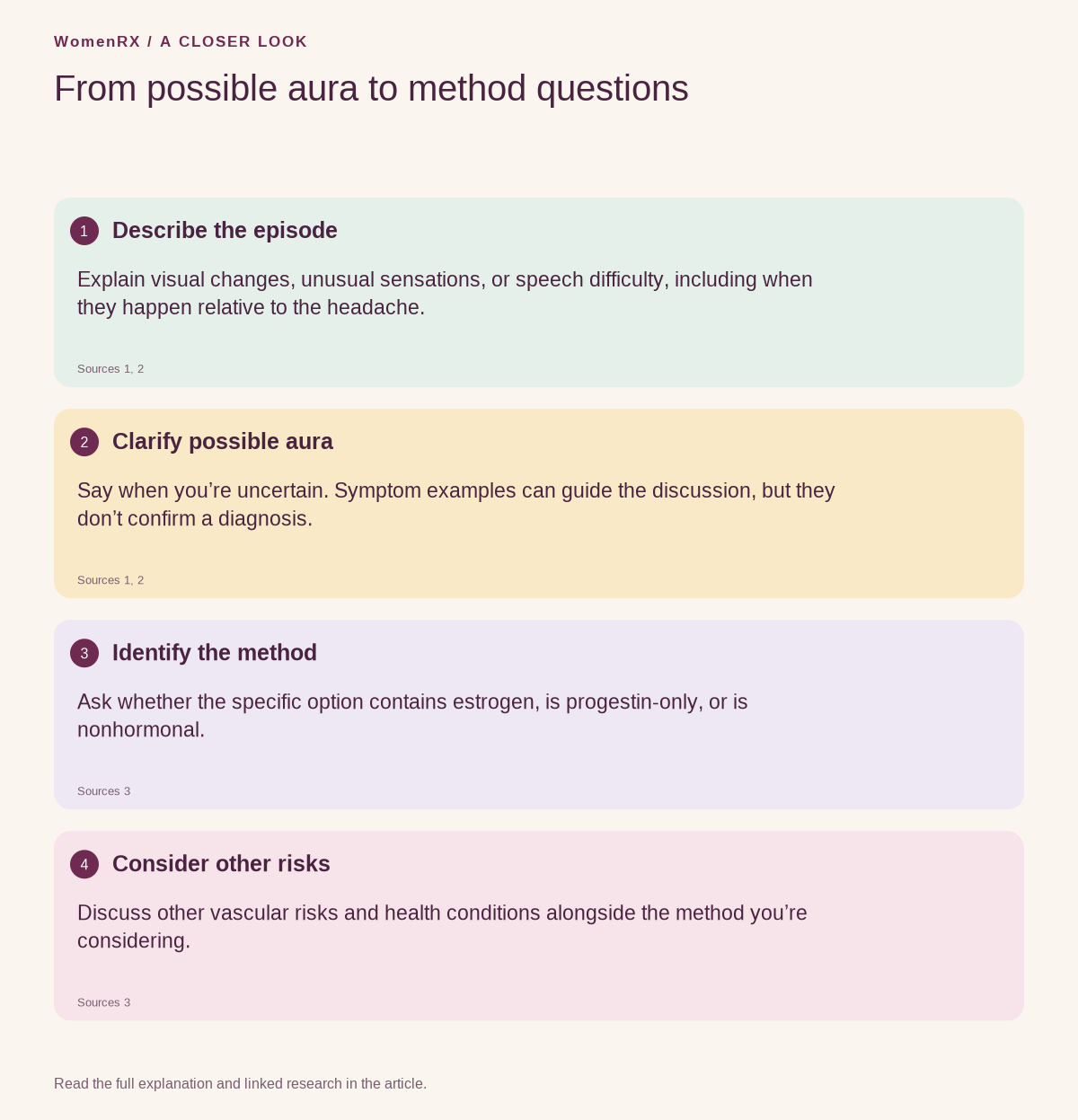
From possible aura to method questions
Describe the episode: Explain visual changes, unusual sensations, or speech difficulty, including when they happen relative to the headache.12
Clarify possible aura: Say when you’re uncertain. Symptom examples can guide the discussion, but they don’t confirm a diagnosis.12
Identify the method: Ask whether the specific option contains estrogen, is progestin-only, or is nonhormonal.3
Consider other risks: Discuss other vascular risks and health conditions alongside the method you’re considering.3
Read the figure as text
Use these steps to make a contraception discussion more specific, not to diagnose aura or clear a method as safe.- Describe the episode: Explain visual changes, unusual sensations, or speech difficulty, including when they happen relative to the headache.12
- Clarify possible aura: Say when you’re uncertain. Symptom examples can guide the discussion, but they don’t confirm a diagnosis.12
- Identify the method: Ask whether the specific option contains estrogen, is progestin-only, or is nonhormonal.3
- Consider other risks: Discuss other vascular risks and health conditions alongside the method you’re considering.3
More questions, answered
Is every visual symptom an aura?
No. Flashing lights and zigzag lines are examples of aura symptoms, but an example isn’t a diagnosis. Describe exactly what happens, particularly if it’s new or different from your usual pattern. 12
Are all hormonal contraceptives treated the same way?
No. The relevant distinction here is between estrogen-containing combined contraception and estrogen-free progestin-only methods. Nonhormonal methods are another option. Ask which category the specific method you’re considering falls into. 3
Sources you can check
- Migraine | MedlinePlusAccessed 2026-09-25Return to first citation
- Migraine - NHSAccessed 2026-09-25Return to first citation
- Migraine and Hormonal Contraception in Gynecological Outpatient Care-Cross-Sectional Study among Practicing Gynecologists in Germany.Fitzek MP, Storch E, Overeem LH, Kull P, Terhart M, Lange KS, Reuter U, Raffaelli B. · Journal of clinical medicine · 2023Return to first citation