How Birth Control Pills Prevent Pregnancy, and Why Timing Differs
Combination pills mainly prevent ovulation; for the progestin-only pill norgestrel, thickened cervical mucus is a key effect.
Combination pills use estrogen and progestin to suppress the hormonal signals that lead to ovulation. The progestin-only pill norgestrel thickens cervical mucus. A review focused on norgestrel describes contraceptive effectiveness within 48 hours of starting use, while ovulation suppression may take up to 28 days and occurs in about half of users. For combination-pill schedules with a hormone-free break, extending that break can matter. These findings explain different timing considerations, not what to do after a missed dose; those steps depend on the specific product. 4 6 2 3
Two pill types, overlapping effects
Both types of birth control pills use hormones to make pregnancy less likely, but they don’t all act in precisely the same way. Combination pills contain estrogen and a progestin. Progestin-only pills contain a progestin without estrogen. 1
With combination pills, the main effect is suppressing the hormonal signals that prompt the ovaries to release an egg. Progestin also thickens cervical mucus, making it harder for sperm to pass through. Estrogen helps limit unscheduled bleeding and contributes to suppression of follicle development. 4
Bleeding patterns and clot risk can also affect pill choice. A review reports that adding estrogen can improve the bleeding profile but increases the risk of blood clots in people at specific risk. That general finding does not determine which pill is appropriate for any one person. 5
For the progestin-only pill norgestrel, thickened cervical mucus is a key effect. A review focused on norgestrel describes contraceptive effectiveness within 48 hours of starting use through this effect, while ovulation suppression may take up to 28 days and occurs in about half of users. Those are findings about starting use, not a rule for a late or missed pill, and they should not be applied to every progestin-only formulation. 6
Why a missed pill can matter differently
For a combination pill, the length of time without hormones can matter. In schedules that include a hormone-free interval, missing pills near that interval can extend it and give ovarian activity more opportunity to resume. In a small randomized study comparing combination-pill schedules with four- and seven-day hormone-free intervals, the shorter interval was associated with greater suppression of ovarian hormone production. 2
A systematic review of missed combined hormonal contraceptives found that risk varied across studies. Extending the hormone-free interval was associated with variable follicular development and a low risk of ovulation in the studies reviewed; studies of missed pills at other points in the cycle generally found little follicular activity and a low risk of ovulation. Much of the evidence used ovarian activity and other surrogate measures rather than pregnancy outcomes, so it does not translate into a single rule for every missed dose. 3
Progestin-only pills need their own instructions rather than a rule borrowed from combination pills. Norgestrel’s cervical-mucus effect and its less consistent suppression of ovulation explain why its timing cannot be understood solely by looking at a combination pill’s hormone-free interval. The findings about how soon norgestrel works after starting it do not establish what happens after a missed dose or supply a rule for another progestin-only pill. 6
If you’re late or missed a pill, check the instructions for the exact product you take. If you don’t have them, a pharmacist can help identify the right instructions. Don’t assume that taking an extra pill or using backup contraception follows the same rule for every formulation.
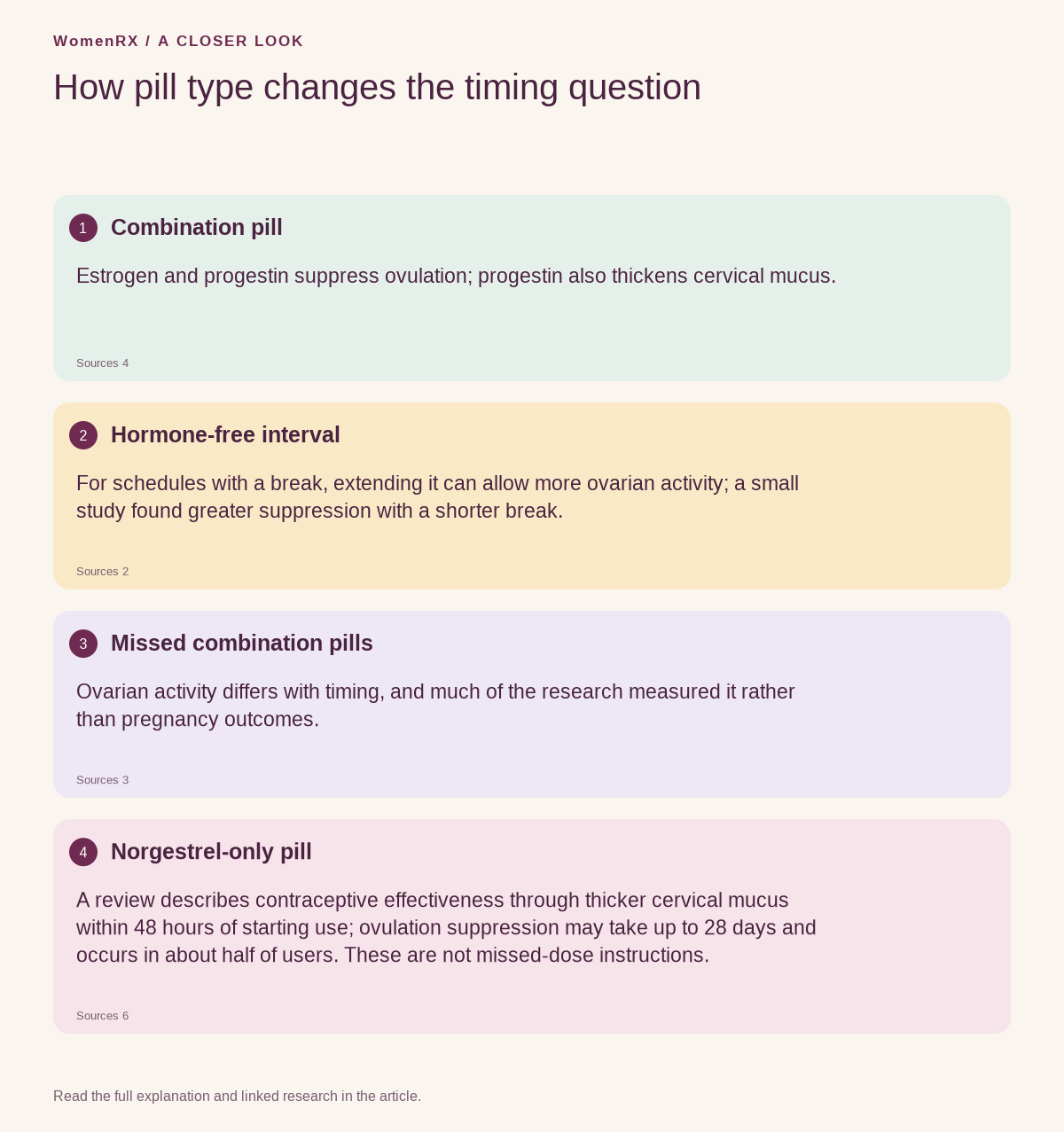
How pill type changes the timing question
Combination pill: Estrogen and progestin suppress ovulation; progestin also thickens cervical mucus.4
Hormone-free interval: For schedules with a break, extending it can allow more ovarian activity; a small study found greater suppression with a shorter break.2
Missed combination pills: Ovarian activity differs with timing, and much of the research measured it rather than pregnancy outcomes.3
Norgestrel-only pill: A review describes contraceptive effectiveness through thicker cervical mucus within 48 hours of starting use; ovulation suppression may take up to 28 days and occurs in about half of users. These are not missed-dose instructions.6
Read the figure as text
The effects overlap, but the formulation and, for some combination pills, a hormone-free interval shape the missed-pill question.- Combination pill: Estrogen and progestin suppress ovulation; progestin also thickens cervical mucus.4
- Hormone-free interval: For schedules with a break, extending it can allow more ovarian activity; a small study found greater suppression with a shorter break.2
- Missed combination pills: Ovarian activity differs with timing, and much of the research measured it rather than pregnancy outcomes.3
- Norgestrel-only pill: A review describes contraceptive effectiveness through thicker cervical mucus within 48 hours of starting use; ovulation suppression may take up to 28 days and occurs in about half of users. These are not missed-dose instructions.6
More questions, answered
Can I use the same missed-pill instructions for every birth control pill?
No. Missed-combination-pill research concerns schedules that may have a hormone-free interval. A review focused on norgestrel describes contraceptive effectiveness within 48 hours of starting use through thicker cervical mucus, while ovulation suppression may take up to 28 days and occurs in about half of users. Those starting-use findings are not missed-dose instructions. Check the directions for your exact pill rather than applying a rule from another formulation. 3 6
Sources you can check
- Birth Control | Contraception | Contraceptives | MedlinePlusAccessed 2026-09-25Return to first citation
- Comparison of serum and cervical mucus hormone levels during hormone-free interval of 24/4 vs. 21/7 combined oral contraceptives.Fels H, Steward R, Melamed A, Granat A, Stanczyk FZ, Mishell DR. · Contraception · 2013Return to first citation
- Effect of missed combined hormonal contraceptives on contraceptive effectiveness: a systematic review.Zapata LB, Steenland MW, Brahmi D, Marchbanks PA, Curtis KM. · Contraception · 2013Return to first citation
- Delayed start of estetrol drospirenone versus ethinyl estradiol gestodene for ovulation inhibition in a noninferiority randomized controlled trial.Ittipuripat S, Phutrakool P, Uaamnuichai S, Porntawansak G, Wongwathanavikrom R, Utaipatanacheep P, Santibenchakul S. · Scientific reports · 2025Return to first citation
- New estrogen-free oral hormonal contraceptive (Estrogene free ill-EFP).Křepelka P. · Ceska gynekologie · 2020Return to first citation
- A review of recommendations, efficacy, and patient safety for over-the-counter norgestrel for daily contraception.Tran G, Wollen J, Davis S, Wang EM, Arriazola J, Rosario N. · Exploratory research in clinical and social pharmacy · 2025Return to first citation