What Side Effects Can Copper and Hormonal IUDs Cause?
Copper IUDs are more likely to bring heavier bleeding and cramps, while hormonal IUDs often bring early spotting followed by lighter periods.
Copper IUDs are more likely than hormonal IUDs to cause heavier bleeding and menstrual cramps. Hormonal IUDs often cause spotting at first, then lighter bleeding or no periods. 4 5 Get prompt care for severe pain or fever after insertion, or a possible pregnancy with abdominal pain or unusual bleeding. New heavy bleeding after months of use also deserves assessment. 1 2 5
The main tradeoff is your period
Both types of IUD can change bleeding, but the pattern differs. In a meta-analysis of randomized trials, levonorgestrel IUD users were less likely than copper IUD users to report increased or heavy bleeding and menstrual cramps. A copper IUD is a hormone-free option, but that bleeding difference may matter if your periods are already heavy or painful. 4
With a copper IUD, spotting and heavier or longer bleeding are common during the first three to six months and generally decrease with continued use. With a levonorgestrel IUD, spotting or light bleeding is expected during those first months; bleeding generally lessens over time, and some users stop having periods. These are patterns, not promises about what your period will do. 5
Mirena and Kyleena both describe irregular bleeding early in use, but their bleeding outcomes aren’t identical. In their respective clinical studies, about 20% of Mirena users had no period by one year, compared with about 12% of Kyleena users. Those are product-specific findings, not a head-to-head comparison. 1 2
What else can happen after insertion?
Pain, bleeding, or dizziness can occur during or just after Mirena or Kyleena placement, and cramping may continue during the first few weeks. If pain, bleeding, or dizziness hasn’t settled while you’re still at the insertion visit, tell the person who placed the IUD. The products’ patient instructions call for an examination if those immediate symptoms don’t pass within 30 minutes. 1 2
Bleeding isn’t the only possible side effect of a hormonal IUD. Kyleena clinical trials also recorded ovarian cysts, acne, headache or migraine, breast discomfort, and pelvic or abdominal pain. A reported effect doesn’t tell you that the IUD caused a particular symptom, but a new or troublesome symptom is worth discussing rather than simply putting up with it. 2 5
Less common problems need a different response. An IUD can partly or completely come out, sometimes without obvious symptoms, and may no longer prevent pregnancy. It can also become embedded in or pass through the uterine wall. Pelvic infection is another possible complication. Pain or bleeding that gets worse after placement should not be dismissed as an ordinary adjustment to the IUD. 1 2
When should you get it checked?
Seek prompt medical assessment if you develop severe pain or fever shortly after insertion. Lower abdominal or pelvic pain with fever, chills, or unusual or foul-smelling discharge also needs prompt attention because infection is possible. Severe or worsening pain or bleeding after placement can be a sign that the IUD needs checking. 1 2
Treat a possible pregnancy as time-sensitive. If you think you’re pregnant with an IUD in place, contact a clinician right away. Abdominal pain or unusual bleeding with a missed period can signal an ectopic pregnancy, which is a medical emergency. A pregnancy in the uterus also needs assessment because leaving an IUD in place raises the risk of serious complications. 1 2 5
Arrange an IUD check if you think it has come out, can feel part of the device rather than just its threads, or can no longer feel threads you previously felt. Missing threads don’t prove expulsion, but the position and pregnancy protection need checking. Until then, avoid intercourse or use non-hormonal backup contraception, as the Mirena and Kyleena patient instructions advise. 1 2
Bring up a new bleeding pattern, especially heavy or prolonged bleeding that begins after you’ve used the IUD for months. With a copper IUD, possibilities include a change in position, pregnancy, an STI, or another condition such as fibroids. Significant new bleeding after prolonged hormonal IUD use also calls for evaluation rather than an assumption that it’s just the device. Bleeding that remains bothersome is itself a reason to discuss whether you want treatment, continued use, or removal. 1 2 5
If you’re getting an IUD after birth
Postpartum timing changes two device-related risks. Expulsion is more likely with placement immediately after delivery than with later placement. Perforation remains uncommon, but its risk is higher with insertion soon after birth or while breastfeeding. A systematic review found a higher relative perforation risk during breastfeeding while describing the absolute risk as low; it rated the certainty of the evidence very low. 1 2 3 5
That doesn’t mean you must avoid an IUD while breastfeeding. The practical choice is between the convenience of placement soon after birth and the greater chance that an immediately placed IUD will come out. If yours was placed postpartum, a change in bleeding, pain, or concern that the device has moved deserves the same attention as it would at any other time. 1 2 5
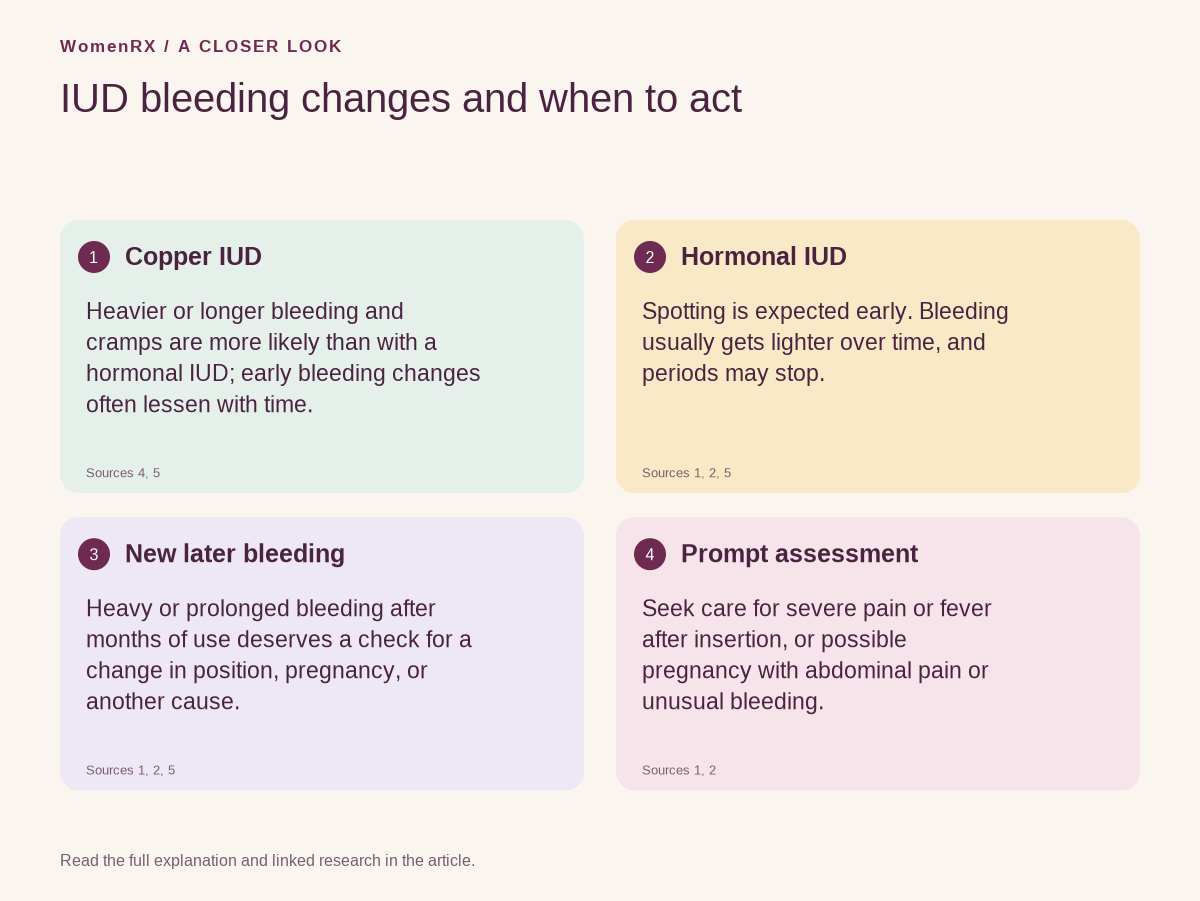
IUD bleeding changes and when to act
Copper IUD: Heavier or longer bleeding and cramps are more likely than with a hormonal IUD; early bleeding changes often lessen with time.45
Hormonal IUD: Spotting is expected early. Bleeding usually gets lighter over time, and periods may stop.125
New later bleeding: Heavy or prolonged bleeding after months of use deserves a check for a change in position, pregnancy, or another cause.125
Prompt assessment: Seek care for severe pain or fever after insertion, or possible pregnancy with abdominal pain or unusual bleeding.12
Read the figure as text
Compare the usual bleeding direction for each IUD type, then distinguish a later change from symptoms that need prompt assessment.- Copper IUD: Heavier or longer bleeding and cramps are more likely than with a hormonal IUD; early bleeding changes often lessen with time.45
- Hormonal IUD: Spotting is expected early. Bleeding usually gets lighter over time, and periods may stop.125
- New later bleeding: Heavy or prolonged bleeding after months of use deserves a check for a change in position, pregnancy, or another cause.125
- Prompt assessment: Seek care for severe pain or fever after insertion, or possible pregnancy with abdominal pain or unusual bleeding.12
More questions, answered
Is no period with a hormonal IUD a side effect or a pregnancy sign?
Periods can stop with a levonorgestrel IUD, and that alone does not mean you’re pregnant. If the missed period is a significant change for you, or you have pregnancy symptoms or pelvic pain, check for pregnancy and contact your clinician. Mirena and Kyleena patient instructions also advise calling if you haven’t had a period for six weeks. 1 2 5
Sources you can check
- MIRENA (LEVONORGESTREL) INTRAUTERINE DEVICE [BAYER HEALTHCARE PHARMACEUTICALS INC.] | US prescribing information and patient instructionsAccessed 2026-09-25Return to first citation
- KYLEENA (LEVONORGESTREL) INTRAUTERINE DEVICE [BAYER HEALTHCARE PHARMACEUTICALS INC.] | US prescribing information and patient instructionsAccessed 2026-09-25Return to first citation
- The safety of intrauterine devices during breastfeeding: an updated systematic review.Ti A, Ayieko S, Gaffield ME, Ali M. · BMJ sexual & reproductive health · 2025Return to first citation
- Contraception with levonorgestrel-releasing intrauterine system versus copper intrauterine device: a meta-analysis of randomized controlled trials.Liu P, Meng J, Xiong Y, Wu Y, Xiao Y, Gao S. · EClinicalMedicine · 2024Return to first citation
- CDC: Intrauterine contraception and copper IUD bleedingAccessed 2026-09-25Return to first citation