Getting an IUD: What to Expect at Placement
You can plan for discomfort before placement and know how recovery and bleeding may differ with a copper or hormonal IUD.
Before placement, you’ll choose an IUD, discuss comfort options, and have a pelvic exam and cervical inspection. Pain may occur when a cervical instrument called a tenaculum is placed or during IUD placement; pain varies, so agree on how you’ll ask for a pause.7 Afterward, bleeding expectations differ: a copper IUD can make bleeding heavier at first, while bleeding with a hormonal IUD generally becomes lighter over time.7

Before the visit: choose the device and make a comfort plan
Start with two separate questions: Which IUD fits what you want from contraception, and how would you like the placement handled? Bleeding expectations are one practical difference. A copper IUD can cause spotting or light bleeding, as well as heavier or longer bleeding, especially during the first three to six months. Those changes generally decrease with continued use. A levonorgestrel-releasing, or hormonal, IUD commonly causes spotting or light bleeding at first; over time, bleeding generally decreases, and some people have little or no period.7
If heavy periods are part of your decision, bring that up before choosing a device. Guidance favors considering a 52 mg levonorgestrel-releasing IUD when someone seeking an IUD also has heavy menstrual bleeding or painful periods. That is a reason to discuss your priorities, not a reason to assume every hormonal IUD has the same effects.3
Pain is worth discussing before you’re on the exam table. You could ask: “What parts of placement might hurt? What comfort options do you offer? What can we do if I need a pause?” CDC guidance recommends a pain-management plan based on your preferences and says a local anesthetic called lidocaine, applied to the cervix or given as an injection near it, might help. The study results for these options are mixed, so neither promises a pain-free placement.7
Research on anti-inflammatory medicines is mixed, too. A review pooling 14 placebo-controlled studies found a modest average reduction in insertion-pain scores, but rated the evidence low certainty because the studies differed substantially. A smaller randomized trial found less insertion pain with a preemptive, multidose ibuprofen regimen; another trial found that naproxen, with or without lidocaine placed inside the uterus, did not significantly reduce average insertion pain. These findings are a reason to discuss the options offered at your visit, not to assume one medicine will work for everyone.456
During placement: know where pain may occur
Before placement, the clinician performs a pelvic exam and inspects the cervix. CDC guidance discusses pain at tenaculum placement, when an instrument is used at the cervix, and pain during IUD placement. It does not establish a sequence for those steps. Ask to be told what’s happening before each step if that would help you. Your comfort plan can include a simple signal to pause, rather than relying on you to explain yourself while you’re in pain.7
Pain can be more than a brief pinch. In one small randomized trial, 26 of the 66 participants who underwent insertion reported severe insertion-related pain, while 28 reported moderate pain. Those figures describe that trial, not what any one person will feel.6
Once the IUD is placed, take a moment to say how you feel before leaving. Pain, bleeding, or dizziness can happen during and after placement. Kyleena’s patient instructions say that if those symptoms do not pass within 30 minutes, the clinician should examine you to check placement.2
Having never given birth does not, by itself, rule out an IUD. Contraception guidance recommends offering intrauterine contraception to people who have and have not given birth, and reports that not having given birth is not associated with higher IUD expulsion risk. Your comfort needs still deserve their own discussion.3
Afterward: compare the bleeding patterns
With a copper IUD, spotting and heavier or longer bleeding are common during the first three to six months and generally ease with continued use. That can matter if your periods are already hard to manage. If heavy or prolonged bleeding starts anew after you’ve used the device for several months, get it checked rather than assuming it’s the usual adjustment: pregnancy, an STI, a displaced IUD, or another condition may need consideration.7
With a hormonal IUD, early spotting or light bleeding is expected, and bleeding generally becomes lighter over time. Mirena and Kyleena information also describes cramping during the first few weeks and irregular bleeding or spotting during the first three to six months. Some people eventually stop having periods.127
For Mirena and Kyleena, product instructions call for immediate assessment of exceptional pain or bleeding during or after placement so the clinician can check for a placement problem. They also say to contact the clinician if bleeding stays heavier than usual or becomes heavier again after it has lightened.12 That’s different from the heavier bleeding that can be an expected early change with a copper IUD. Whatever your device, you can raise bleeding or other side effects that concern you rather than waiting for a scheduled check.7
A scheduled check soon after placement isn’t routinely required just to improve IUD continuation, according to CDC guidance. You can still raise concerns at any time; at a routine visit, a clinician can discuss how the method is working for you and consider checking the strings.7
If you’re planning placement after a birth
Postpartum placement is a choice about timing, not a simple yes-or-no question. Contraception guidance reports that placement immediately after delivery has a higher risk of the IUD coming out than placement at six weeks. It also reports higher perforation risk with postpartum placement and with placement while breastfeeding. Ask how timing, breastfeeding, and the possibility of needing a replacement would affect the plan that works for you.3
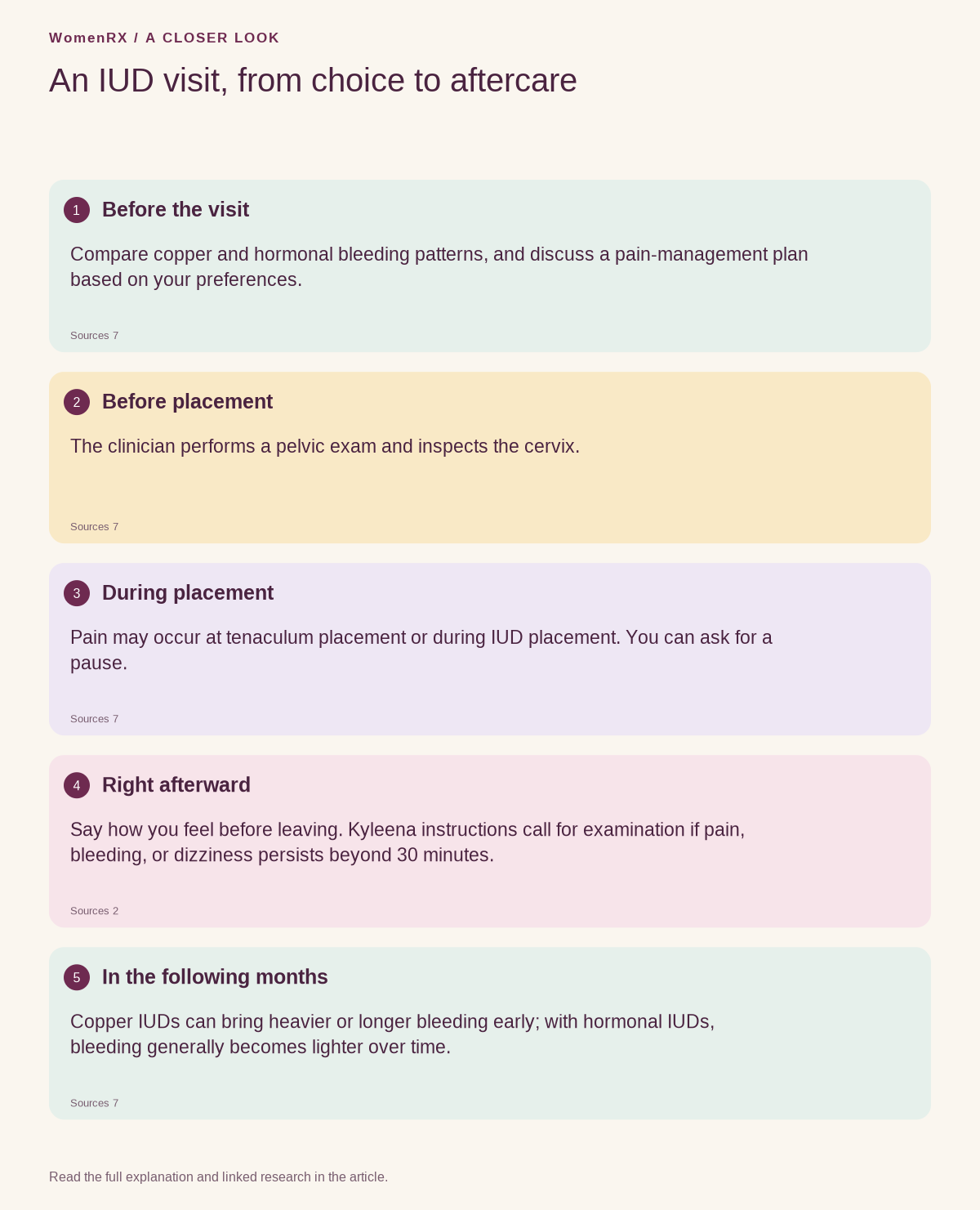
An IUD visit, from choice to aftercare
Before the visit: Compare copper and hormonal bleeding patterns, and discuss a pain-management plan based on your preferences.7
Before placement: The clinician performs a pelvic exam and inspects the cervix.7
During placement: Pain may occur at tenaculum placement or during IUD placement. You can ask for a pause.7
Right afterward: Say how you feel before leaving. Kyleena instructions call for examination if pain, bleeding, or dizziness persists beyond 30 minutes.2
In the following months: Copper IUDs can bring heavier or longer bleeding early; with hormonal IUDs, bleeding generally becomes lighter over time.7
Read the figure as text
The sequence shows when to discuss comfort, what happens at placement, and how bleeding expectations differ afterward.- Before the visit: Compare copper and hormonal bleeding patterns, and discuss a pain-management plan based on your preferences.7
- Before placement: The clinician performs a pelvic exam and inspects the cervix.7
- During placement: Pain may occur at tenaculum placement or during IUD placement. You can ask for a pause.7
- Right afterward: Say how you feel before leaving. Kyleena instructions call for examination if pain, bleeding, or dizziness persists beyond 30 minutes.2
- In the following months: Copper IUDs can bring heavier or longer bleeding early; with hormonal IUDs, bleeding generally becomes lighter over time.7
Sources you can check
- MIRENA (LEVONORGESTREL) INTRAUTERINE DEVICE [BAYER HEALTHCARE PHARMACEUTICALS INC.] | US prescribing information and patient instructionsAccessed 2026-09-25Return to first citation
- KYLEENA (LEVONORGESTREL) INTRAUTERINE DEVICE [BAYER HEALTHCARE PHARMACEUTICALS INC.] | US prescribing information and patient instructionsAccessed 2026-09-25Return to first citation
- Canadian Contraception Consensus (Part 3 of 4): Chapter 7--Intrauterine Contraception.Black A, Guilbert E, Costescu D, Dunn S, Fisher W, Kives S, Mirosh M, Norman W, Pymar H, Reid R, Roy G, Varto H, Waddington A, Wagner MS, Whelan AM, Mansouri S. · Journal of obstetrics and gynaecology Canada : JOGC = Journal d'obstetrique et gynecologie du Canada : JOGC · 2016Return to first citation
- Intrauterine lidocaine and naproxen for analgesia during intrauterine device insertion: randomized controlled trial.Miles SM, Shvartsman K, Dunlow S. · Contraception and reproductive medicine · 2019Return to first citation
- The Effectiveness of Non-Steroidal Anti-Inflammatory Drugs for Pain Relief During Outpatient Intrauterine Device Insertion: A Systematic Review and Meta-Analysis.Bolic MS, Ainsworth J, Heal C, Drever N. · The Australian & New Zealand journal of obstetrics & gynaecology · 2026Return to first citation
- Multidose Ibuprofen Prior to Intrauterine device insertion (MIPI): a triple blinded randomized controlled trial.Ouyang C, Lamvu G, Quach H, Carrillo J, Castellanos M, Wang A, Lewis H, Barish S, Feranec J. · American journal of obstetrics and gynecology · 2026Return to first citation
- CDC: Intrauterine contraception and copper IUD bleedingAccessed 2026-09-25Return to first citation