Hormonal IUD Side Effects: What Needs Attention
Spotting can happen after placement, but worsening pain, heavy bleeding, fever, unusual discharge, or possible pregnancy calls for prompt attention.
Irregular bleeding or spotting is common during the first month after placement of a 52-mg levonorgestrel IUD, and it may settle with time. Contact a clinician promptly about heavy or worsening bleeding, new or increasing pelvic pain, fever, unusual discharge, or possible pregnancy. Severe or sudden pelvic pain, or pelvic pain with heavy bleeding, needs urgent evaluation. 1247
What may happen after placement
With a 52-mg levonorgestrel IUD, irregular bleeding often occurs in the first month; for some users, it continues or returns beyond six months. That doesn’t mean persistent bleeding is automatically a complication, but it’s reasonable to ask about it if it’s bothering you or not improving. 7
Bleeding patterns also differ by product and person. For example, a 52-mg levonorgestrel system can reduce menstrual blood loss, but a change in bleeding during longer-term use still deserves attention if it’s significant or unusual for you. 16
Pelvic or abdominal pain, cramping, headache, acne, and breast discomfort are among the effects reported in Kyleena clinical trials. Those trial results describe that specific product, not every hormonal IUD or what any one person will experience. Pain that is severe, getting worse, or newly appearing after placement shouldn’t be written off as routine cramping. 2
Sort symptoms by what to do
Contact a clinician promptly if you have pelvic or lower abdominal pain, fever or chills, unusual or foul-smelling discharge, pain during sex, or unexplained bleeding. These can be symptoms of pelvic infection, which can sometimes be mild or subtle. The risk of pelvic inflammatory disease related to IUD placement is concentrated in the first few weeks, but symptoms still warrant attention later; sexually transmitted infections can also cause pelvic infection. 13
Call about possible movement or expulsion if pain or bleeding worsens after placement, or you can’t feel your IUD strings when you previously could. Don’t tug on strings. If you can’t feel them, contact your clinician to confirm the IUD’s location; the Mirena instructions advise avoiding sex or using non-hormonal backup birth control until its location is confirmed. Follow the instructions for your own IUD, since that advice is product-specific. 1
Get urgent evaluation for severe or rapidly worsening pelvic pain, sudden intense lower-abdominal pain, or pelvic pain with heavy vaginal bleeding. These symptoms need assessment rather than home monitoring. 4
Contact a clinician promptly if pregnancy is possible or a test is positive. Pregnancy with an IUD in place needs medical assessment, including to determine where the pregnancy is located. Don’t assume the IUD is the cause of pain or bleeding, and don’t wait for symptoms to become severe before asking for advice. 16
Bleeding after birth needs its own context
If your IUD was placed around the time of delivery, tell the clinician how many weeks postpartum you are and whether you delivered vaginally or by cesarean. A systematic review found that expulsion rates varied with insertion timing and delivery method; immediate and early postpartum placements had higher pooled expulsion rates than placements four or more weeks after delivery. The review included both copper and levonorgestrel IUDs, so its overall rates shouldn’t be treated as a prediction for one person or one device. 5
After pregnancy, don’t automatically attribute new, heavier, or persistent bleeding to the IUD. The timing of postpartum bleeding and your delivery are useful context for an individualized assessment. If bleeding is heavy, pain is worsening, or you have fever or unusual discharge, contact a clinician promptly; severe pain with heavy bleeding needs urgent evaluation. 145
Make the conversation more useful
When you call, note when the IUD was placed, when the symptom began, whether it’s improving or worsening, and how the bleeding compares with your usual pattern. Mention fever or chills, discharge, pain with sex, a change in strings, possible pregnancy, and recent delivery. These details help the clinician decide how quickly you need to be seen and what needs checking. They don’t diagnose a problem on their own.
If bleeding becomes significantly different after a period of stable use, it may need evaluation for causes other than the IUD. For a 52-mg Mirena, product instructions specifically advise appropriate diagnostic assessment when a significant bleeding change develops during prolonged use. 1
What to do about IUD symptoms
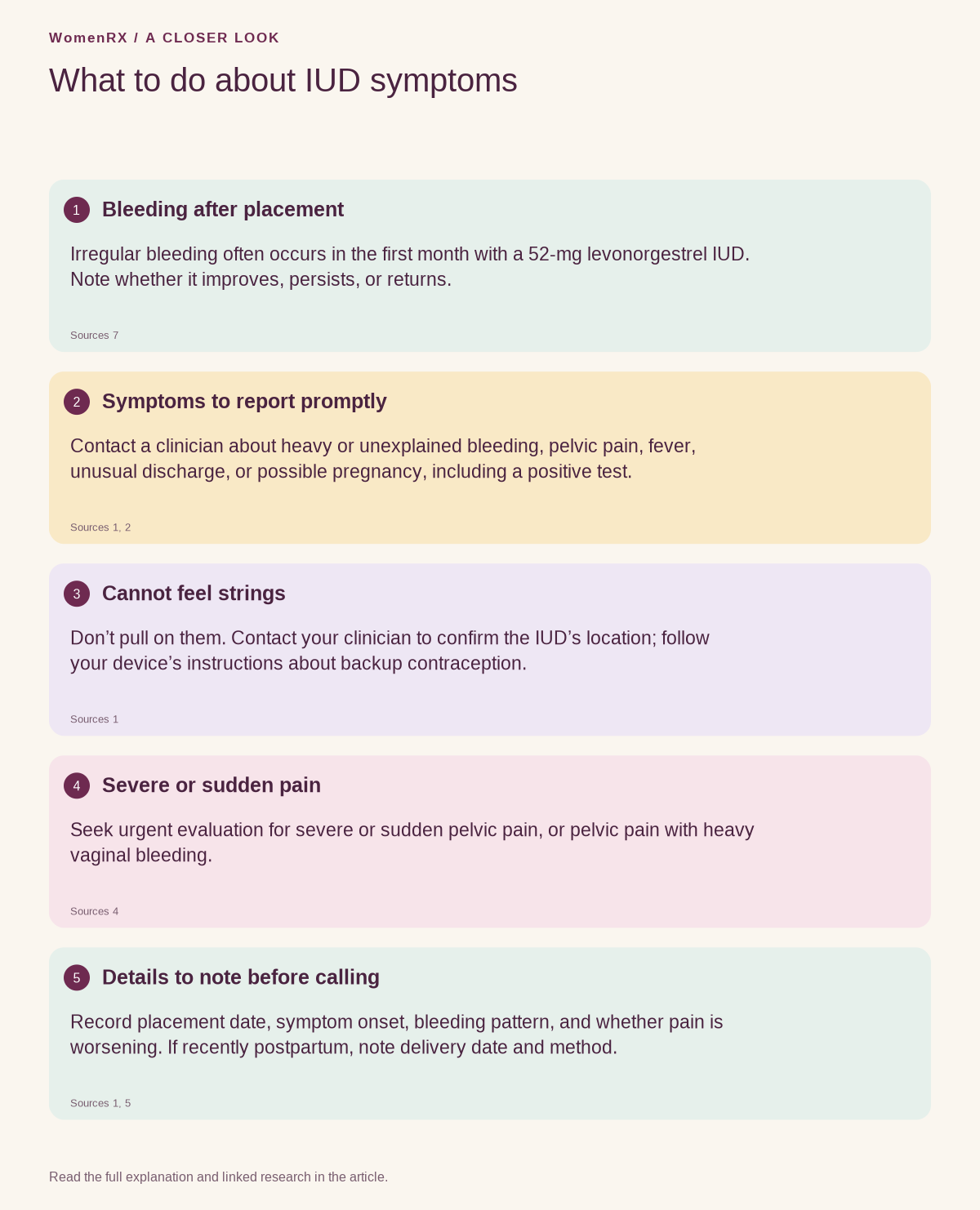
Bleeding after placement: Irregular bleeding often occurs in the first month with a 52-mg levonorgestrel IUD. Note whether it improves, persists, or returns.7
Symptoms to report promptly: Contact a clinician about heavy or unexplained bleeding, pelvic pain, fever, unusual discharge, or possible pregnancy, including a positive test.12
Cannot feel strings: Don’t pull on them. Contact your clinician to confirm the IUD’s location; follow your device’s instructions about backup contraception.1
Severe or sudden pain: Seek urgent evaluation for severe or sudden pelvic pain, or pelvic pain with heavy vaginal bleeding.4
Details to note before calling: Record placement date, symptom onset, bleeding pattern, and whether pain is worsening. If recently postpartum, note delivery date and method.15
Read the figure as text
Use the symptom pattern and timing to decide whether to contact a clinician promptly or seek urgent evaluation; this guide does not diagnose a complication.- Bleeding after placement: Irregular bleeding often occurs in the first month with a 52-mg levonorgestrel IUD. Note whether it improves, persists, or returns.7
- Symptoms to report promptly: Contact a clinician about heavy or unexplained bleeding, pelvic pain, fever, unusual discharge, or possible pregnancy, including a positive test.12
- Cannot feel strings: Don’t pull on them. Contact your clinician to confirm the IUD’s location; follow your device’s instructions about backup contraception.1
- Severe or sudden pain: Seek urgent evaluation for severe or sudden pelvic pain, or pelvic pain with heavy vaginal bleeding.4
- Details to note before calling: Record placement date, symptom onset, bleeding pattern, and whether pain is worsening. If recently postpartum, note delivery date and method.15
More questions, answered
What should I do if I can’t feel my IUD strings?
Contact your clinician to confirm the IUD’s location, and don’t pull on the strings. Mirena’s instructions advise avoiding sex or using non-hormonal backup birth control until its location is confirmed; check the instructions for your specific device. 1
Can I assume new bleeding after childbirth is from the IUD?
No. Postpartum timing and delivery method matter when assessing possible IUD expulsion, and bleeding can’t be attributed to the IUD without considering the circumstances. Tell your clinician when you delivered and when the IUD was placed, especially if bleeding is heavy or comes with worsening pain, fever, or unusual discharge. 15
Sources you can check
- MIRENA (LEVONORGESTREL) INTRAUTERINE DEVICE [BAYER HEALTHCARE PHARMACEUTICALS INC.] | US prescribing information and patient instructionsAccessed 2026-09-25Return to first citation
- KYLEENA (LEVONORGESTREL) INTRAUTERINE DEVICE [BAYER HEALTHCARE PHARMACEUTICALS INC.] | US prescribing information and patient instructionsAccessed 2026-09-25Return to first citation
- Pelvic Inflammatory Disease | PID | MedlinePlusAccessed 2026-09-25Return to first citation
- Pelvic inflammatory disease - NHSAccessed 2026-09-25Return to first citation
- Intrauterine Device Expulsion After Postpartum Placement: A Systematic Review and Meta-analysis.Jatlaoui TC, Whiteman MK, Jeng G, Tepper NK, Berry-Bibee E, Jamieson DJ, Marchbanks PA, Curtis KM. · Obstetrics and gynecology · 2018Return to first citation
- Canadian Contraception Consensus (Part 3 of 4): Chapter 7--Intrauterine Contraception.Black A, Guilbert E, Costescu D, Dunn S, Fisher W, Kives S, Mirosh M, Norman W, Pymar H, Reid R, Roy G, Varto H, Waddington A, Wagner MS, Whelan AM, Mansouri S. · Journal of obstetrics and gynaecology Canada : JOGC = Journal d'obstetrique et gynecologie du Canada : JOGC · 2016Return to first citation
- Treatment of unacceptable bleeding in long-term users of 52-mg levonorgestrel intrauterine device: a prospective observational study.van der Heijden PAHH, Röttgering KA, Oderkerk TJ, Dieleman JP, Lim AC, Bongers MY, Geomini PMAJ. · AJOG global reports · 2025Return to first citation