Hormonal IUDs and Weight: What Studies Show
The weight studies here compare different contraceptive methods, but neither can predict what will happen to your weight with a levonorgestrel IUD.
These comparisons don’t establish that a levonorgestrel IUD causes weight gain on average, or rule out a contribution to an individual’s change. In a teen study, BMI rose more in a group combining hormonal IUD and implant users than in copper IUD users, so the IUD’s separate effect is unknown. In randomized trials, weight gain was more likely with implants than with levonorgestrel IUDs. 3 5
What the comparisons can, and can’t, tell you
Weight changes can happen during the years someone uses contraception. The useful question is whether a method is responsible for a change, and the available comparisons don’t give a clear answer for every levonorgestrel IUD user.
One retrospective study followed 196 adolescents, ages 14 to 19, and compared BMI recorded around insertion with a later measurement 6 to 18 months afterward, typically about 10 months afterward. Average BMI rose by 0.92 kg/m² among the 127 users of progestin-releasing long-acting contraception, compared with 0.37 kg/m² among the 69 copper IUD users. But the progestin group combined levonorgestrel IUD users with users of the etonogestrel implant. Because those methods were grouped together, the result can’t show the levonorgestrel IUD’s separate effect. The study was also limited to adolescents and excluded those with childbirth. 3
A 2025 review and meta-analysis of six randomized trials, involving 1,503 reproductive-aged women, compared subdermal implants with levonorgestrel IUDs. Weight gain was more likely in the implant groups than in the IUD groups (odds ratio 4.63). That relative comparison doesn’t tell you the absolute likelihood of weight gain with either method, or whether the IUD differs from a copper IUD or using no contraception. 5
Together, these studies offer a partial comparison, not a dependable forecast for one person. They don’t prove that a levonorgestrel IUD causes weight gain; they also can’t rule out a contribution for an individual.
Keep the method differences straight
A levonorgestrel IUD releases progestin, while a copper IUD is nonhormonal. They’re different options, but the adolescent study doesn’t provide a clean, separate weight comparison between levonorgestrel IUD users and copper IUD users because it combines the hormonal IUD group with implant users. The implant comparison is more specific, but it answers a different question: how weight-gain outcomes compared between those two methods in the included trials. 3 5
Weight isn’t the only tradeoff. A clinical consensus statement reports that the 52-mg levonorgestrel IUD significantly reduces menstrual blood loss and dysmenorrhea, or painful periods. That may matter if heavy or painful bleeding is part of your decision; it’s a separate consideration from weight. 4
If your weight changed after insertion
The timing may be worth discussing, but it isn’t proof of cause. For example, you might compare the date of insertion with when you first noticed a change and whether anything else changed around then. The studies above don’t provide a reliable way to separate the IUD’s effect from other influences for an individual.
If weight is a major concern, you can ask about the choice in concrete terms: What does the evidence say about this specific IUD compared with the copper IUD? What bleeding changes might matter to me? Which alternative fits my priorities if I decide to switch? That keeps the conversation focused on the differences the evidence can help address, rather than promising a weight outcome it can’t predict.
Postpartum timing is a separate question
The adolescent BMI study excluded those with childbirth, so its results don’t answer whether a levonorgestrel IUD affects postpartum weight. Postpartum insertion has its own timing considerations: US product information describes insertion immediately after placental delivery or, for interval insertion, waiting at least six weeks or until the uterus is fully involuted. Those are insertion considerations, not evidence about weight. 1 2 3
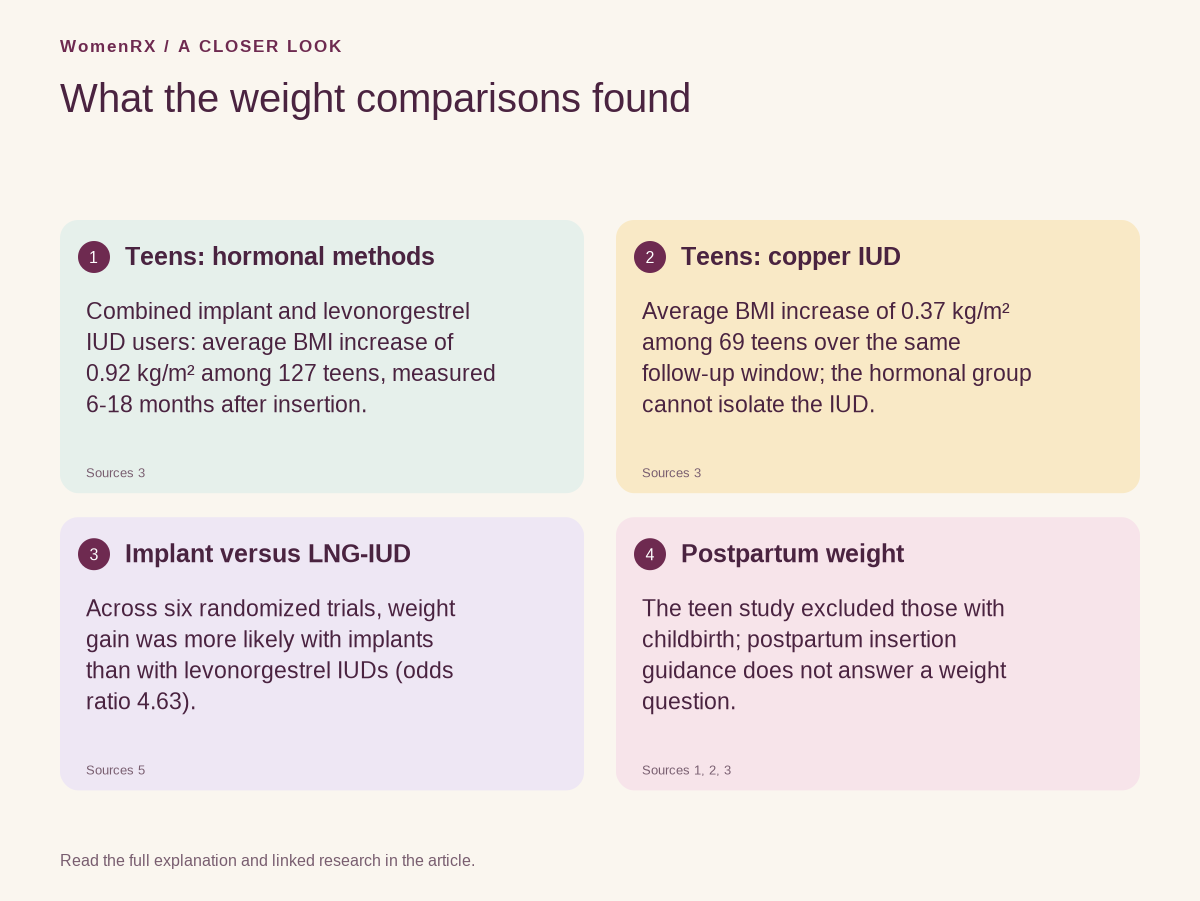
What the weight comparisons found
Teens: hormonal methods: Combined implant and levonorgestrel IUD users: average BMI increase of 0.92 kg/m² among 127 teens, measured 6-18 months after insertion.3
Teens: copper IUD: Average BMI increase of 0.37 kg/m² among 69 teens over the same follow-up window; the hormonal group cannot isolate the IUD.3
Implant versus LNG-IUD: Across six randomized trials, weight gain was more likely with implants than with levonorgestrel IUDs (odds ratio 4.63).5
Postpartum weight: The teen study excluded those with childbirth; postpartum insertion guidance does not answer a weight question.123
Read the figure as text
The outcomes differ because the studies compared different methods and populations.- Teens: hormonal methods: Combined implant and levonorgestrel IUD users: average BMI increase of 0.92 kg/m² among 127 teens, measured 6-18 months after insertion.3
- Teens: copper IUD: Average BMI increase of 0.37 kg/m² among 69 teens over the same follow-up window; the hormonal group cannot isolate the IUD.3
- Implant versus LNG-IUD: Across six randomized trials, weight gain was more likely with implants than with levonorgestrel IUDs (odds ratio 4.63).5
- Postpartum weight: The teen study excluded those with childbirth; postpartum insertion guidance does not answer a weight question.123
More questions, answered
Does a copper IUD have better evidence for avoiding weight gain?
The teen study included copper IUD users, but its hormonal comparison group combined levonorgestrel IUD and implant users. It therefore doesn’t establish a direct weight difference between copper and levonorgestrel IUDs. 3
Was weight gain more likely with an implant than a levonorgestrel IUD?
In a review of six randomized trials, weight gain was more likely in implant users than in levonorgestrel IUD users. The reported odds ratio compares the two methods; it doesn’t give either method’s absolute chance of weight gain. 5
Sources you can check
- MIRENA (LEVONORGESTREL) INTRAUTERINE DEVICE [BAYER HEALTHCARE PHARMACEUTICALS INC.] | US prescribing information and patient instructionsAccessed 2026-09-25Return to first citation
- KYLEENA (LEVONORGESTREL) INTRAUTERINE DEVICE [BAYER HEALTHCARE PHARMACEUTICALS INC.] | US prescribing information and patient instructionsAccessed 2026-09-25Return to first citation
- Does Obesity Influence Body Mass Index Changes in Nulliparous Adolescent Users of Long-Acting Reversible Contraceptives?Scott N, Silver EJ, Dodson NA, Coupey SM. · Journal of pediatric and adolescent gynecology · 2021Return to first citation
- Canadian Contraception Consensus (Part 3 of 4): Chapter 7--Intrauterine Contraception.Black A, Guilbert E, Costescu D, Dunn S, Fisher W, Kives S, Mirosh M, Norman W, Pymar H, Reid R, Roy G, Varto H, Waddington A, Wagner MS, Whelan AM, Mansouri S. · Journal of obstetrics and gynaecology Canada : JOGC = Journal d'obstetrique et gynecologie du Canada : JOGC · 2016Return to first citation
- Subdermal implants vs. levonorgestrel intrauterine devices outcomes in reproductive-aged women: a systematic review and meta-analysis.Oliveira JA, Neves GL, Pinhati MES, de Oliveira FR, Filho ALDS. · Archives of gynecology and obstetrics · 2025Return to first citation