Hormonal IUDs and weight: what the evidence can tell you
A 12-month study found no difference in weight change between hormonal- and copper-IUD users, but your own timeline still matters.
A weight change after a hormonal IUD is worth taking seriously, but timing alone can’t show that the IUD caused it. In one small 12-month study, weight and body-composition changes didn’t differ between levonorgestrel-IUD and copper-IUD users who continued their methods. That group result can’t predict your individual experience. 3 Record when the change began and what else was changing around that time.

What the studies say, and what they can’t
The most useful comparison in the available research is between a levonorgestrel IUD and a copper IUD. In a prospective cohort study, researchers followed 149 women who continued their method for 12 months: 85 used a levonorgestrel IUD, 31 a copper IUD, and 33 an implant. Weight and body-composition changes did not differ between the groups. The study was small, and its participants were relatively young, with a mean age of 25.9. It also only analyzed people who kept using their method for the full year. 3
A separate three-year study examined levonorgestrel and etonogestrel implants, with copper-IUD users as a comparison group. It did not study hormonal-IUD users. The copper-IUD group included 971 women, and its reported average weight increase at 36 months was 1.1 kg from baseline. That illustrates how weight can change over time even in a group using a nonhormonal IUD. It cannot tell us whether a levonorgestrel IUD affects weight. 2
The 12-month IUD comparison did not find a difference in weight change between methods, but it cannot rule out an individual change or establish what caused it. The three-year study adds context about weight over time, not another test of the hormonal IUD.
Put your own timeline beside the IUD date
If your weight changed after insertion, write down when the change began and how it has moved over time. Include your weight before insertion if you know it, the insertion date, and any weigh-ins since. If you were postpartum or going through a midlife transition around the same time, note that too. Those dates provide context; the studies above don’t tell us how weight changes during those life stages compare with IUD-related changes.
It can help to make weigh-ins comparable, such as using the same scale and similar conditions when you measure. Weight includes water, muscle, bone, and fat, so a single number can’t explain what changed. Look at the pattern rather than treating one measurement as a verdict. 1
Also note other changes that happened around the same time, such as a new medication or a change in routine. This doesn’t prove another factor is responsible; it helps keep the IUD from being the only explanation considered. You can bring this short timeline to a clinician and ask what fits your pattern and whether any other evaluation makes sense.
Decide what you want from the next conversation
You don’t have to dismiss a change just because studies report average results. Nor does a change after insertion establish that the IUD is the cause. A useful next step is to separate what you observed from what you suspect: for example, “My weight began trending up several months after insertion” is more informative than “the IUD made me gain weight.”
If the change is sudden or unintentional, MedlinePlus advises discussing it with a health care provider. Otherwise, your dated measurements and notes about what else was changing can help make a conversation more specific. 1
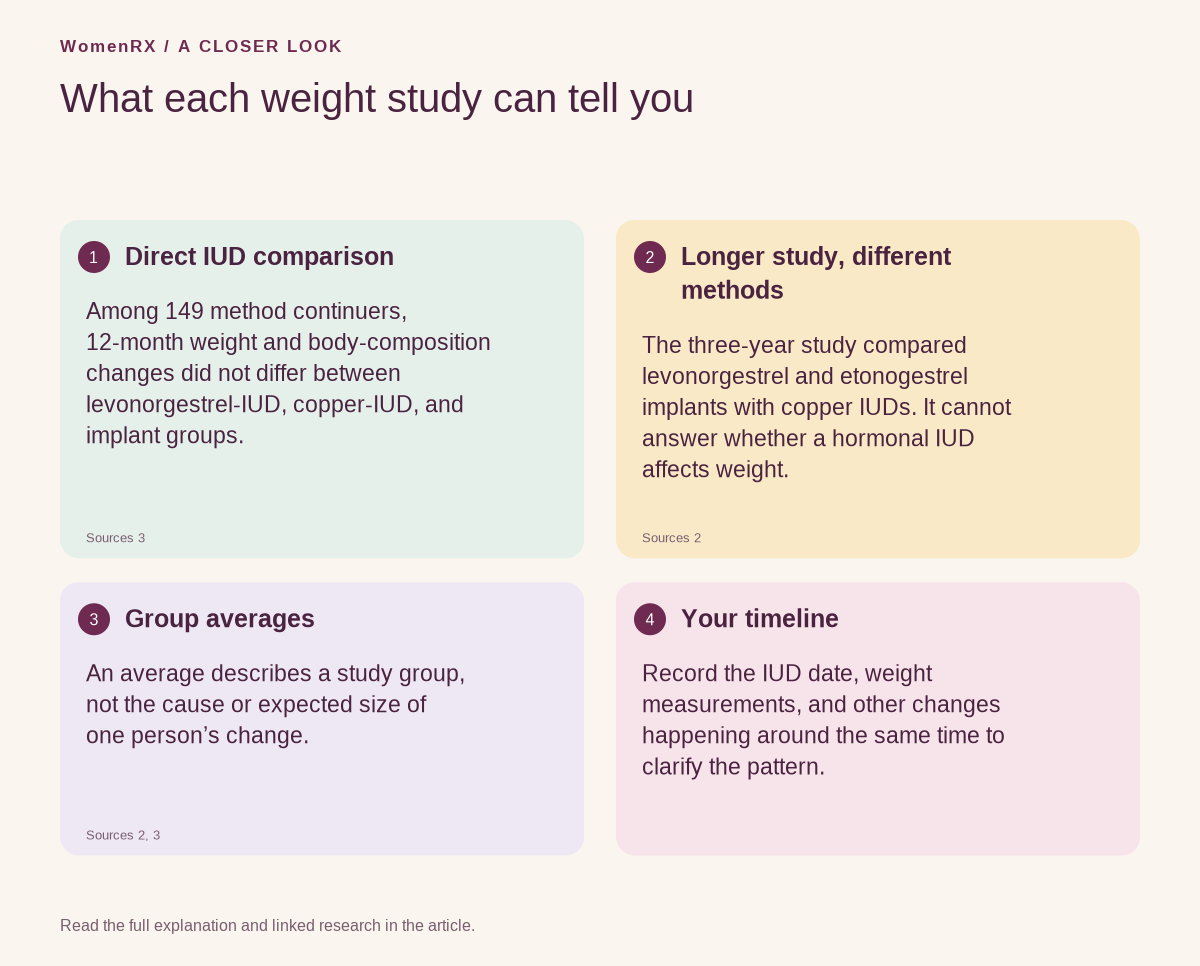
What each weight study can tell you
Direct IUD comparison: Among 149 method continuers, 12-month weight and body-composition changes did not differ between levonorgestrel-IUD, copper-IUD, and implant groups.3
Longer study, different methods: The three-year study compared levonorgestrel and etonogestrel implants with copper IUDs. It cannot answer whether a hormonal IUD affects weight.2
Group averages: An average describes a study group, not the cause or expected size of one person’s change.23
Your timeline: Record the IUD date, weight measurements, and other changes happening around the same time to clarify the pattern.
Read the figure as text
The direct IUD comparison lasted 12 months. A longer study tracked implants and copper IUDs, not hormonal IUDs.- Direct IUD comparison: Among 149 method continuers, 12-month weight and body-composition changes did not differ between levonorgestrel-IUD, copper-IUD, and implant groups.3
- Longer study, different methods: The three-year study compared levonorgestrel and etonogestrel implants with copper IUDs. It cannot answer whether a hormonal IUD affects weight.2
- Group averages: An average describes a study group, not the cause or expected size of one person’s change.23
- Your timeline: Record the IUD date, weight measurements, and other changes happening around the same time to clarify the pattern.
Sources you can check
- Body Weight: MedlinePlusAccessed 2026-09-25Return to first citation
- A multicenter randomized clinical trial of etonogestrel and levonorgestrel contraceptive implants with nonrandomized copper intrauterine device controls: effect on weight variations up to 3 years after placement.Bahamondes L, Brache V, Ali M, Habib N, WHO study group on contraceptive implants for women. · Contraception · 2018Return to first citation
- Changes in body composition in women using long-acting reversible contraception.Silva Dos Santos PN, Madden T, Omvig K, Peipert JF. · Contraception · 2017Return to first citation