Kyleena and Weight Change: What the Evidence Can Tell You
A weight change after Kyleena insertion is worth taking seriously, but timing alone can’t tell you what caused it.
Kyleena might be part of your question, but a change on the scale after insertion doesn’t establish that it caused the change. In studies of levonorgestrel IUD users, average weight change over 12 months did not differ significantly from that of copper IUD users after adjustment, though individual changes varied widely. Those studies were not specific to Kyleena. 34
What the comparison studies actually measured
The most useful question isn’t whether anyone gained weight while using a hormonal IUD. Some people gain weight during any given year. It’s whether weight changes differ from those seen with an IUD that doesn’t release hormones.
In a prospective study that weighed 427 women at enrollment and again at 12 months, the 130 levonorgestrel IUD users gained an average of 1.0 kg (about 2.2 pounds), while the 100 copper IUD users gained an average of 0.2 kg (about 0.4 pounds). Individual weight changes varied widely in both groups. After the researchers adjusted for other factors, they did not find a difference in weight gain between the levonorgestrel and copper IUD groups. This was an observational comparison, not a trial that randomly assigned women to IUDs. 3
A second, smaller prospective study measured both weight and body composition. Among women who continued their method for 12 months, changes did not differ between 85 levonorgestrel IUD users and 31 copper IUD users. Its participants were selected to exclude certain preexisting conditions and recent substantial weight changes, so the finding won’t describe every IUD user’s circumstances. 4
The distinction: These findings don’t show a clear average weight effect compared with a copper IUD over one year. They also can’t rule out a different experience for one person. Neither study provides a Kyleena-specific estimate of weight change. 34
Put the timing in context, not on trial
If your weight changed soon after insertion, it makes sense to notice the connection. Compare the trend before insertion with what happened afterward, rather than relying on one reading. For example, was your weight already rising over the preceding months, or did a new pattern begin later? Has the change been steady, or did it happen suddenly?
Also note what else changed around that time: a new medication, a change in activity or eating, an illness, or a major shift in routine. These aren’t explanations to assume. They’re details that can help you and a clinician examine more than one possibility. Unintentional weight gain or loss, especially a sudden unexpected change, can sometimes signal a medical problem. 2
Life stage can complicate that timeline. If Kyleena was placed after a birth, weight retained from pregnancy may be part of what you’re noticing; postpartum weight retention is a recognized pattern. 5 During perimenopause, body composition and where fat is carried can also change. Shifting cycles or night sweats may add context, though Kyleena itself can change bleeding patterns. These possibilities neither prove nor rule out a Kyleena effect. 61
Notice whether it’s weight, bloating, or another symptom
A higher scale reading and a feeling of abdominal fullness aren’t quite the same complaint. If what you’ve noticed is new pelvic discomfort or pain with sex, mention those symptoms rather than describing the whole experience as weight gain. Kyleena’s prescribing information reports ovarian cysts in its clinical trials; most were asymptomatic, but some were accompanied by pelvic pain or pain with sex. That does not mean a cyst explains your symptoms, but it gives a clinician a more useful question to assess. 1 If you also feel persistent fullness, mention it separately without assuming it has the same cause.
For a follow-up conversation, a short record is enough: when Kyleena was inserted, any weights you recorded before and after, whether the change was gradual or sudden, and any new symptoms or changes in your routine. You don’t need to prove causation to bring it up. If your weight is changing without an apparent reason, arrange a review rather than waiting to see whether you can settle the Kyleena question yourself. 2
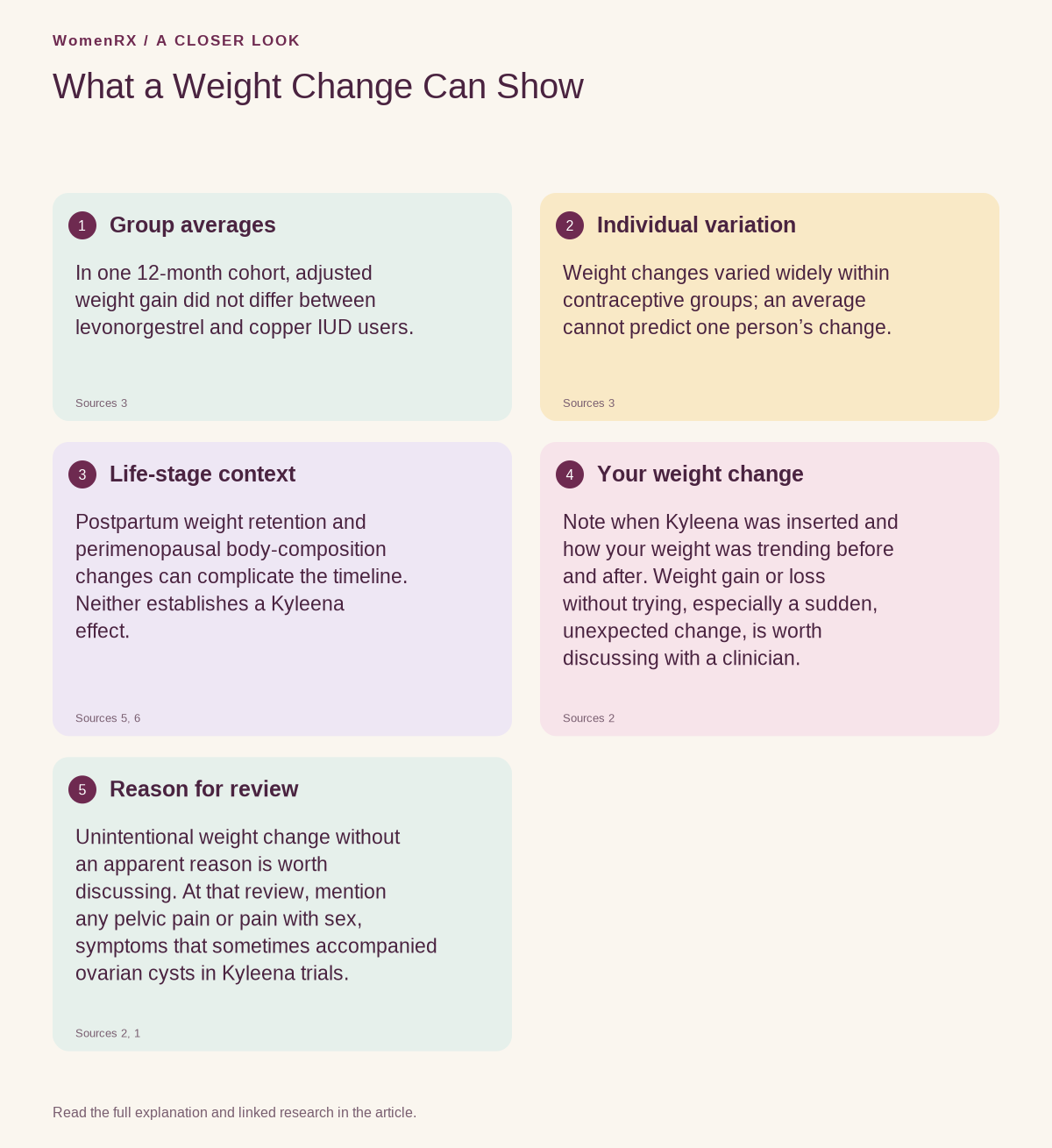
What a Weight Change Can Show
Group averages: In one 12-month cohort, adjusted weight gain did not differ between levonorgestrel and copper IUD users.3
Individual variation: Weight changes varied widely within contraceptive groups; an average cannot predict one person’s change.3
Life-stage context: Postpartum weight retention and perimenopausal body-composition changes can complicate the timeline. Neither establishes a Kyleena effect.56
Your weight change: Note when Kyleena was inserted and how your weight was trending before and after. Weight gain or loss without trying, especially a sudden, unexpected change, is worth discussing with a clinician.2
Reason for review: Unintentional weight change without an apparent reason is worth discussing. At that review, mention any pelvic pain or pain with sex, symptoms that sometimes accompanied ovarian cysts in Kyleena trials.21
Read the figure as text
Study findings and personal context answer different parts of the Kyleena question.- Group averages: In one 12-month cohort, adjusted weight gain did not differ between levonorgestrel and copper IUD users.3
- Individual variation: Weight changes varied widely within contraceptive groups; an average cannot predict one person’s change.3
- Life-stage context: Postpartum weight retention and perimenopausal body-composition changes can complicate the timeline. Neither establishes a Kyleena effect.56
- Your weight change: Note when Kyleena was inserted and how your weight was trending before and after. Weight gain or loss without trying, especially a sudden, unexpected change, is worth discussing with a clinician.2
- Reason for review: Unintentional weight change without an apparent reason is worth discussing. At that review, mention any pelvic pain or pain with sex, symptoms that sometimes accompanied ovarian cysts in Kyleena trials.21
More questions, answered
Does gaining weight after Kyleena mean I need it removed?
The timing by itself can’t tell you whether Kyleena caused the gain or whether removal would change your weight. The levonorgestrel IUD comparison studies found no significant average difference from copper IUD users over 12 months after adjustment, but individual changes varied. Bring your weight trend and any other symptoms into a conversation about whether the method still works for you. 34
Sources you can check
- KYLEENA (LEVONORGESTREL) INTRAUTERINE DEVICE [BAYER HEALTHCARE PHARMACEUTICALS INC.] | US prescribing information and patient instructionsAccessed 2026-09-25Return to first citation
- Body Weight: MedlinePlusAccessed 2026-09-25Return to first citation
- Weight change at 12 months in users of three progestin-only contraceptive methods.Vickery Z, Madden T, Zhao Q, Secura GM, Allsworth JE, Peipert JF. · Contraception · 2013Return to first citation
- Changes in body composition in women using long-acting reversible contraception.Silva Dos Santos PN, Madden T, Omvig K, Peipert JF. · Contraception · 2017Return to first citation
- Effect of mode of delivery on postpartum weight retention: A systematic review and meta-analysis.Wang M, Ji Y, Chen S, Wang M, Lin X, Yang M. · Midwifery · 2024Return to first citation
- Lifestyle interventions targeting body weight changes during the menopause transition: a systematic review.Jull J, Stacey D, Beach S, Dumas A, Strychar I, Ufholz LA, Prince S, Abdulnour J, Prud'homme D. · Journal of obesity · 2014Return to first citation