Nexplanon and Weight: What the Evidence Can Tell You
Some studies find a small average weight difference, but they don’t predict what will happen to you.
Nexplanon doesn’t lead to the same weight change for everyone. In a large three-year study, etonogestrel implant users gained an average of 3.0 kg, compared with 1.1 kg among copper IUD users, though the study authors described the difference as having little clinical significance. Other studies found no faster weight gain among younger implant users. Your own timeline matters, but a change after insertion alone can’t prove the implant caused it. 3 4 6
Start with the pattern, not one weigh-in
If your weight changed after Nexplanon was placed, it’s reasonable to want to know whether the timing is connected. Research offers a mixed picture: some studies find a modest average difference, while others don’t find that implant users gain weight faster than comparison groups. Those averages can inform a conversation, but they can’t confirm or dismiss an individual experience.
A useful first step is to look at the trend before and after insertion. If you have earlier measurements, compare them with measurements from the months after placement. A single number is harder to interpret: body weight includes water, muscle, bone, and fat, and the scale doesn’t show which changed. 1
What studies found, and what they can’t settle
In a multicenter study, researchers followed 995 etonogestrel implant users for up to three years. At 36 months, their average weight had increased by 3.0 kg. Copper IUD users, who were not randomly assigned to that method, had an average increase of 1.1 kg. Weight increased significantly within each group. In the study’s analysis of participants whose baseline weight was above 50 kg, implant users gained significantly more per year than copper IUD users. The researchers described the overall changes as having little clinical significance. A group average doesn’t show how much any one person gained, or whether the implant caused her change. 3
Other studies offer a different comparison. In a study of adolescents and young adults, implant users gained an average of 3.6 kg over about two years, compared with 3.1 kg among similar nonusers. The difference wasn’t statistically significant. 6 Another cohort study of patients ages 13 to 25 found that weight gain did not accelerate after insertion compared with the period before insertion. 4
These studies aren’t identical: they involve different ages, designs, comparison groups, and follow-up periods. Together, they suggest that weight gain can happen while using the implant, but they don’t establish that Nexplanon is the cause for every person. A smaller exploratory study also found little agreement between participants’ reports of weight gain and measured change. That doesn’t make a person’s concern less real; it shows why it helps to consider both the experience and the measurements. 5
Make a simple record of timing and changes
You don’t need a complicated tracker or a perfect set of old measurements. If it would help you, jot down:
- When Nexplanon was inserted, and when you first noticed a change.
- Weight measurements you already have, with their dates. Try to compare measurements taken in similar circumstances rather than treating one reading as the whole story.
- Changes in appetite or other symptoms, including when they started.
- Context that may help explain the timeline, such as pregnancy and postpartum recovery, or changes you associate with perimenopause.
This is a way to organize your observations, not a validated test for whether the implant caused weight change. If you don’t have measurements from before insertion, your recollection and the timing of symptoms are still useful to share. The postpartum evidence here comes from a trial comparing implant insertion within 48 hours of delivery with insertion at six weeks. BMI decreased over time in both groups, with similar patterns between them. Because the trial didn’t compare implant users with nonusers, it can’t tell us whether the implant itself caused a postpartum weight change. 2
Perimenopause is also worth mentioning when you discuss a change, but these studies don’t establish whether that life stage changes the implant’s effect on weight.
Bring the concern into your decision
You can tell your clinician what changed, when you noticed it, and what matters most to you. For example: “My weight began changing several months after insertion, and I’ve also noticed a change in appetite. Could we look at the timeline and talk through what else might be contributing?”
Ask how your measurements compare over time, what other explanations are worth considering, and what your options are if you’d rather not continue with Nexplanon. If removal is on your mind, include your contraception needs in that conversation so you can make a plan that suits you. You don’t have to prove the implant caused the change to have a valid reason to discuss whether the method still works for you.
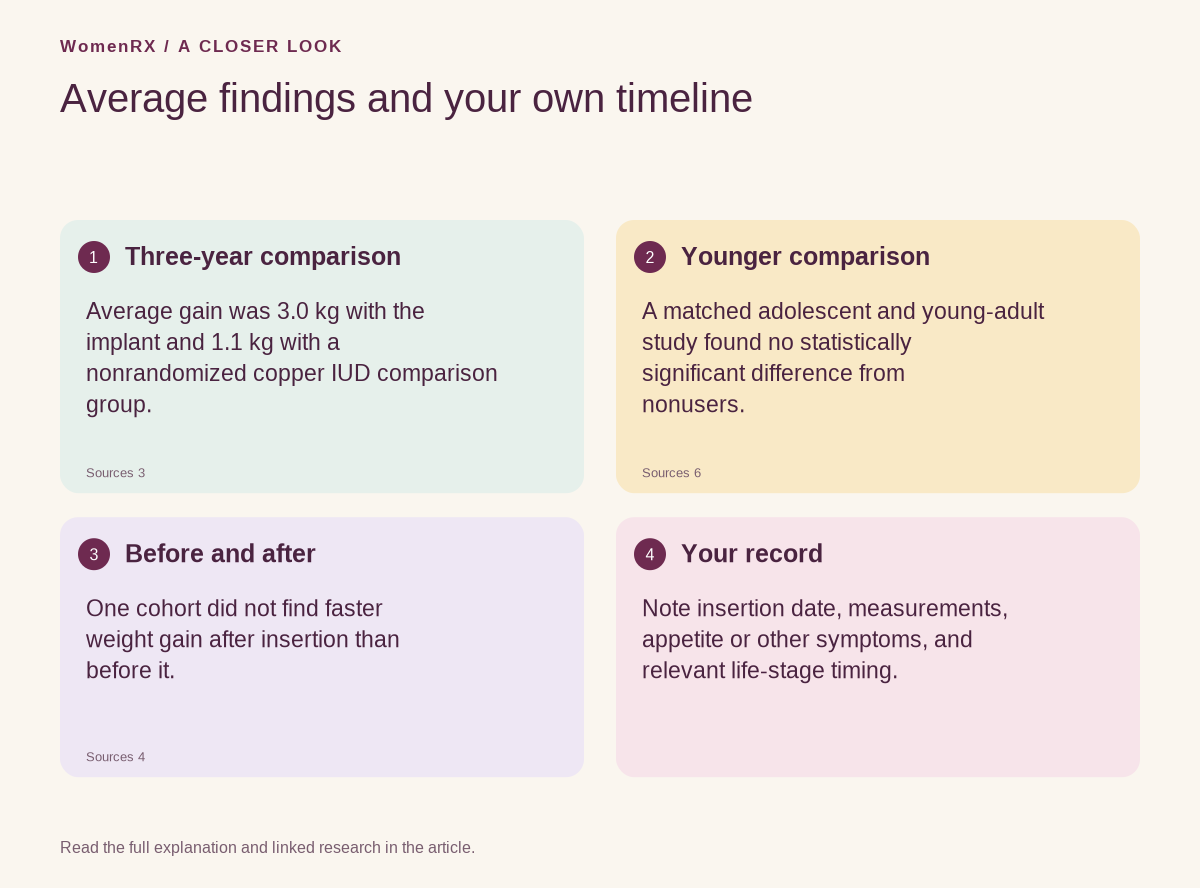
Average findings and your own timeline
Three-year comparison: Average gain was 3.0 kg with the implant and 1.1 kg with a nonrandomized copper IUD comparison group.3
Younger comparison: A matched adolescent and young-adult study found no statistically significant difference from nonusers.6
Before and after: One cohort did not find faster weight gain after insertion than before it.4
Your record: Note insertion date, measurements, appetite or other symptoms, and relevant life-stage timing.
Read the figure as text
These study results can help frame a conversation, but none can determine the cause of one person’s weight change.- Three-year comparison: Average gain was 3.0 kg with the implant and 1.1 kg with a nonrandomized copper IUD comparison group.3
- Younger comparison: A matched adolescent and young-adult study found no statistically significant difference from nonusers.6
- Before and after: One cohort did not find faster weight gain after insertion than before it.4
- Your record: Note insertion date, measurements, appetite or other symptoms, and relevant life-stage timing.
Sources you can check
- Body Weight: MedlinePlusAccessed 2026-09-25Return to first citation
- Timing of postpartum etonogestrel-releasing implant insertion and bleeding patterns, weight change, 12-month continuation and satisfaction rates: a randomized controlled trial.Vieira CS, de Nadai MN, de Melo Pereira do Carmo LS, Braga GC, Infante BF, Stifani BM, Ferriani RA, Quintana SM. · Contraception · 2019Return to first citation
- A multicenter randomized clinical trial of etonogestrel and levonorgestrel contraceptive implants with nonrandomized copper intrauterine device controls: effect on weight variations up to 3 years after placement.Bahamondes L, Brache V, Ali M, Habib N, WHO study group on contraceptive implants for women. · Contraception · 2018Return to first citation
- Weight Gain Patterns in Adolescent and Young Adult Women With the Etonogestrel Implant: Comparison by Weight Category.Batt CE, Sheeder J, Love-Osborne K. · The Journal of adolescent health : official publication of the Society for Adolescent Medicine · 2021Return to first citation
- An exploratory analysis on the influence of genetic variants on weight gain among etonogestrel contraceptive implant users.Lazorwitz A, Dindinger E, Harrison M, Aquilante CL, Sheeder J, Teal S. · Contraception · 2020Return to first citation
- Assessing Weight Status in Adolescent and Young Adult Users of the Etonogestrel Contraceptive Implant.Romano ME, Braun-Courville DK. · Journal of pediatric and adolescent gynecology · 2019Return to first citation