What to Know Before Choosing the Nexplanon Implant
Nexplanon offers years of contraception without a daily task, but bleeding changes are worth weighing before insertion.
Nexplanon is a progestin-only rod a trained healthcare professional places just under the skin of your upper arm. It prevents pregnancy for up to five years. Spotting, frequent bleeding and prolonged bleeding are among the changes reported with etonogestrel implants. You can request removal earlier; planning that visit matters if you want to switch methods or try for pregnancy. 6

The tradeoff is convenience versus bleeding changes
Nexplanon doesn’t require you to remember a pill or manage a method during sex. A trained healthcare professional inserts one rod under the skin of your upper arm, and it can provide pregnancy prevention for up to five years. It’s reversible: you don’t have to keep it for the full five years if it stops fitting your life. 6
The biggest practical question is often bleeding. Spotting, frequent bleeding, heavy bleeding and prolonged bleeding are among the irregularities reported with etonogestrel implants. In clinical trials of the earlier non-radiopaque etonogestrel implant, bleeding irregularities were the most common reason for stopping it. A separate study of Nexplanon users at one clinic also found irregular bleeding was the most frequent reason women requested early removal. These findings make bleeding a sensible part of the decision, not an afterthought. 65
For example, if occasional spotting would be manageable but weeks of unexpected bleeding would interfere with work or sex, say that when you discuss options. You can value highly effective, low-maintenance contraception and still decide that bleeding predictability matters more to you.
What happens at placement
Placement is an arm procedure, not a pelvic procedure. The healthcare professional numbs an area on the inner side of your nondominant upper arm and inserts the rod just beneath the skin. Afterward, both of you should be able to feel it. That check confirms its presence and helps make future removal more straightforward. You’ll leave with a bandage, and the placement is recorded in your medical chart. 6
Ask at the visit when the implant will begin protecting you. Whether you need temporary backup contraception depends on when it’s inserted and what birth control you’ve been using; it isn’t the same answer for everyone. 6
Some tenderness or bruising at the site can happen. Headache, acne, breast pain and reported weight increase are among effects reported in trials of the earlier non-radiopaque etonogestrel implant and included in Nexplanon’s labeling. A reported effect doesn’t mean the implant caused every instance of it, and trial rates don’t predict what will happen to an individual. 6
What to do if bleeding or other effects bother you
You don’t have to wait until the five-year mark to revisit your choice. If bleeding becomes hard to live with, tell the clinician caring for you what’s happening and whether you’d rather explore ways to manage it or have the implant removed. Before placement, tell the clinician if you have unexplained abnormal bleeding; Nexplanon’s labeling lists undiagnosed abnormal uterine bleeding among reasons not to use it. 6
The same goes for an effect that matters to you even if someone else might consider it minor. The question isn’t whether you can tolerate the implant in theory. It’s whether its benefits still outweigh its downsides in your everyday life.
Plan for removal as well as insertion
A trained healthcare professional removes Nexplanon. For an implant that can be felt, the clinician locates it, numbs the area, makes a small incision and removes the rod. If you want to continue using Nexplanon, a new one may be placed at the removal visit. The existing implant must be removed by the end of its fifth year. 6
If you or your clinician can’t feel the rod, don’t assume it fell out or try to find or remove it yourself. It needs to be located, often with imaging, before anyone attempts removal; a clinician experienced with difficult removals may be needed. If its presence can’t be confirmed after insertion, the product instructions advise using nonhormonal contraception until it’s verified. 61
If you’re thinking about pregnancy, you can arrange removal when you’re ready to stop using the method. If you’re switching instead, discuss how the next method will begin so there isn’t an unintended gap in protection. Options have different demands: an IUD also provides long-acting contraception but is placed in the uterus, while pills require regular use. Condoms can help protect against sexually transmitted infections, which the implant does not do. 63
If you’ve recently given birth
The implant may be an appealing option when you want contraception without another daily task, including while breastfeeding. Postpartum timing deserves a specific conversation, though. Nexplanon’s product instructions specify insertion between 21 and 28 days after birth if you’re not breastfeeding and after the fourth postpartum week if you are. CDC’s contraceptive eligibility guidance allows clinicians to consider the implant earlier postpartum, including during breastfeeding. 64
A randomized trial of 155 postpartum people at risk for low milk supply found similar breastfeeding outcomes across early and later placement groups, but it did not meet its prespecified threshold for proving non-inferiority. Your feeding plans, health and need for contraception all belong in the timing decision. 24
Before choosing, make sure the arm procedure, the possibility of bleeding changes and your route to removal all work for you. Those are the details most likely to determine whether the convenience feels worthwhile.
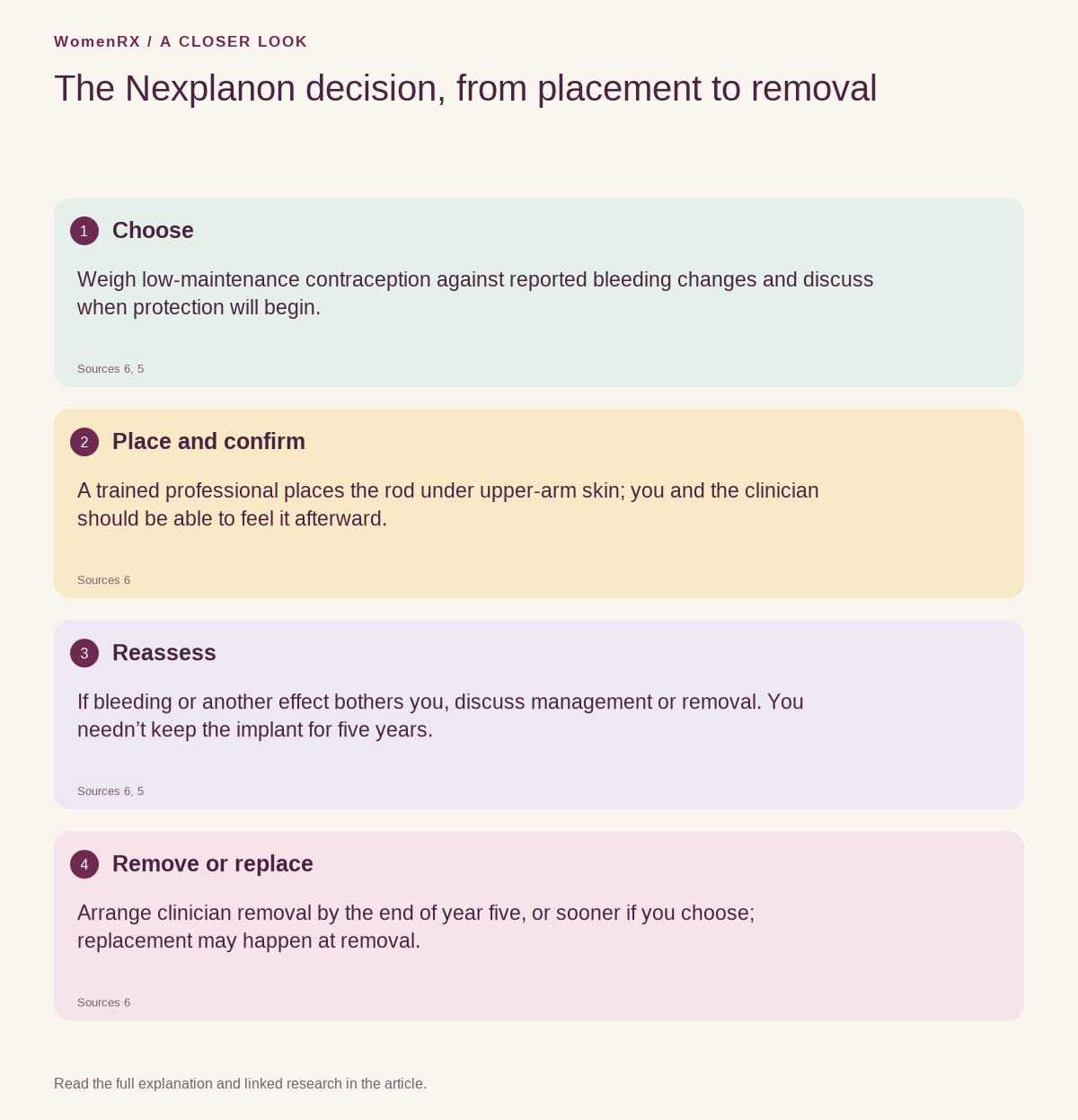
The Nexplanon decision, from placement to removal
Choose: Weigh low-maintenance contraception against reported bleeding changes and discuss when protection will begin.65
Place and confirm: A trained professional places the rod under upper-arm skin; you and the clinician should be able to feel it afterward.6
Reassess: If bleeding or another effect bothers you, discuss management or removal. You needn’t keep the implant for five years.65
Remove or replace: Arrange clinician removal by the end of year five, or sooner if you choose; replacement may happen at removal.6
Read the figure as text
A sequence of decisions and checks, not a prediction of how your bleeding will change.- Choose: Weigh low-maintenance contraception against reported bleeding changes and discuss when protection will begin.65
- Place and confirm: A trained professional places the rod under upper-arm skin; you and the clinician should be able to feel it afterward.6
- Reassess: If bleeding or another effect bothers you, discuss management or removal. You needn’t keep the implant for five years.65
- Remove or replace: Arrange clinician removal by the end of year five, or sooner if you choose; replacement may happen at removal.6
More questions, answered
Does Nexplanon protect against sexually transmitted infections?
No. Condoms can help protect against HIV and other sexually transmitted infections and can be used alongside another contraceptive method. 3
Can I have Nexplanon removed before five years?
Yes. Five years is the latest removal point in the current product instructions, not a commitment to keep the implant that long. Removal is performed by a trained healthcare professional. 6
Sources you can check
- Non-Palpable Contraceptive Implant Evaluation and Removal: A Protocol That Can Be Adopted for Practice in Low-Middle Income Countries.Sium AF, Abdu AN, Grentzer JM, Reeves MF, Prager S. · Public health challenges · 2025Return to first citation
- Immediate postpartum contraceptive implant placement and breastfeeding success in postpartum people at risk for low milk supply: A randomized non-inferiority trial.Levi EE, Avila K, Wu H. · Contraception · 2025Return to first citation
- CDC: Birth control methods, barrier methods, fertility awareness and breastfeedingAccessed 2026-09-25Return to first citation
- Appendix C: Classifications for Progestin-Only Contraceptives | Contraception | CDCAccessed 2026-09-25Return to first citation
- The association between BMI and continuity of etonogestrel (ENG)-releasing implant.Mohr-Sasson A, Dalal L, Bhalwal A. · International journal of gynaecology and obstetrics: the official organ of the International Federation of Gynaecology and Obstetrics · 2024Return to first citation
- NEXPLANON etonogestrel implantAccessed 2026-09-25Return to first citation