NuvaRing: The Routine, Side Effects, and Safety Questions
NuvaRing replaces a daily pill with a three-week ring routine, but a ring that slips out or a delayed replacement can change what you need to do.
NuvaRing is a combined hormonal contraceptive ring containing etonogestrel and ethinyl estradiol. You insert one ring, leave it in for three weeks, remove it for one week, then insert a new ring on schedule. Its fit inside the vagina doesn’t have to be exact. Before starting, review your blood pressure, migraine history, including any migraine if you’re over 35, clot risk, medications, and any postpartum or breastfeeding plans.13
What using NuvaRing actually involves
NuvaRing delivers an estrogen and a progestin through a ring placed in the vagina. Its hormones help prevent ovulation. Its practical appeal is that you don’t have to remember a pill every day. The tradeoff is that you do have to keep track of when to remove and replace it, and notice if it slips out.13
For NuvaRing’s usual schedule, compress the ring and insert it into your vagina in a position that feels comfortable. Its exact position isn’t critical to how it works. Leave it in continuously for three weeks, then remove it for a one-week break. Insert the next ring exactly one week after removing the last, on the same day of the week, even if you’re still bleeding. A withdrawal bleed usually occurs during the break.1
When you first start matters too. NuvaRing’s instructions say that starting on the first day of menstrual bleeding requires no additional contraception. If you start on cycle days two through five, they call for a barrier method for the first seven days. Switching from another method has its own instructions, so use the directions for the method you’re leaving rather than assuming you can start at any point without backup.1
Combined pills, transdermal patches, and vaginal rings are all combined hormonal methods. Choosing the ring instead of a pill or patch does not remove the need to assess whether estrogen-containing contraception is suitable for you. If a ring is often expelled or the schedule is hard to keep, that’s a practical reason to consider a different method.134
If the ring slips out or the schedule changes
NuvaRing can come out while removing a tampon, during sex, or while straining during a bowel movement. Its instructions suggest checking that it’s present, for example before and after sex. If it has been out for less than three hours, the label says contraceptive effectiveness is not reduced. Rinse it with cool to lukewarm water, not hot water, and reinsert it as soon as possible within that three-hour window.1
If it has been out for more than three continuous hours, the week of use changes the next step:
- Weeks one or two: Reinsert the ring as soon as you remember. Use a barrier method until the ring has been in place continuously for seven days.1
- Week three: Discard that ring. The product instructions offer two options: insert a new ring immediately, starting a new three-week period, or insert one no later than seven days after the old ring came out. The second option applies only if the old ring was in place continuously for at least seven days before it came out. Either way, use a barrier method until the new ring has been in place continuously for seven days.1
If you don’t know how long the ring has been out, NuvaRing’s instructions say to consider pregnancy and take a pregnancy test before inserting a new ring. A ring-free break that lasts more than one week also calls for considering pregnancy and using additional contraception until a ring has been in place continuously for seven days.1
If you left a ring in longer than planned, the next step depends on its total time in place. Up to four weeks total, protection remains: remove the ring, take a one-week ring-free break, then insert a new ring. If it has been in place for more than four weeks, remove it and rule out pregnancy before restarting. After restarting, use an additional method of contraception until the new ring has been in place continuously for seven days.1
Those are NuvaRing-specific directions. Don’t assume another vaginal ring uses the same schedule or the same rules for interrupted use. CDC guidance also emphasizes that extending a hormone-free interval is a particularly risky kind of combined-method use error.13
What you might notice
Spotting or bleeding outside the expected break can happen, especially in the first three months. Headache, nausea, breast tenderness, mood changes, vaginal discharge or discomfort, and feeling the ring or having it slip out are among effects reported in NuvaRing trials. For context, among 2,501 women ages 18 to 41 in trials lasting 6 to 13 cycles, vaginitis was reported by 13.8%, headache including migraine by 11.2%, and device-related events such as expulsion or discomfort by 6.3%. Trial percentages describe what participants reported; they can’t predict what you personally will experience.1
The ring may occasionally be noticeable to you during sex, and a partner may feel it. If bleeding persists after previously regular cycles, or you develop new recurrent, persistent, or severe headaches, those changes warrant evaluation rather than simply waiting them out. Migraine with aura is a separate safety issue: it’s listed as a reason not to use NuvaRing. The label also says women over 35 with any migraine headache should not use it.1
The health-history check is still part of choosing a ring
NuvaRing is not appropriate for everyone who wants a lower-maintenance routine. Its prescribing information lists a current or past deep vein thrombosis or pulmonary embolism, migraine with aura or any migraine headache in women over 35, uncontrolled high blood pressure, certain liver conditions, and current or past breast cancer among reasons not to use it. It also says women over 35 who smoke should not use it. Blood pressure should be measured before starting a combined hormonal contraceptive.13
Combined hormonal contraception increases the risk of blood clots. Observational studies described in NuvaRing’s prescribing information found clot rates among ring users similar to those among combined-pill users studied, but similar does not mean risk-free, and those comparisons do not override your own health history. Bring up any past clot, migraine symptoms, high blood pressure, planned major surgery with prolonged immobility, or medicines that could affect your contraceptive choice. Examples of relevant medicines include rifampin or rifabutin and certain seizure medicines such as carbamazepine or topiramate; NuvaRing is also contraindicated with hepatitis C combinations containing ombitasvir/paritaprevir/ritonavir, with or without dasabuvir.14
After childbirth, timing and breastfeeding change the conversation. NuvaRing’s instructions say women who are not breastfeeding should start no sooner than four weeks after delivery because of postpartum clot risk. They advise women who are breastfeeding to use another form of contraception until weaning, and note that combined hormonal methods can reduce milk production. CDC’s broader eligibility guidance makes more nuanced distinctions by postpartum timing, breastfeeding, and other clot-risk factors. That difference is a reason to discuss your situation rather than treating four weeks as an automatic start date, especially if you’re breastfeeding.14 A review of U.S. guidance and studies found that evidence for reduced milk supply with combined hormonal contraception is low quality, while progestin-only methods have more reassuring breastfeeding evidence.2
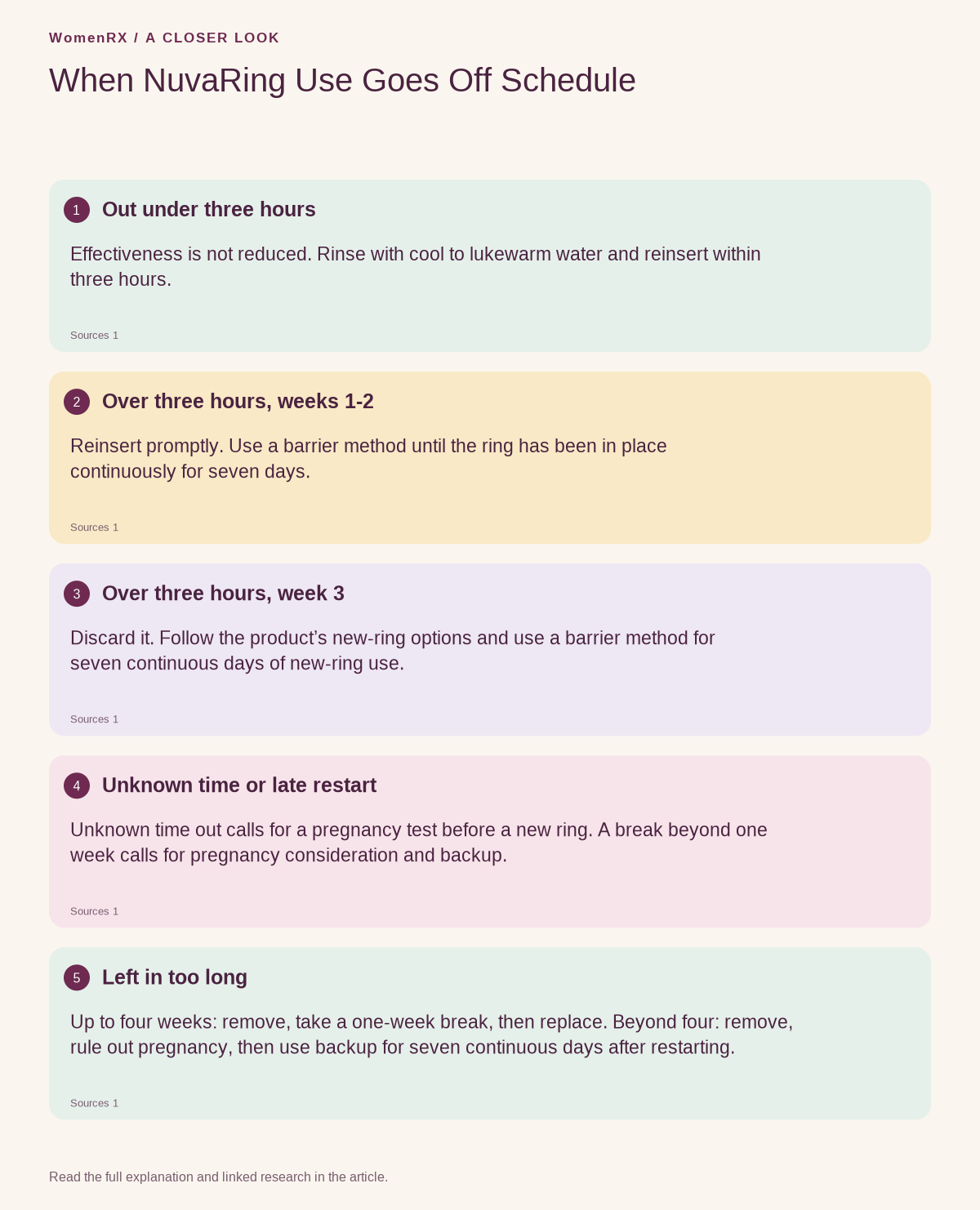
When NuvaRing Use Goes Off Schedule
Out under three hours: Effectiveness is not reduced. Rinse with cool to lukewarm water and reinsert within three hours.1
Over three hours, weeks 1-2: Reinsert promptly. Use a barrier method until the ring has been in place continuously for seven days.1
Over three hours, week 3: Discard it. Follow the product’s new-ring options and use a barrier method for seven continuous days of new-ring use.1
Unknown time or late restart: Unknown time out calls for a pregnancy test before a new ring. A break beyond one week calls for pregnancy consideration and backup.1
Left in too long: Up to four weeks: remove, take a one-week break, then replace. Beyond four: remove, rule out pregnancy, then use backup for seven continuous days after restarting.1
Read the figure as text
If a ring comes out, use the time out of the vagina and week of use to find the next step. A ring left in too long has different instructions.- Out under three hours: Effectiveness is not reduced. Rinse with cool to lukewarm water and reinsert within three hours.1
- Over three hours, weeks 1-2: Reinsert promptly. Use a barrier method until the ring has been in place continuously for seven days.1
- Over three hours, week 3: Discard it. Follow the product’s new-ring options and use a barrier method for seven continuous days of new-ring use.1
- Unknown time or late restart: Unknown time out calls for a pregnancy test before a new ring. A break beyond one week calls for pregnancy consideration and backup.1
- Left in too long: Up to four weeks: remove, take a one-week break, then replace. Beyond four: remove, rule out pregnancy, then use backup for seven continuous days after restarting.1
More questions, answered
Does NuvaRing protect against sexually transmitted infections?
No. Like other combined hormonal contraceptives, it prevents pregnancy but does not protect against STIs. Condoms can provide STI protection.3
What if the ring is lost or breaks?
NuvaRing’s instructions say to insert a new ring if one is lost and continue the schedule without changing it. If a ring comes apart at its joint, discard it and replace it with a new one; a disconnected ring is more likely to cause discomfort or slip out.1
Sources you can check
- NUVARING (ETONOGESTREL AND ETHINYL ESTRADIOL) INSERT, EXTENDED RELEASE [ORGANON LLC] | US prescribing information and patient instructionsAccessed 2026-09-25Return to first citation
- Breastfeeding and Hormonal Contraception: A Scoping Review of Clinical Guidelines, Professional Association Recommendations, and the Literature.Sausjord IK, Acton LW, White KO, O'Connor SK, Lerner NM. · Breastfeeding medicine : the official journal of the Academy of Breastfeeding Medicine · 2023Return to first citation
- Combined Hormonal Contraceptives | Contraception | CDCAccessed 2026-09-25Return to first citation
- Appendix A: Summary of Classifications for U.S. Medical Eligibility Criteria for Contraceptive Use, 2024 | Contraception | CDCAccessed 2026-09-25Return to first citation