Slynd Alternatives: Match the Method to Your Priorities
The right alternative depends on what you want to change: the hormone, the routine, bleeding, or how much control you want over starting and stopping.
Alternatives to discuss include another progestin-only pill, a combined pill, patch or vaginal ring, an implant, an injection, a hormonal or copper IUD, and barrier methods. They differ in hormone exposure, routine, bleeding patterns and whether placement is involved. IUDs are reversible, while sterilization is permanent. No option is a universal substitute; your health history, breastfeeding plans and timing for a future pregnancy help narrow the conversation. 1 2 6
Start with what isn’t fitting
Before switching, name the reason Slynd no longer works for you. Is it the daily routine, bleeding, a wish to avoid hormones, or a change in when you might want to become pregnant? Those priorities point toward different options. Method choice can also depend on your health history, convenience, cost and personal control. 1 2
A useful distinction: a progestin-only pill and a pill that combines progestin with estrogen are not the same kind of option. If avoiding estrogen is part of your preference, say so at the start. Combined pills, patches and vaginal rings are alternatives for some people, but whether one fits your health history is an individual decision. 1 6
If you want to keep a pill routine
Slynd is a drospirenone-only pill. Ask whether another progestin-only pill is suitable, or whether a combined pill better fits your priorities. The general pill category includes both progestin-only and combined formulations, but no particular progestin-only pill is automatically the right replacement for you. Don’t assume that a pill containing estrogen is interchangeable with Slynd just because both are pills. 1 6
A pill may appeal if you want a method you manage yourself rather than one placed in your body. It still means keeping up with a pill routine. If remembering a pill is the part you want to change, the patch or vaginal ring may offer a different schedule: the patch is changed weekly, while the ring follows a repeating cycle of use and time out. These are combined hormonal options, so ask whether their hormone type fits your history and preferences. 1 6
If you’d rather not take a pill every day
An implant or an IUD is placed by a provider and avoids a daily pill routine. Mirena and Kyleena are levonorgestrel-releasing IUDs; copper IUDs are another type. The injection is another option that doesn’t require daily use, though it involves repeat visits to a provider’s office. These options differ in how they’re started and maintained, so ask what the process would look like for you. 1 3 4
Bleeding is worth discussing before choosing an IUD. Spotting or irregular bleeding is common in the first months after placement of Mirena and Kyleena. In a U.S. prospective cohort, a planned analysis included 137 IUD users who provided at least 60 days of continuous responses during the first 90 days: copper-IUD users reported a median of 13 spotting days, compared with 31 among 52-mg levonorgestrel-IUD users. That finding describes early bleeding in this group; it doesn’t predict exactly what your experience will be. 3 4 5
If avoiding hormones matters most
The copper IUD is a provider-placed option. Condoms and other barrier methods are also options; condoms have an additional distinction because latex external condoms can help protect against HIV and other sexually transmitted infections. Most contraceptive methods don’t prevent STIs. 1 2
If you’re considering a method without daily hormones but don’t want a device, ask which user-managed options fit your needs and how reliably you can use them as intended. Methods differ in routine and typical-use effectiveness; for example, CDC guidance reports a range rather than one rate for fertility-awareness methods. There isn’t one best fit simply because an option is non-hormonal. 2
Bring postpartum plans and pregnancy timing into it
If you’re postpartum or breastfeeding, ask about timing as well as method. Breastfeeding counts as temporary contraception through lactational amenorrhea only when all three conditions apply: your periods haven’t returned, you’re fully or nearly fully breastfeeding, and you’re less than six months postpartum. If any condition changes, another method is needed to rely on this approach. 2
For a hormonal IUD, placement can happen immediately after childbirth in some circumstances. For interval placement, Mirena and Kyleena instructions say to wait a minimum of six weeks or until the uterus is fully involuted. Ask what timing applies to your situation and whether you need another method during a transition. 3 4
Also say how soon, if at all, you might want to become pregnant. Pills, patches, rings, injections and barrier methods involve ongoing use; IUDs are listed as long-acting reversible contraception. Tubal ligation and vasectomy, by contrast, are permanent. 1 3 4
A focused way to compare options
You could bring a short list like this: “I want to avoid estrogen,” “I don’t want a daily task,” “I’m concerned about spotting,” or “I may want pregnancy soon.” Then ask which options match those priorities, what bleeding changes are common, how the method is started and maintained, and what to use during a switch. A complete medical and social history can help determine whether an IUD is appropriate; the same kind of personal-fit discussion matters across methods. 2 3
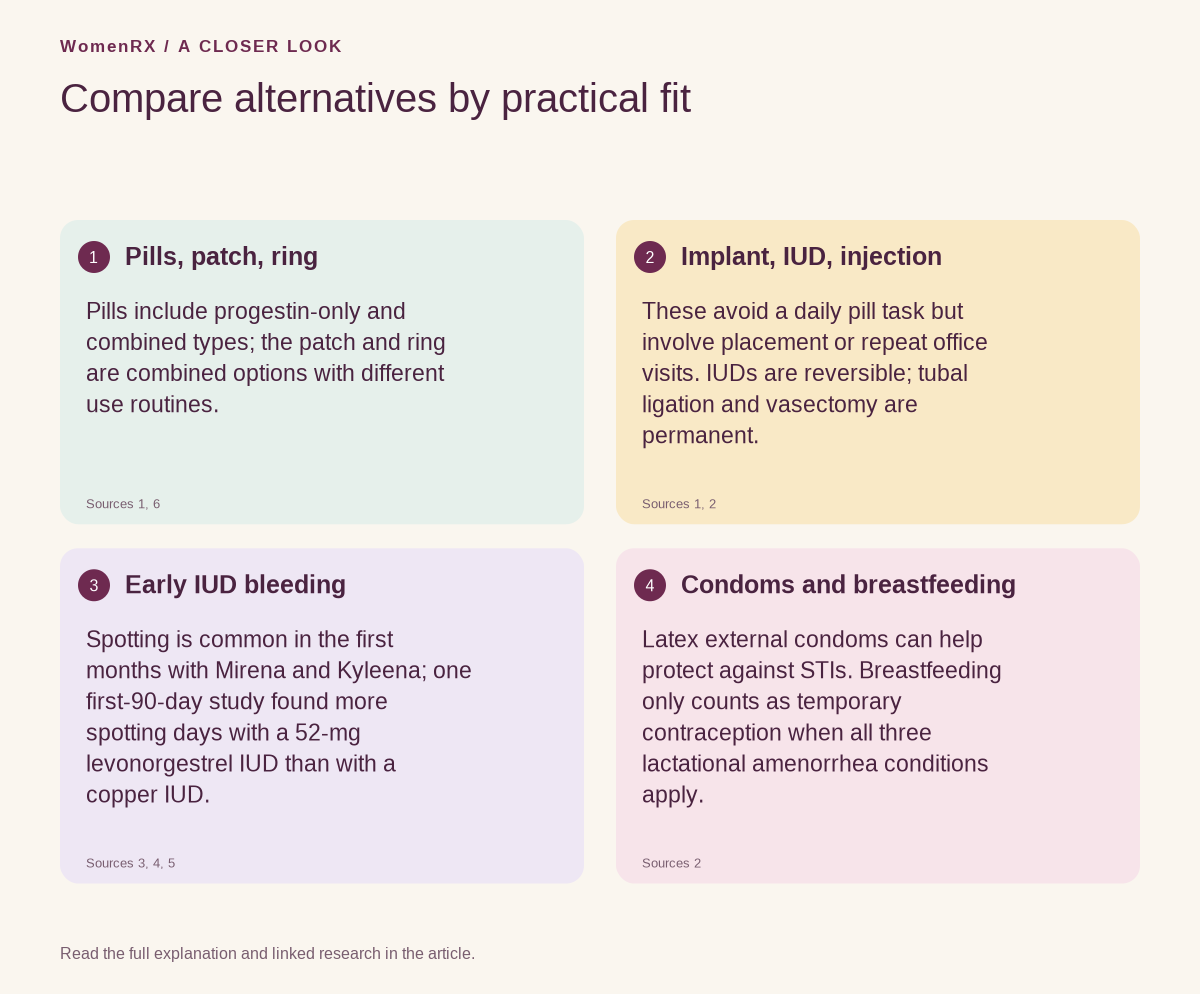
Compare alternatives by practical fit
Pills, patch, ring: Pills include progestin-only and combined types; the patch and ring are combined options with different use routines.16
Implant, IUD, injection: These avoid a daily pill task but involve placement or repeat office visits. IUDs are reversible; tubal ligation and vasectomy are permanent.12
Early IUD bleeding: Spotting is common in the first months with Mirena and Kyleena; one first-90-day study found more spotting days with a 52-mg levonorgestrel IUD than with a copper IUD.345
Condoms and breastfeeding: Latex external condoms can help protect against STIs. Breastfeeding only counts as temporary contraception when all three lactational amenorrhea conditions apply.2
Read the figure as text
These distinctions can help you identify which options to discuss; they don’t rank methods or predict your personal experience.- Pills, patch, ring: Pills include progestin-only and combined types; the patch and ring are combined options with different use routines.16
- Implant, IUD, injection: These avoid a daily pill task but involve placement or repeat office visits. IUDs are reversible; tubal ligation and vasectomy are permanent.12
- Early IUD bleeding: Spotting is common in the first months with Mirena and Kyleena; one first-90-day study found more spotting days with a 52-mg levonorgestrel IUD than with a copper IUD.345
- Condoms and breastfeeding: Latex external condoms can help protect against STIs. Breastfeeding only counts as temporary contraception when all three lactational amenorrhea conditions apply.2
More questions, answered
Is breastfeeding alone enough to prevent pregnancy?
Only temporarily, and only when all three lactational amenorrhea conditions apply: no periods since birth, full or nearly full breastfeeding, and less than six months postpartum. If any condition stops applying, use another contraceptive method if you want to prevent pregnancy. 2
Does switching to an IUD mean bleeding will stop?
Not necessarily. Irregular bleeding or spotting is common in the first months with Mirena and Kyleena. In one U.S. study of the first 90 days, 52-mg levonorgestrel-IUD users reported more spotting days than copper-IUD users; individual experiences can differ. 3 4 5
Sources you can check
- Birth Control | Contraception | Contraceptives | MedlinePlusAccessed 2026-09-25Return to first citation
- CDC: Birth control methods, barrier methods, fertility awareness and breastfeedingAccessed 2026-09-25Return to first citation
- MIRENA (LEVONORGESTREL) INTRAUTERINE DEVICE [BAYER HEALTHCARE PHARMACEUTICALS INC.] | US prescribing information and patient instructionsAccessed 2026-09-25Return to first citation
- KYLEENA (LEVONORGESTREL) INTRAUTERINE DEVICE [BAYER HEALTHCARE PHARMACEUTICALS INC.] | US prescribing information and patient instructionsAccessed 2026-09-25Return to first citation
- Bleeding and Cramping in the First 90 Days After Copper or Levonorgestrel Intrauterine Device Placement.Nippita S, Modest AM, Westhoff CL, Castaño PM, Oviedo J, Rivlin K. · Perspectives on sexual and reproductive health · 2026Return to first citation
- New Contraception Update - Annovera, Phexxi, Slynd, and Twirla.Baker CC, Chen MJ. · Current obstetrics and gynecology reports · 2022Return to first citation