Slynd and Weight: What the Evidence Can Tell You
Research on some progestin-only methods can’t tell us whether Slynd itself changes weight, but a clear record can help you assess what’s happening for you.
The cited review and studies do not establish whether Slynd causes weight gain or loss. A Cochrane review found limited, low-quality evidence across progestin-only methods, including only two studies of progestin-only pills, without a Slynd-specific estimate. Other studies examine injections or implants, which shouldn’t be treated as interchangeable with a pill. A dated record can help you and your prescriber discuss your own pattern. 2
The short answer: the pill-specific evidence is limited
Weight change is a reasonable concern when you start a contraceptive. But evidence about progestin-only contraception as a broad group can’t establish what Slynd does on its own.
A 2016 Cochrane review included 22 studies of different progestin-only methods. Only two studied progestin-only pills. Across the review, evidence was rated low overall, and most comparisons did not show a significant difference in weight change between contraceptive groups. The review’s summary does not give a Slynd-specific estimate. That means the findings can’t confirm that Slynd causes weight gain, rule out a change for an individual, or predict how your weight will respond. 2
Why findings from other methods don’t answer the Slynd question
Progestin-only contraception includes pills, injections, implants, and hormonal IUDs. Those are different methods, so a result from one isn’t automatically a result for another.
For example, a randomized trial in women ages 16 to 35 compared an injectable, an implant, and a copper IUD. Over 12 to 18 months, average weight increased in all three groups, with different average changes across groups. The study tested an injectable and an implant, not Slynd. It can help show why method-specific evidence matters, but it cannot tell you what to expect from this pill. 4
A separate 12-month cohort study compared implants, hormonal IUDs, an injectable, and a copper IUD. Weight changes varied widely among participants, and after adjustment the study found no significant difference between the progestin-only methods studied and the copper IUD. Again, those results were not about Slynd. 3
The practical takeaway is not that weight changes never happen, or that every change is caused by contraception. It’s that averages from a different method are a weak guide to what one person will experience on a specific pill.
Make your own record useful, not overwhelming
If you’re concerned about a change, write down enough to see the pattern without turning it into a daily investigation. You might note:
- When you started Slynd, and when you first noticed a change.
- Dated weights, if you already weigh yourself or want to track them. Use the same units, and note whether measurements were taken in similar conditions.
- Symptoms or other changes you’ve noticed, such as a change in how clothes fit.
- Relevant context, such as a postpartum period, perimenopause, or a change in routine. These details help describe what was happening at the time; they don’t prove what caused a weight change.
Weight is one measure, not a complete picture. It includes water, muscle, bone, and fat, and everyday factors can affect it. A weight record can show when a change happened, but it can’t identify its cause by itself. 1
For example, if your notes show that your weight changed gradually over several months after starting the pill, you can bring that timeline to your prescriber. If measurements vary from one entry to the next, the record may show that too. Either way, it gives you a more specific starting point than trying to recall the change later.
Use the pattern to weigh your options
If a change concerns you, share the timeline and any other symptoms with the person who prescribes your contraception. Ask how the available evidence applies to Slynd specifically, what other explanations may fit your timing, and what alternatives make sense if you want to consider a different method.
You don’t have to decide that the pill caused the change before raising the concern. And you don’t have to dismiss your experience just because a study average is small or uncertain. The record is there to make the discussion more concrete, not to diagnose the cause on its own.
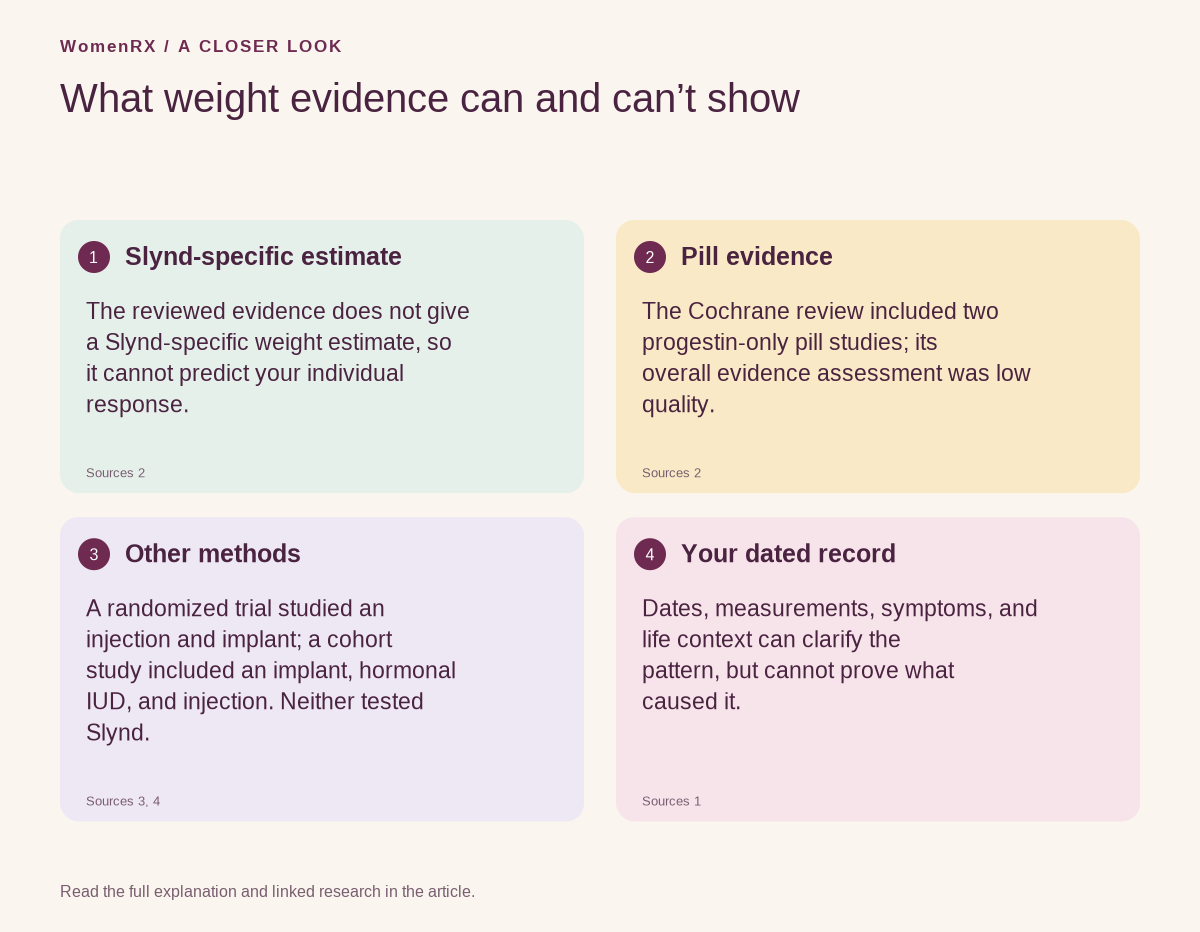
What weight evidence can and can’t show
Slynd-specific estimate: The reviewed evidence does not give a Slynd-specific weight estimate, so it cannot predict your individual response.2
Pill evidence: The Cochrane review included two progestin-only pill studies; its overall evidence assessment was low quality.2
Other methods: A randomized trial studied an injection and implant; a cohort study included an implant, hormonal IUD, and injection. Neither tested Slynd.34
Your dated record: Dates, measurements, symptoms, and life context can clarify the pattern, but cannot prove what caused it.1
Read the figure as text
Separate findings about other contraceptive methods from the personal timeline you can bring to a discussion about Slynd.- Slynd-specific estimate: The reviewed evidence does not give a Slynd-specific weight estimate, so it cannot predict your individual response.2
- Pill evidence: The Cochrane review included two progestin-only pill studies; its overall evidence assessment was low quality.2
- Other methods: A randomized trial studied an injection and implant; a cohort study included an implant, hormonal IUD, and injection. Neither tested Slynd.34
- Your dated record: Dates, measurements, symptoms, and life context can clarify the pattern, but cannot prove what caused it.1
More questions, answered
Can studies of the shot or implant predict what will happen on Slynd?
No. Those studies can describe the methods they tested, but their results don’t establish the effect of Slynd. The progestin-only methods review included only two pill studies and did not provide a Slynd-specific estimate. 2
Does a weight record prove that Slynd caused a change?
No. A record can help establish timing and show a pattern, but weight reflects several components and can vary for everyday reasons. It can support a discussion about possible causes without proving one. 1
Sources you can check
- Body Weight: MedlinePlusAccessed 2026-09-25Return to first citation
- Progestin-only contraceptives: effects on weight.Lopez LM, Ramesh S, Chen M, Edelman A, Otterness C, Trussell J, Helmerhorst FM. · The Cochrane database of systematic reviews · 2016Return to first citation
- Weight change at 12 months in users of three progestin-only contraceptive methods.Vickery Z, Madden T, Zhao Q, Secura GM, Allsworth JE, Peipert JF. · Contraception · 2013Return to first citation
- Weight change among women using intramuscular depot medroxyprogesterone acetate, a copper intrauterine device, or a levonorgestrel implant for contraception: Findings from a randomised, multicentre, open-label trial.Beksinska M, Issema R, Beesham I, Lalbahadur T, Thomas K, Morrison C, Hofmeyr GJ, Steyn PS, Mugo N, Palanee-Phillips T, Ahmed K, Nair G, Baeten JM, Smit J. · EClinicalMedicine · 2021Return to first citation