Opill and Weight: What the Evidence Can Tell You
A weight change while taking Opill doesn’t, by itself, show that the pill caused it.
Research on progestin-only contraception offers only limited clues about weight, and studies of other pill formulations or methods can’t establish what Opill does specifically. In the studies reviewed, most comparisons didn’t find a clear difference in weight change between contraceptive groups, though evidence quality was low. If you notice a persistent or sudden change, consider the timing and broader context before deciding what to do. 2
What the research says, and what it doesn’t
A 2016 Cochrane review included 22 studies and 11,450 women using different progestin-only methods, including pills, implants, injections, and hormonal IUDs. Most studies found no significant difference in weight change between contraceptive groups. The review judged the overall evidence low quality, in part because many studies weren’t randomized or had substantial participant drop-off. It also found that mean weight gain at six or 12 months was under 2 kg in most studies, but that figure describes study averages, not a prediction for any one person. 2
That review included only two studies of progestin-only pills. Its overall findings don’t tell us whether Opill, specifically, causes weight gain or weight loss. Evidence about injections, implants, or hormonal IUDs shouldn’t be treated as evidence about this particular pill: they are different methods, and results can’t simply be transferred from one to another. 2
For perspective, a randomized trial found different average weight changes over 12 to 18 months among women using an injectable, a levonorgestrel implant, or a copper IUD. Those results are useful for understanding those methods, but they don’t answer the question about Opill. 3
So the fairest conclusion is neither “Opill definitely causes weight gain” nor “Opill is weight-neutral.” The 2016 review doesn’t establish either claim for Opill. 2
Read your own trend, not one weigh-in
Body weight includes water, muscle, bone, and fat, and a scale can’t distinguish among them. A single reading may not reflect a lasting change. 1
If tracking feels useful, note when you started Opill and compare weights taken under similar conditions. Look for a sustained pattern rather than reading too much into one measurement. You can also jot down other changes happening around the same time, such as shifts in routine or life stage. If you’re postpartum or in perimenopause, record that as context; it doesn’t prove what caused a change.
This kind of record is not a diagnostic test. Its purpose is to give you a clearer account of timing and trend if you decide to ask about the change. You don’t have to track weight if doing so feels stressful or unhelpful.
When a change deserves attention
If your weight is changing without an obvious reason and the change persists, you can discuss it with a healthcare professional. A sudden, unexpected gain or loss is also a reason to seek advice, since it can sometimes signal a health problem. 1
Bring the practical question that matters most to you: whether the timing fits with starting Opill, what else could be contributing, and what contraceptive options would fit your needs if you want to switch. The evidence doesn’t let anyone identify the cause from timing alone, but a clear trend and context can make that conversation more useful.
If you’re considering stopping or changing contraception because of weight concerns, focus on finding an option that works for you rather than treating the weight change as proof of an Opill effect.
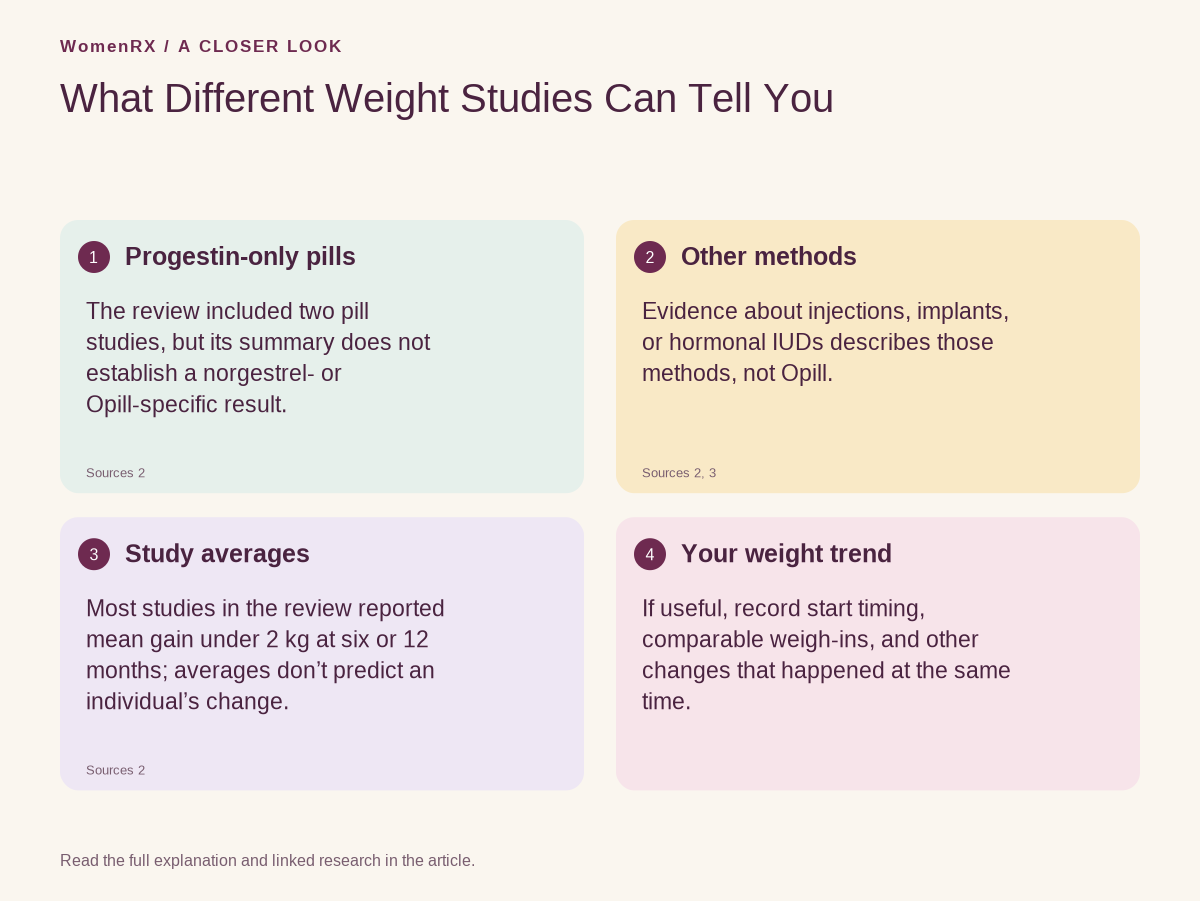
What Different Weight Studies Can Tell You
Progestin-only pills: The review included two pill studies, but its summary does not establish a norgestrel- or Opill-specific result.2
Other methods: Evidence about injections, implants, or hormonal IUDs describes those methods, not Opill.23
Study averages: Most studies in the review reported mean gain under 2 kg at six or 12 months; averages don’t predict an individual’s change.2
Your weight trend: If useful, record start timing, comparable weigh-ins, and other changes that happened at the same time.
Read the figure as text
These findings concern different methods and answer different questions; results from one method do not establish an Opill-specific effect.- Progestin-only pills: The review included two pill studies, but its summary does not establish a norgestrel- or Opill-specific result.2
- Other methods: Evidence about injections, implants, or hormonal IUDs describes those methods, not Opill.23
- Study averages: Most studies in the review reported mean gain under 2 kg at six or 12 months; averages don’t predict an individual’s change.2
- Your weight trend: If useful, record start timing, comparable weigh-ins, and other changes that happened at the same time.
More questions, answered
Does weight gain mean Opill is the cause?
No. A change that happens while you’re taking a pill doesn’t establish that the pill caused it. The 2016 Cochrane review found limited, low-quality evidence across progestin-only methods and doesn’t establish an Opill-specific effect. 2
Is the evidence about the shot or implant relevant to Opill?
It can provide context about other progestin-only methods, but it doesn’t establish what to expect from Opill. The methods differ, and the studies shouldn’t be treated as interchangeable. 23
Sources you can check
- Body Weight: MedlinePlusAccessed 2026-09-25Return to first citation
- Progestin-only contraceptives: effects on weight.Lopez LM, Ramesh S, Chen M, Edelman A, Otterness C, Trussell J, Helmerhorst FM. · The Cochrane database of systematic reviews · 2016Return to first citation
- Weight change among women using intramuscular depot medroxyprogesterone acetate, a copper intrauterine device, or a levonorgestrel implant for contraception: Findings from a randomised, multicentre, open-label trial.Beksinska M, Issema R, Beesham I, Lalbahadur T, Thomas K, Morrison C, Hofmeyr GJ, Steyn PS, Mugo N, Palanee-Phillips T, Ahmed K, Nair G, Baeten JM, Smit J. · EClinicalMedicine · 2021Return to first citation