Nonhormonal Birth Control Options If You’re Leaving Slynd
A copper IUD offers highly effective pregnancy prevention without hormones, while condoms and other nonhormonal methods give you more control from one use to the next.
Slynd is a progestin-only pill, so avoiding hormones means choosing a different kind of contraception. The copper IUD is the most effective nonhormonal option covered here; condoms, diaphragms, and fertility-awareness methods require more action from you and have different typical-use pregnancy rates. External latex condoms also help protect against STIs. Before stopping Slynd, decide what you’ll use during any gap in protection.456
Start with the trade-off you care about most
If your goal is to avoid hormones and make pregnancy as unlikely as possible, ask about the copper IUD. If you’d rather avoid a placement procedure or want a method you control each time you have sex, condoms may be a better fit. A diaphragm or fertility-awareness method is another nonhormonal choice, but each asks more of you in everyday use.56
Slynd contains the progestin drospirenone. In a US single-arm trial of the drospirenone-only pill, contraceptive effectiveness was assessed in nonbreastfeeding participants aged 35 or younger. That result isn’t a head-to-head comparison with the nonhormonal methods below, so use the method-specific typical-use figures for this decision rather than comparing the trial numbers directly.45
“Typical use” includes the way people actually use a method, not just how well it works under ideal conditions. The CDC figures below describe pregnancies during the first year among 100 people using each method. A lower number means fewer pregnancies, but the right choice also depends on whether you want STI protection, how you feel about a procedure, and what you can reliably use.5
If you want to stop thinking about contraception each time
The copper IUD is hormone-free and reversible. In the CDC’s typical-use figures, about 0.8 out of 100 users become pregnant in the first year. A clinician places it, and an exam and cervical inspection are needed beforehand. It doesn’t protect against STIs.56
Its main trade-off may be your period. Spotting, light bleeding, or heavier or longer bleeding is common in the first three to six months after placement and often decreases with continued use. If heavy periods are already a concern, bring that up before choosing it. Copper supplements are dietary supplements; the IUD’s pregnancy-prevention figure does not apply to them.35
A hormonal IUD such as Mirena or Kyleena is a different choice. Both contain levonorgestrel, so neither meets a goal of avoiding hormones altogether.12
If you want a method you use yourself
External condoms don’t require a placement visit. The CDC lists 13 pregnancies per 100 users in the first year of typical use. External latex condoms also help protect against HIV and other STIs, a benefit the copper IUD doesn’t provide. Condoms can slip or break, and latex can cause irritation or allergy for some people.567
Internal condoms are another hormone-free barrier option, with 21 pregnancies per 100 users in the first year of typical use in the CDC figures. They can irritate or slip out. The CDC’s guidance specifically identifies external latex condoms as helping protect against HIV and other STIs; don’t assume every barrier product offers the same protection.57
A diaphragm is used with spermicide. Its CDC typical-use figure is 17 pregnancies per 100 users in the first year. The spermicide and diaphragm can cause irritation or allergic reactions, and urinary tract infections are another possible downside. If spermicide tends to irritate you, that practical detail may matter as much as the pregnancy figure.57
Fertility-awareness methods are not one single method with one success rate. The CDC gives a broad range of 2 to 23 pregnancies per 100 users in the first year of typical use, depending on the method. That range shouldn’t be read as a promise that any app or calendar will perform at its lower end. If you’re considering this approach, ask which specific method you’d learn and how you’d prevent pregnancy on days when you might be fertile.5
The pregnancy figures above are for the named contraceptive methods, not for herbs, supplements, or withdrawal. They cannot tell you how well a product marketed as “natural birth control” prevents pregnancy. If you want a quantified typical-use figure, the CDC provides one for each of the contraceptive methods listed above.5
Make the change without an accidental gap
The decision isn’t only what to use after Slynd. It’s when the new method will be in place and what you’ll use until then. Before you stop the pill, ask: When can I rely on my chosen method, and do I need another method in the meantime? The answer depends on the method and your circumstances; don’t assume a scheduled IUD appointment already provides protection. If you’ve recently had sex without reliable contraception, say so when arranging care. The copper IUD can also be placed within five days of unprotected sex for emergency contraception.5
If you’ve recently given birth, the timing deserves its own conversation. A copper IUD can be considered postpartum, but placement soon after birth has a higher chance of expulsion than placement later. Breastfeeding can serve as temporary contraception only when all three conditions hold: you haven’t had a period since birth, you’re fully or nearly fully breastfeeding, and you’re under six months postpartum. Once any condition stops applying, another method is needed. Breastfeeding by itself isn’t a dependable transition plan.56
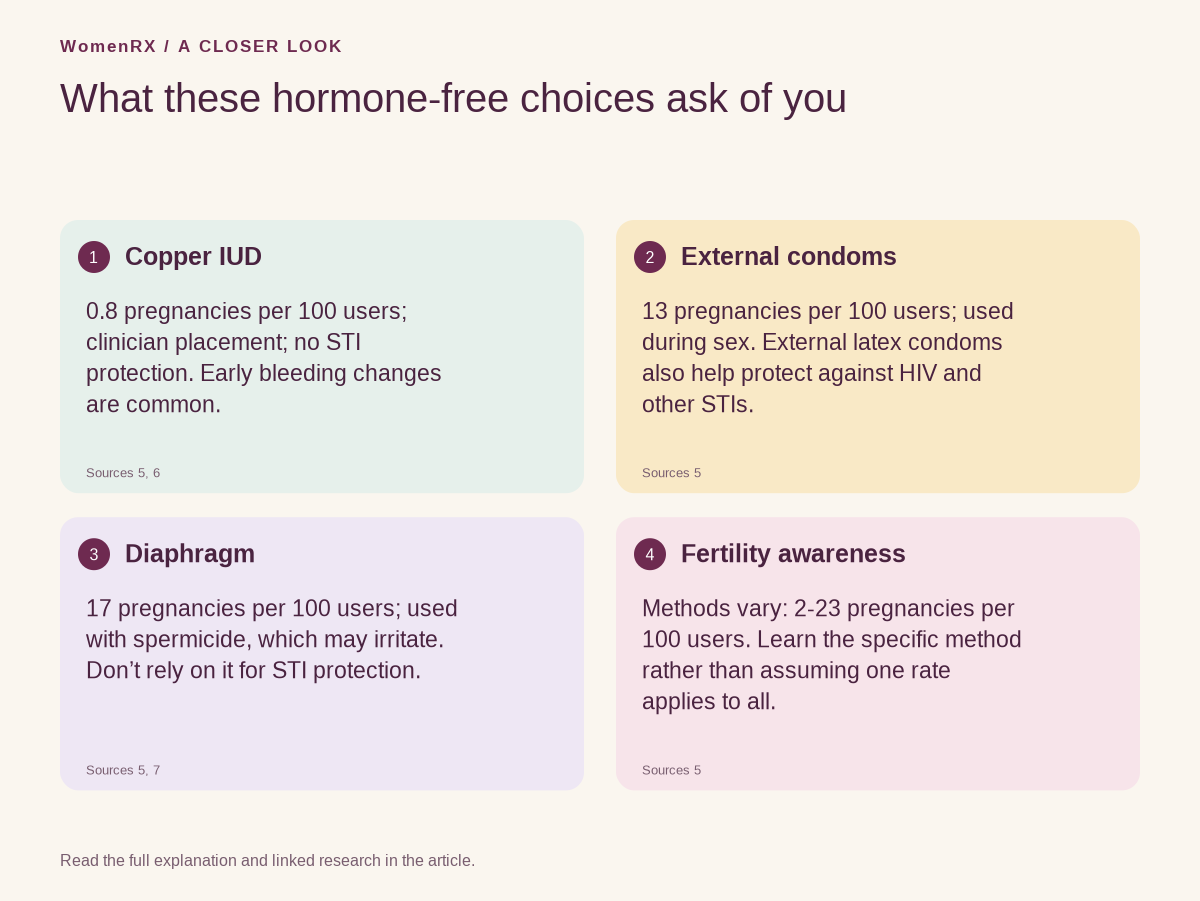
What these hormone-free choices ask of you
Copper IUD: 0.8 pregnancies per 100 users; clinician placement; no STI protection. Early bleeding changes are common.56
External condoms: 13 pregnancies per 100 users; used during sex. External latex condoms also help protect against HIV and other STIs.5
Diaphragm: 17 pregnancies per 100 users; used with spermicide, which may irritate. Don’t rely on it for STI protection.57
Fertility awareness: Methods vary: 2-23 pregnancies per 100 users. Learn the specific method rather than assuming one rate applies to all.5
Read the figure as text
Compare selected nonhormonal methods by first-year typical-use pregnancy figures, how each is used, and whether it offers STI protection.- Copper IUD: 0.8 pregnancies per 100 users; clinician placement; no STI protection. Early bleeding changes are common.56
- External condoms: 13 pregnancies per 100 users; used during sex. External latex condoms also help protect against HIV and other STIs.5
- Diaphragm: 17 pregnancies per 100 users; used with spermicide, which may irritate. Don’t rely on it for STI protection.57
- Fertility awareness: Methods vary: 2-23 pregnancies per 100 users. Learn the specific method rather than assuming one rate applies to all.5
Sources you can check
- MIRENA (LEVONORGESTREL) INTRAUTERINE DEVICE [BAYER HEALTHCARE PHARMACEUTICALS INC.] | US prescribing information and patient instructionsAccessed 2026-09-25Return to first citation
- KYLEENA (LEVONORGESTREL) INTRAUTERINE DEVICE [BAYER HEALTHCARE PHARMACEUTICALS INC.] | US prescribing information and patient instructionsAccessed 2026-09-25Return to first citation
- Copper - Health Professional Fact SheetAccessed 2026-09-25Return to first citation
- A 1-year prospective, open-label, single-arm, multicenter, phase 3 trial of the contraceptive efficacy and safety of the oral progestin-only pill drospirenone 4 mg using a 24/4-day regimen.Kimble T, Burke AE, Barnhart KT, Archer DF, Colli E, Westhoff CL. · Contraception: X · 2020Return to first citation
- CDC: Birth control methods, barrier methods, fertility awareness and breastfeedingAccessed 2026-09-25Return to first citation
- CDC: Intrauterine contraception and copper IUD bleedingAccessed 2026-09-25Return to first citation
- Office on Women's Health: Barrier contraception side effectsAccessed 2026-09-25Return to first citation