Which Nonhormonal Birth Control Fits Your Priorities?
A copper IUD offers strong pregnancy prevention without a task during sex, while condoms add STI protection and permanent methods call for a different decision about future pregnancy.
If you want to avoid hormones, start with what matters most: pregnancy prevention, STI protection, effort, or future pregnancy plans. The CDC reports typical-use failure figures of 0.8% for the copper IUD, 13% for external condoms, 21% for internal condoms, and 17% for the diaphragm. Fertility-awareness methods range from 2% to 23%. These figures are not all identified as first-year rates. 1
Start with the tradeoff you care about most
“Nonhormonal” describes a group of very different choices. A copper IUD stays in place without a task at each sexual encounter, but getting one requires a clinical visit. Condoms, a diaphragm, and spermicide depend on use when you have sex; choosing a diaphragm may also involve a visit to find the right size. Fertility-awareness methods vary in effectiveness. Sterilization is intended to be permanent. None is automatically the right answer just because it has no hormones. 135
Here’s the pregnancy-prevention comparison: the CDC reports typical-use failure figures of 0.8% for the copper IUD, 13% for external condoms, 21% for internal condoms, and 17% for the diaphragm. Its reported range across fertility-awareness methods is 2% to 23%, so a single number would be misleading. These are the CDC’s typical-use figures; its overview does not identify each one as a first-year rate. Separately, CDC clinical guidance says fewer than one in 100 IUD users becomes pregnant during the first year of typical use. 13
If pregnancy prevention with little ongoing effort comes first
The copper IUD is a highly effective option. A clinician places it in the uterus, and it’s reversible. It doesn’t protect against STIs, so condoms may still matter with a partner whose STI status is uncertain. 13
The main practical tradeoff to discuss is bleeding. Copper IUD users may have spotting or heavier or prolonged bleeding. If your periods are already difficult to manage, that possibility may weigh more heavily than the convenience of not doing anything at each sexual encounter. 3
Placement also takes a clinical visit. If you want an IUD but are concerned about the procedure, pain-management options are a reasonable part of that discussion. 3
If STI protection or control at each encounter comes first
External latex condoms help protect against HIV and other STIs as well as pregnancy. They can break or slip, and latex may cause irritation or an allergic reaction. Lambskin condoms may not provide the same STI protection. 14
Internal condoms are another nonhormonal barrier option. They can help prevent STIs. They can irritate or slip out. Unlike an IUD, condoms are used by you or your partner during sex rather than placed by a clinician. If STI protection is a deciding priority, the protection condoms can offer matters more than the shared “nonhormonal” label. 145
A diaphragm covers the cervix and is used with spermicide. It requires preparation when you have sex and attention to fit; diaphragms come in different sizes, so choosing one may involve a care visit. Diaphragms and spermicides can cause irritation or allergic reactions, and urinary tract infections are another possible concern. Most contraceptive methods don’t prevent STIs, so consider condom protection separately. 145
Spermicide can also be used on its own; the CDC reports a 21% typical-use failure figure for spermicides and vaginal pH regulators grouped together. Don’t assume that adding spermicide makes every barrier choice equally effective. Frequent spermicide use may increase the risk of acquiring HIV, a particularly relevant downside if STI exposure is possible. 14
If you’d rather avoid a device or barrier
Fertility-awareness methods differ in effectiveness, so don’t treat them as a single method with one pregnancy-prevention rate. If you’re considering this approach, compare the specific methods rather than assuming “cycle tracking” describes just one choice. If STI protection also matters, consider that priority separately; condoms can help protect against STIs. 1
Breastfeeding can temporarily prevent pregnancy under the lactational amenorrhea method, but only while all three conditions hold: you haven’t had a period since birth, you’re fully or nearly fully breastfeeding, and you’re under six months postpartum. Once any one condition no longer applies, another contraceptive method is needed. It’s a short-term postpartum option, not a general substitute for contraception whenever you’re nursing. 1
If you’re considering a permanent choice
Tubal sterilization prevents a woman from becoming pregnant; vasectomy prevents a male partner from getting someone pregnant. Both are surgical, permanent birth control options. The CDC reports typical-use failure figures of 0.5% for tubal surgery and 0.15% for vasectomy. Unlike tubal surgery, vasectomy does not provide immediate pregnancy protection: another method is needed until a follow-up sperm check confirms it’s working. If STI protection matters too, condoms can help address that separate priority. 15
Don’t treat “permanent” as a promise of a simple reversal later. If you’re unsure whether you may want another pregnancy, a reversible option such as the copper IUD deserves consideration alongside surgery. If you’re comparing the two permanent procedures, ask for procedure-specific information about recovery and risks rather than assuming those details are interchangeable. 35
After a birth, timing changes the IUD conversation
A copper IUD can be discussed as a postpartum option, but when it’s placed affects the chance it will come out. A systematic review of postpartum IUD studies found higher expulsion rates with placement soon after birth than with placement at a later visit; its estimates combined different IUD types and clinical circumstances. That’s a tradeoff between getting contraception in place promptly and the greater chance of expulsion, not a reason to rule out postpartum placement altogether. 23
One way to narrow your choices is to name your first priority, then your deal-breaker. For example, if avoiding pregnancy without thinking about contraception during sex matters most, the copper IUD may merit discussion, with bleeding and placement as the tradeoffs. If STI protection comes first, start with condoms even if you’re also considering another method for pregnancy prevention. If you’re certain your family is complete, include permanent options, but evaluate them as procedures rather than as versions of an IUD. 135
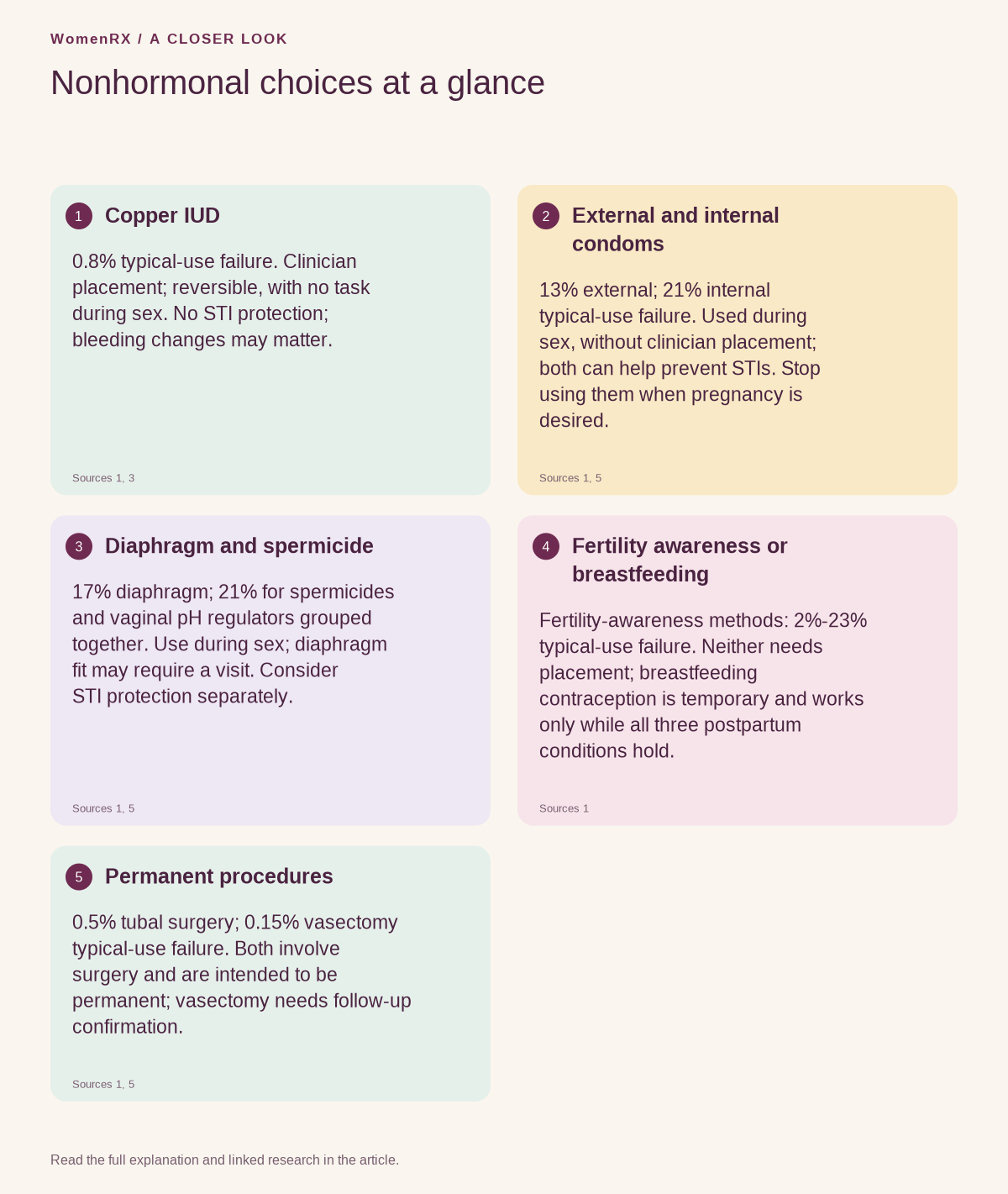
Nonhormonal choices at a glance
Copper IUD: 0.8% typical-use failure. Clinician placement; reversible, with no task during sex. No STI protection; bleeding changes may matter.13
External and internal condoms: 13% external; 21% internal typical-use failure. Used during sex, without clinician placement; both can help prevent STIs. Stop using them when pregnancy is desired.15
Diaphragm and spermicide: 17% diaphragm; 21% for spermicides and vaginal pH regulators grouped together. Use during sex; diaphragm fit may require a visit. Consider STI protection separately.15
Fertility awareness or breastfeeding: Fertility-awareness methods: 2%-23% typical-use failure. Neither needs placement; breastfeeding contraception is temporary and works only while all three postpartum conditions hold.1
Permanent procedures: 0.5% tubal surgery; 0.15% vasectomy typical-use failure. Both involve surgery and are intended to be permanent; vasectomy needs follow-up confirmation.15
Read the figure as text
These CDC-reported typical-use failure figures help compare pregnancy prevention; effort, access, STI protection, and future pregnancy plans may change your shortlist.- Copper IUD: 0.8% typical-use failure. Clinician placement; reversible, with no task during sex. No STI protection; bleeding changes may matter.13
- External and internal condoms: 13% external; 21% internal typical-use failure. Used during sex, without clinician placement; both can help prevent STIs. Stop using them when pregnancy is desired.15
- Diaphragm and spermicide: 17% diaphragm; 21% for spermicides and vaginal pH regulators grouped together. Use during sex; diaphragm fit may require a visit. Consider STI protection separately.15
- Fertility awareness or breastfeeding: Fertility-awareness methods: 2%-23% typical-use failure. Neither needs placement; breastfeeding contraception is temporary and works only while all three postpartum conditions hold.1
- Permanent procedures: 0.5% tubal surgery; 0.15% vasectomy typical-use failure. Both involve surgery and are intended to be permanent; vasectomy needs follow-up confirmation.15
More questions, answered
Can a copper IUD be used as emergency contraception?
Yes. A copper IUD can be placed within five days of unprotected sex for emergency contraception. Placement requires a clinician, so access to an appointment matters when time is short. 13
Sources you can check
- CDC: Birth control methods, barrier methods, fertility awareness and breastfeedingAccessed 2026-09-25Return to first citation
- Intrauterine Device Expulsion After Postpartum Placement: A Systematic Review and Meta-analysis.Jatlaoui TC, Whiteman MK, Jeng G, Tepper NK, Berry-Bibee E, Jamieson DJ, Marchbanks PA, Curtis KM. · Obstetrics and gynecology · 2018Return to first citation
- CDC: Intrauterine contraception and copper IUD bleedingAccessed 2026-09-25Return to first citation
- Office on Women's Health: Barrier contraception side effectsAccessed 2026-09-25Return to first citation
- Birth Control | Contraception | Contraceptives | MedlinePlusAccessed 2026-09-25Return to first citation