Birth Control Options: What Changes From Method to Method
The most useful comparison starts with what you’d need to do, how often you’d need to do it, and whether you also want STI protection.
Birth control ranges from methods used every time you have sex to scheduled hormonal methods, clinician-placed devices, and permanent procedures. A copper IUD has no hormones; the Nexplanon implant contains progestin and is labeled to last up to five years. Condoms offer something most other methods don’t: STI protection. Your routine, bleeding concerns, health history, and pregnancy plans matter too. 128
Start with the action each method asks of you
A useful first question is: When would I have to think about this method? A condom needs to be used each time you have sex. A pill needs a daily routine. An implant or IUD is placed by a clinician and then works without an action before sex. That difference helps explain why typical use, which accounts for real-life use rather than consistently correct use, matters when you compare pregnancy rates. 125
Placed once, reversible: The Nexplanon implant is a progestin-containing rod placed under the skin of the upper arm; its current US labeling says it can prevent pregnancy for up to five years. An IUD is placed in the uterus; options include hormonal IUDs and a hormone-free copper IUD. MedlinePlus broadly describes IUDs as lasting three to ten years, but the duration to check is the one for the specific device you’re considering. These devices can be removed if your plans change. IUDs and implants are among the most effective reversible methods, but neither protects against STIs. 2578
Used on a schedule: Pills may contain progestin alone or both estrogen and progestin, and are taken daily. A patch releases hormones and is changed weekly. MedlinePlus describes a vaginal ring used for three weeks, then removed for one week, and an injection repeated every three months. These choices avoid a procedure to place a device, but keeping up with the schedule is part of using them effectively. Check the instructions for the specific product rather than assuming every ring or injection follows the same schedule. 25
Used with sex: External and internal condoms act as barriers. A diaphragm or cervical cap covers the cervix; diaphragms are used with spermicide. Other options include a contraceptive sponge and spermicide on its own. Condoms stand apart here because they can also reduce STI risk. Latex and polyurethane condoms can help protect against STIs, although protection isn’t absolute; lambskin condoms may not provide the same protection. Condoms can slip or break, and barrier products or spermicides can cause irritation for some people. 1236
Based on fertility signs or timing: Fertility-awareness methods involve identifying fertile days and avoiding sex or using a barrier on those days. Withdrawal means withdrawing the penis before ejaculation, but sperm can enter the vagina before withdrawal is complete. Neither is a single, set-and-forget method: fertility awareness covers several approaches with different typical-use pregnancy rates. 12
Intended to be permanent: Tubal ligation is surgery intended to prevent pregnancy permanently; a partner’s vasectomy is another permanent option. These belong in a different conversation from removable contraception if you might want a pregnancy later. 2
If sex has already happened without contraception, emergency contraception is a separate, time-sensitive question. A copper IUD can be placed within five days of unprotected sex as emergency contraception. 1
Effectiveness is only one part of the comparison
The CDC’s typical-use failure estimates show meaningful differences among methods used with sex: 13% for external condoms, 21% for internal condoms, and 17% for diaphragms. Its estimate for the copper IUD is 0.8%. Fertility-awareness methods have a range of estimates, 2% to 23%, not one rate that applies to every approach. These are estimates of pregnancy with typical use, not measures of STI protection. 1
The comparison has a boundary: those figures don’t give you a like-for-like number for every option. IUDs and implants are the most effective reversible method groups, and CDC guidance says fewer than one in 100 IUD users becomes pregnant during the first year of typical use. Pills, patches, rings, and injections instead require actions on a schedule. That tells you something practical about missed use, but it doesn’t establish one shared pregnancy rate for those four methods or a ranking among them. The table below makes the routine visible without pretending its categories are a complete effectiveness chart. 257
That doesn’t make a condom a poor choice. It answers a second question. If STI protection matters to you, a condom can be used alongside a pregnancy-prevention method that better fits your routine. Most contraceptive methods do not prevent STIs. 13
Bleeding can matter just as much as convenience, and the best-supported comparisons here are specific to devices, not every method group. Spotting or heavier or longer bleeding is common during the first three to six months after copper IUD placement and often decreases with continued use. Changes in menstrual bleeding are also a leading reason people stop using the Nexplanon implant; that doesn’t tell you what your own pattern would be. “No added hormones” doesn’t mean “no possible side effects”: condoms, diaphragms, and spermicides can cause irritation, too. If bleeding is a deciding factor, ask about the expected pattern for the specific method or product you’re considering rather than assuming all IUDs or all hormonal methods feel alike. 678
What changes after childbirth or while breastfeeding?
Breastfeeding can work as temporary contraception through the lactational amenorrhea method, but all three conditions must hold: you have had no menstrual period since birth, you are fully or nearly fully breastfeeding, and you are less than six months postpartum. Once any condition no longer applies, another contraceptive method is needed if you want to avoid pregnancy. 1
An IUD may be placed after childbirth, but timing affects the trade-off. Postpartum IUD placement has a higher chance of the device coming out than placement later on. For the levonorgestrel IUD Mirena specifically, its prescribing information describes both placement immediately after delivery and later placement after the uterus has returned to its usual size. It also says Mirena provides no contraceptive protection if it is displaced or expelled. Nexplanon has different product-specific timing: its US instructions say not to place it until after the fourth postpartum week when breastfeeding. 478
Put the trade-offs side by side
| Method group | Action and duration | Hormones, bleeding, and effectiveness | Reversibility and STI protection |
|---|---|---|---|
| Implant or IUD | Clinician-placed. Nexplanon is labeled for up to five years; MedlinePlus broadly describes IUDs as lasting three to ten years. Check the specific device. 28 | Nexplanon contains progestin; IUDs come in hormonal and copper forms. These are among the most effective reversible choices. Fewer than one in 100 IUD users becomes pregnant during the first year of typical use. Irregular bleeding is a leading reason people stop Nexplanon; copper IUDs can cause heavier or longer bleeding at first. These patterns aren’t interchangeable. 2578 | Removable; no STI protection. 127 |
| Pill, patch, ring, or injection | Pill daily; patch weekly; the ring described by MedlinePlus three weeks in and one week out; injection every three months. Check the specific product’s schedule. 2 | Hormonal. Staying on schedule matters to effectiveness; these methods don’t have one shared typical-use rate. This group is too broad to assign one expected bleeding pattern. 25 | Not intended to be permanent; no STI protection from the method itself. 12 |
| Condoms and other barriers | Used with sex; protection depends on using the method each time. 12 | No hormonal release. CDC typical-use failure estimates are 13% for external condoms, 21% for internal condoms, and 17% for diaphragms. Irritation is possible with some barrier products or spermicides. 16 | You can stop using them, but you need another plan if you still want pregnancy prevention. Condoms can also reduce STI risk; the other barriers listed here are not substitutes for condoms for that purpose. 123 |
| Fertility awareness or withdrawal | Requires attention to fertile days or action during sex. 12 | No added hormones. CDC typical-use failure estimates for fertility-awareness methods range from 2% to 23% across approaches; withdrawal is a different method. 12 | Can be stopped; neither provides STI protection. 12 |
| Sterilization | A procedure rather than an ongoing routine. 2 | This is a permanent-choice comparison, not a bleeding-treatment comparison. 2 | Intended to be permanent; does not replace condoms for STI protection. 12 |
If you’re comparing specific devices, add each product’s current duration and expected bleeding pattern to this table. The broad IUD duration above isn’t a substitute for product details, and neither the table nor the effectiveness estimates predict your personal bleeding experience. 278
Which health and practical details can change the choice?
Preferences such as avoiding a daily task matter, but they’re different from questions about whether a particular method fits your health history or can be placed now:
- Have you had breast cancer, a blood clot, a liver tumor or active liver disease, or undiagnosed abnormal uterine bleeding? Nexplanon’s labeling lists a current or past history of thrombosis or thromboembolic disorders, liver tumors or active liver disease, undiagnosed abnormal uterine bleeding, and known or suspected breast cancer or a personal history of breast cancer among reasons it should not be used. That’s a reason to compare specific methods, not to assume the same restriction applies to every hormonal option or to a copper IUD. Pills also come in estrogen-plus-progestin and progestin-only forms; they shouldn’t be treated as one interchangeable choice. 28
- Could you be pregnant, or have you recently given birth? Pregnancy status matters before Mirena placement. After childbirth, IUD placement timing changes the chance of expulsion. Those are placement and timing questions, not a reason to assume every method has the same restrictions. 47
- If you’re breastfeeding, have periods returned, and how fully are you breastfeeding? Those answers determine whether breastfeeding meets the conditions for temporary lactational amenorrhea contraception. They don’t, by themselves, settle which other method to choose. 1
- Have you had irritation or an allergy with a barrier product? A latex reaction may make a latex condom a poor fit, while diaphragms and spermicides can cause reactions too. Polyurethane condoms are another option for someone allergic to latex. 36
- Has heavy or prolonged bleeding started after you were already using a copper IUD? That differs from bleeding soon after placement and may need assessment for another cause, including device displacement. 7
These questions can change a choice that looks straightforward on a comparison chart. They aren’t a complete medical-eligibility screen. The useful next comparison is between the specific methods that meet your needs, not a search for one method that wins every category.
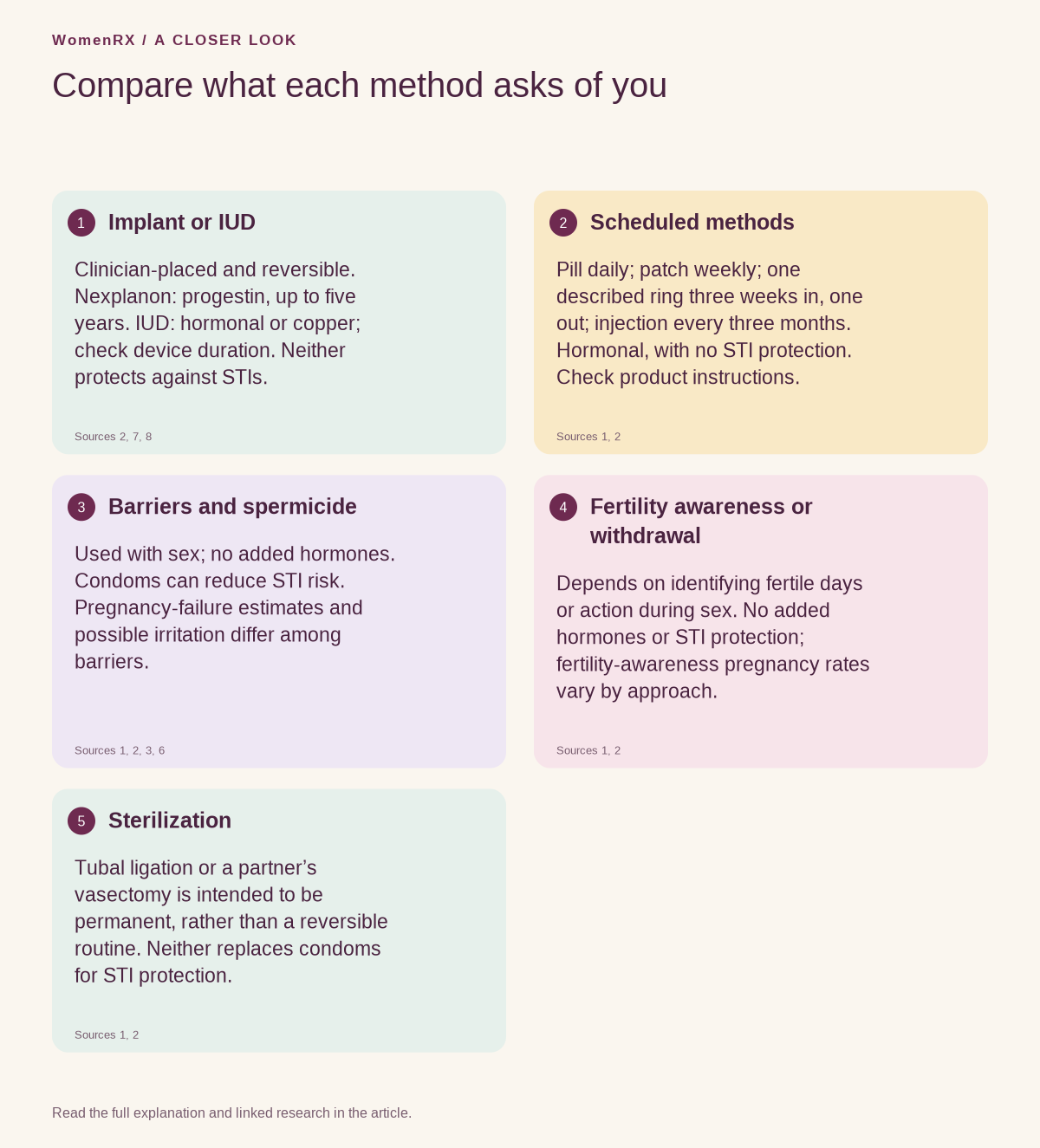
Compare what each method asks of you
Implant or IUD: Clinician-placed and reversible. Nexplanon: progestin, up to five years. IUD: hormonal or copper; check device duration. Neither protects against STIs.278
Scheduled methods: Pill daily; patch weekly; one described ring three weeks in, one out; injection every three months. Hormonal, with no STI protection. Check product instructions.12
Barriers and spermicide: Used with sex; no added hormones. Condoms can reduce STI risk. Pregnancy-failure estimates and possible irritation differ among barriers.1236
Fertility awareness or withdrawal: Depends on identifying fertile days or action during sex. No added hormones or STI protection; fertility-awareness pregnancy rates vary by approach.12
Sterilization: Tubal ligation or a partner’s vasectomy is intended to be permanent, rather than a reversible routine. Neither replaces condoms for STI protection.12
Read the figure as text
Scan the action, schedule or duration, hormone distinction, and STI protection; the article’s table adds available effectiveness figures, bleeding considerations, and reversibility.- Implant or IUD: Clinician-placed and reversible. Nexplanon: progestin, up to five years. IUD: hormonal or copper; check device duration. Neither protects against STIs.278
- Scheduled methods: Pill daily; patch weekly; one described ring three weeks in, one out; injection every three months. Hormonal, with no STI protection. Check product instructions.12
- Barriers and spermicide: Used with sex; no added hormones. Condoms can reduce STI risk. Pregnancy-failure estimates and possible irritation differ among barriers.1236
- Fertility awareness or withdrawal: Depends on identifying fertile days or action during sex. No added hormones or STI protection; fertility-awareness pregnancy rates vary by approach.12
- Sterilization: Tubal ligation or a partner’s vasectomy is intended to be permanent, rather than a reversible routine. Neither replaces condoms for STI protection.12
More questions, answered
Does an IUD protect against sexually transmitted infections?
No. Neither a copper nor a hormonal IUD protects against STIs. If you need STI protection as well as pregnancy prevention, condoms can be part of the plan. 137
Does “hormone-free” mean a method has no side effects?
No. For example, copper IUD users may have spotting or heavier or longer bleeding, especially in the first three to six months. Condoms and spermicides can cause irritation for some people. 67
Sources you can check
- CDC: Birth control methods, barrier methods, fertility awareness and breastfeedingAccessed 2026-09-25Return to first citation
- Birth Control | Contraception | Contraceptives | MedlinePlusAccessed 2026-09-25Return to first citation
- Sexually Transmitted Infections | MedlinePlusAccessed 2026-09-25Return to first citation
- MIRENA (LEVONORGESTREL) INTRAUTERINE DEVICE [BAYER HEALTHCARE PHARMACEUTICALS INC.] | US prescribing information and patient instructionsAccessed 2026-09-25Return to first citation
- Canadian Contraception Consensus (Part 2 of 4).Black A, Guilbert E, Co-Authors, Costescu D, Dunn S, Fisher W, Kives S, Mirosh M, Norman WV, Pymar H, Reid R, Roy G, Varto H, Waddington A, Wagner MS, Whelan AM, Special Contributo... · Journal of obstetrics and gynaecology Canada : JOGC = Journal d'obstetrique et gynecologie du Canada : JOGC · 2015Return to first citation
- Office on Women's Health: Barrier contraception side effectsAccessed 2026-09-25Return to first citation
- CDC: Intrauterine contraception and copper IUD bleedingAccessed 2026-09-25Return to first citation
- NEXPLANON etonogestrel implantAccessed 2026-09-25Return to first citation