What Changes Might You Notice After Starting Slynd?
Spotting or a missed period may be the most noticeable change, but neither follows a set schedule.
After starting Slynd, you may notice spotting between expected periods, a change in when you bleed, or no bleeding at all. Irregular bleeding is especially common in the first three months and may lessen over time, though that isn’t guaranteed. Headache, acne, breast discomfort, nausea, and weight increase were also reported in trials; none is a change you should expect to happen. 2

Bleeding is the change to expect some uncertainty around
Slynd is a drospirenone-only birth control pill, not a combined pill containing estrogen. That distinction matters when you’re reading about someone else’s “before and after”: a study of a pill that combines drospirenone with estrogen cannot tell you what your bleeding will look like on Slynd. 2
With Slynd, you might spot between expected periods, bleed during a different part of the pack than you anticipated, or miss a scheduled bleed. Irregular bleeding and spotting are especially common during the first three months. They may settle with time, but you don’t need to see steady improvement each month for your experience to be real. 2
The trials show the range more clearly than a single testimonial could. In adult trial diaries, unscheduled bleeding or spotting was recorded by 1,337 of 2,178 participants with data in cycle 1 (61.4%), 703 of 1,482 in cycle 6 (47.4%), and 282 of 700 in cycle 13 (40.3%). Scheduled bleeding or spotting also became less common across those cycles. These are snapshots of groups with different numbers of participants contributing data, not a timeline that predicts when your spotting will stop. 2
A separate phase III study found that 3.7% of women taking drospirenone-only pills stopped treatment because of abnormal bleeding, compared with 7.3% taking a different progestin-only pill, desogestrel. That comparison offers context, not a promise that bleeding will be easy to live with: what matters is how disruptive it is for you. 1
Other changes: possible, not promised
In four pooled Slynd studies, reported adverse reactions included acne (3.8% of 2,598 participants), headache (2.7%), breast pain (2.2%), weight increase (1.9%), and nausea (1.8%). These figures describe what was reported during treatment. They don’t mean that Slynd will cause any one of these changes in you, or that it will reliably improve your skin or change your weight in either direction. 2
It can help to separate a new symptom from a conclusion about its cause. For example, if headaches begin after you start Slynd, their timing is worth noticing, but timing alone won’t establish why they’re happening. If a symptom is persistent or bothersome, discuss it with your prescriber rather than feeling you have to wait for a particular cycle. Depression also deserves attention: the product information says evidence linking progestin-only contraception to the onset or worsening of depression is limited, and calls for close observation if you have a history of it. 2
Age and life stage change the context, not the rules for your body. In an adolescent Slynd study described in the product information, scheduled bleeding became less common over time, while the proportion reporting unscheduled bleeding or spotting was similar in cycle 1 and cycle 13. Adult averages therefore shouldn’t be treated as a universal pattern. If you’re postpartum or approaching menopause, the adult trial figures still can’t forecast your individual bleeding pattern. 2
When a change needs more than watching
Contact your prescriber about bleeding that continues to trouble you or starts again after your cycles had become regular. Bleeding can change on Slynd, but persistent or newly occurring irregular bleeding may need assessment for another cause, including pregnancy. If you miss a period after not taking your pills as directed, or miss two periods in a row despite taking them as directed, ask about a pregnancy check. If you have severe abdominal pain while taking Slynd, call your healthcare provider or go to a hospital emergency room right away, even if you think pregnancy is unlikely. A pregnancy on Slynd could be ectopic. 2
Get urgent help for severe chest pain, sudden severe shortness of breath, a sudden severe headache unlike your usual headaches, sudden vision changes, trouble speaking, or leg pain that won’t go away. These are warning symptoms listed in Slynd’s patient information. Seek immediate help for thoughts of harming yourself, too. You don’t need to decide whether Slynd caused a symptom before getting help. 2
There’s one less visible issue to check: drospirenone can raise potassium in people at increased risk. Slynd’s product information says not to take it if you have kidney, liver, or adrenal disease; if one of these conditions develops while you’re taking it, stop Slynd and contact your healthcare provider. If you take a daily, long-term medicine that can raise potassium, the product information calls for a potassium blood test before starting Slynd and during the first treatment cycle. It also calls for consideration of potassium monitoring with long-term use of certain interacting medicines, including the antifungals ketoconazole and itraconazole and the antibiotic clarithromycin. If you have palpitations or an irregular heartbeat, call your healthcare provider or go to a hospital emergency room right away. 2
A useful way to judge the change isn’t whether your first month resembles anyone else’s. Notice whether bleeding is becoming manageable for you, whether a new symptom is interfering with daily life, and whether any of the warning signs above call for care now.
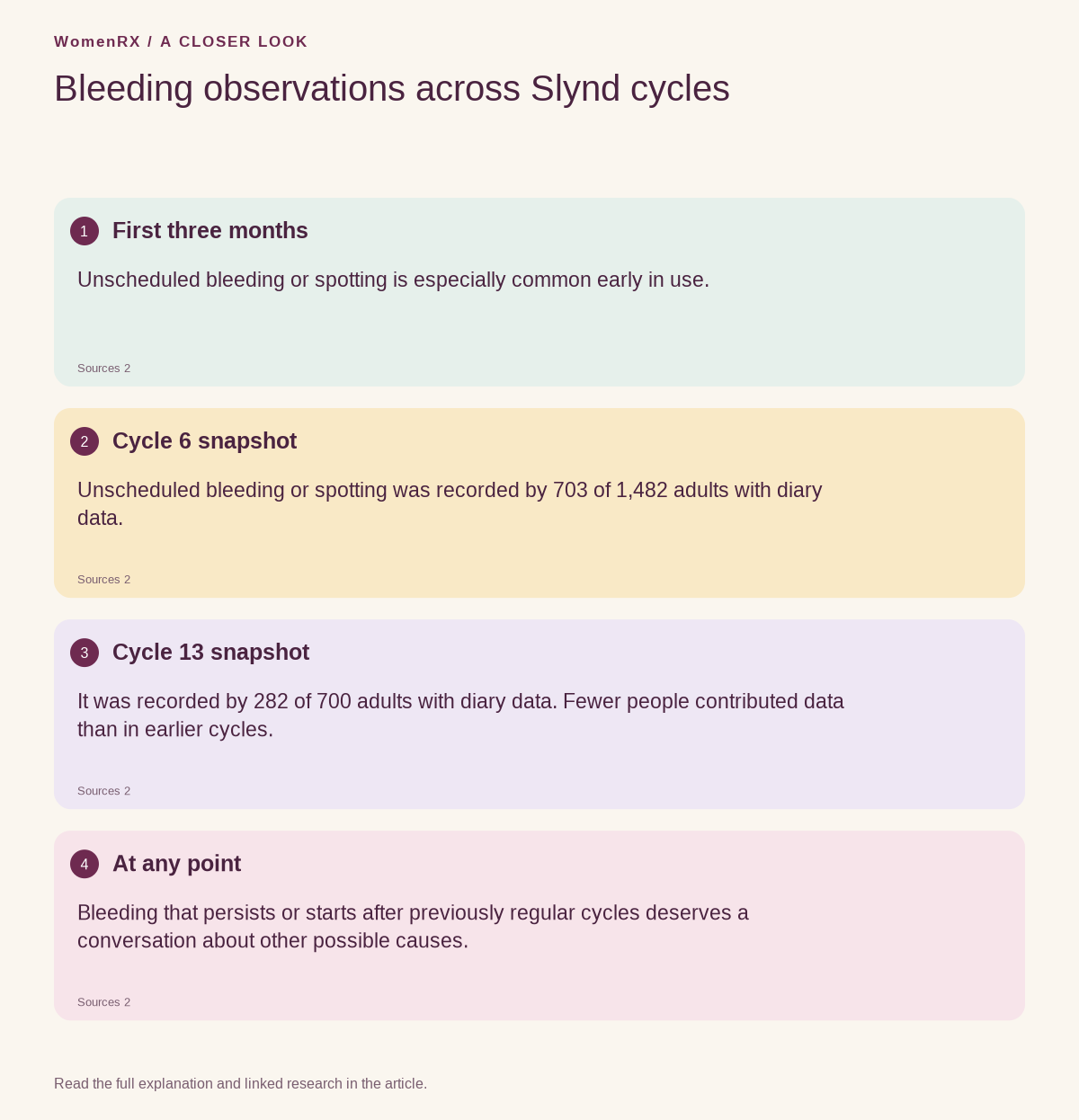
Bleeding observations across Slynd cycles
First three months: Unscheduled bleeding or spotting is especially common early in use.2
Cycle 6 snapshot: Unscheduled bleeding or spotting was recorded by 703 of 1,482 adults with diary data.2
Cycle 13 snapshot: It was recorded by 282 of 700 adults with diary data. Fewer people contributed data than in earlier cycles.2
At any point: Bleeding that persists or starts after previously regular cycles deserves a conversation about other possible causes.2
Read the figure as text
Trial results provide context for changes over time, not a schedule your body has to follow.- First three months: Unscheduled bleeding or spotting is especially common early in use.2
- Cycle 6 snapshot: Unscheduled bleeding or spotting was recorded by 703 of 1,482 adults with diary data.2
- Cycle 13 snapshot: It was recorded by 282 of 700 adults with diary data. Fewer people contributed data than in earlier cycles.2
- At any point: Bleeding that persists or starts after previously regular cycles deserves a conversation about other possible causes.2
More questions, answered
Does missing a period mean Slynd has stopped working?
No. Some people miss scheduled bleeding while taking Slynd. Pregnancy does need to be considered if you missed a period after not taking the pills as directed, or if you miss two consecutive periods despite taking them as directed. 2
Should I expect Slynd to clear my acne?
No. Acne was reported by 98 of 2,598 participants (3.8%) in four pooled Slynd studies. That doesn’t predict what will happen to your skin or establish Slynd as an acne treatment. 2
Sources you can check
- Overall and bleeding-related discontinuation rates of a new oral contraceptive containing 4 mg drospirenone only in a 24/4 regimen and comparison to 0.075 mg desogestrel.Regidor PA, Colli E, Palacios S. · Gynecological endocrinology : the official journal of the International Society of Gynecological Endocrinology · 2021Return to first citation
- SLYND drospirenone tablets, ExeltisAccessed 2026-09-25Return to first citation