Slynd: How It Works and Who Might Consider It
Slynd prevents pregnancy mainly by stopping ovulation, but its daily routine, bleeding changes, and health considerations determine whether it fits your life.
Slynd is a drospirenone-only birth control pill that prevents pregnancy primarily by suppressing ovulation. Its pack has 24 active pills and four inactive pills, and you take a pill every day. It may be worth considering if you want a pill without estrogen, but irregular bleeding, certain health conditions, and medication interactions can change the decision. 12
What Slynd does, and what it doesn’t
Slynd contains drospirenone, a progestin, without estrogen. It lowers the chance of pregnancy mainly by stopping the ovary from releasing an egg. That’s a useful distinction from some other progestin-only pills: norethindrone and norgestrel pills don’t consistently stop ovulation, while ovulation suppression is Slynd’s primary mechanism. A drospirenone-only pill is also different from a combined pill that contains drospirenone and an estrogen. 12
Slynd is a contraceptive, not a treatment for every menstrual or hormonal concern. If you’re hoping a pill will reliably make bleeding predictable, its bleeding pattern deserves as much attention as its lack of estrogen. 1
The daily routine is part of the choice
Each Slynd pack contains 24 white pills with hormone, followed by four green pills without hormone. The instructions say to take a pill at the same time every day, in pack order, and to begin the next pack after the green pills, whether or not you’re bleeding. The four inactive pills are part of a continuous daily routine, not a four-day break from taking pills. 1
There’s some room for an occasional late active pill, but not unlimited room. Slynd’s instructions say that missing one white pill does not require backup contraception; missing two or more calls for nonhormonal backup if you have sex during the first seven days afterward. Missing a green inactive pill does not have the same consequence. Frequent missed pills are a different matter: inconsistent use is a major reason oral contraception fails. If remembering a daily pill is routinely difficult, a method that doesn’t depend on daily action may fit better. 12
Starting also needs its own plan. CDC guidance for drospirenone-only pills allows starting or switching without waiting for the next period when pregnancy can reasonably be ruled out, but whether backup contraception is needed depends on the timing and the method you’re leaving. This is especially worth sorting out before an IUD is removed or when starting postpartum. 2
Expect the possibility of unpredictable bleeding
Spotting or bleeding between expected periods is common, particularly early on. Some people have no bleeding. In Slynd’s adult bleeding study, the proportion reporting unscheduled bleeding or spotting was lower by cycle 13 than in cycle 1, but it had not disappeared, and fewer participants had bleeding data at the later cycle. That pattern can’t tell you exactly what your own periods will do. 1
Consider what matters most to you: avoiding estrogen, having a pill you control yourself, or knowing when bleeding is likely to happen. Slynd may meet the first two preferences without meeting the third. Nausea can also occur, especially during the first few months. If bleeding persists or begins after your cycles had become regular, it deserves evaluation rather than an assumption that it’s just the pill. 1
When “no estrogen” isn’t the whole safety answer
Being progestin-only does not make Slynd suitable for everyone. Its drospirenone can raise potassium in people at higher risk. The product labeling lists kidney impairment, adrenal insufficiency, liver impairment or liver tumors, a history of certain cancers, and unexplained abnormal uterine bleeding among reasons not to use it. These aren’t details to guess about if one applies to you. 1
Medication review matters for two different reasons. Medicines that can raise potassium, such as spironolactone and some blood-pressure medicines, may call for potassium monitoring with Slynd. Other medicines or products, including carbamazepine, rifampin, and St. John’s wort, can reduce hormonal contraceptive effectiveness. They don’t all create the same problem, so a current medication and supplement list is more useful than a general question about whether anything “interacts with the pill.” 1
The label says it is unknown whether drospirenone alone increases the risk of a blood clot. It also calls for attention to the clotting risk already present in the postpartum period and for people with a history of thromboembolism. Avoiding estrogen is a meaningful feature, but it isn’t a substitute for considering your own history. 1
What if you’re breastfeeding?
Breastfeeding can be a reason to ask about a progestin-only option, not an automatic reason to choose Slynd. Its labeling reports that small amounts of drospirenone enter breast milk and that effects on breastfed infants aren’t anticipated at therapeutic use. In general, adverse effects on milk production or infant health have not been found with progestin-only pills. 1
The timing still matters. CDC guidance has specific backup-contraception recommendations for starting a drospirenone-only pill postpartum, which vary with factors such as whether periods have returned and whether breastfeeding is full or nearly full. Before relying on Slynd after birth, make sure you know when your contraception starts providing protection in your situation. 2
Slynd is most worth a closer look if you want an estrogen-free pill and can work a daily pack into your life. The deciding questions are concrete: How much would unpredictable bleeding bother you? Do any of your conditions or medicines affect its safety or effectiveness? And, if you’re switching methods or postpartum, what protection do you need while starting? 12
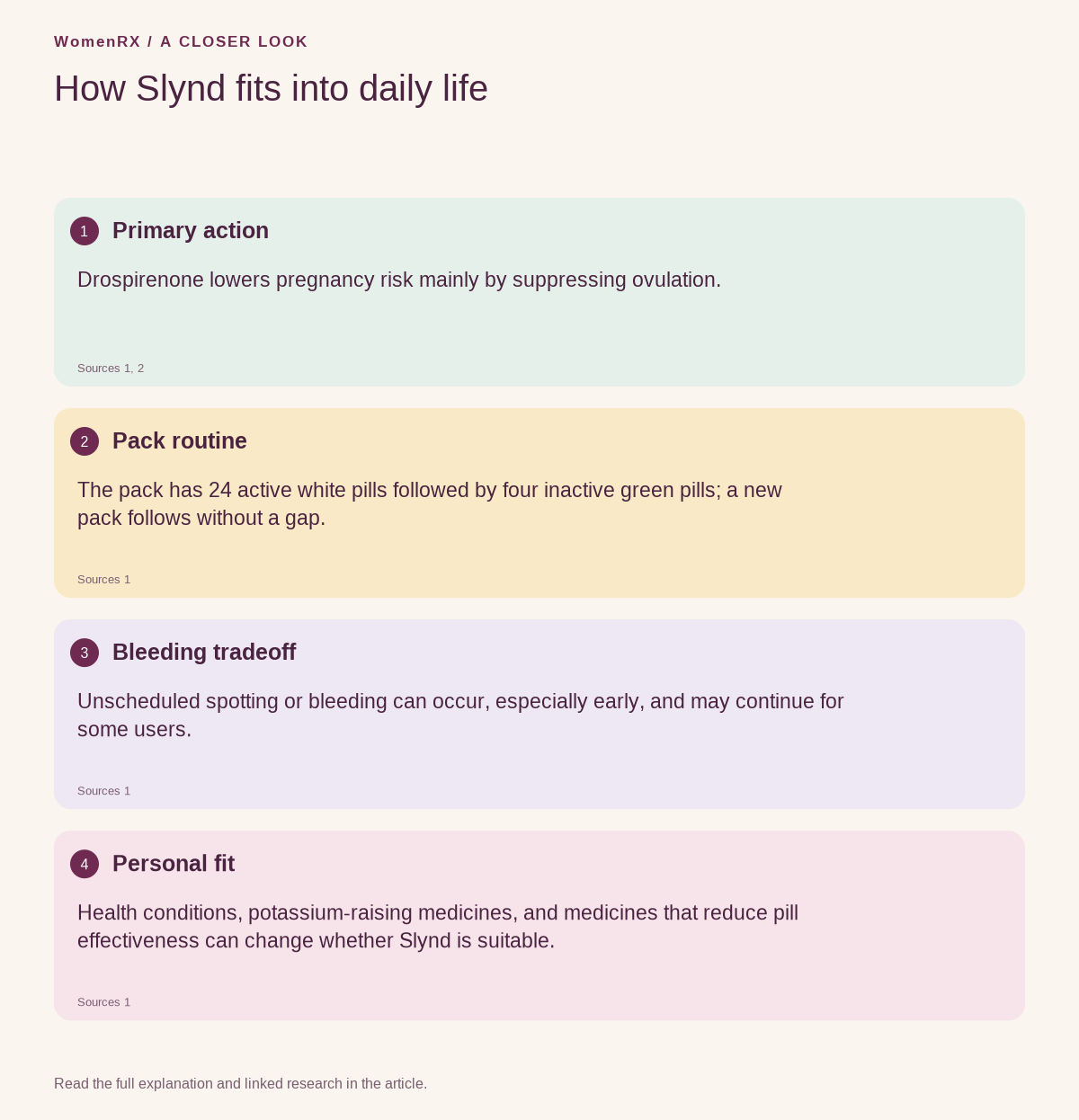
How Slynd fits into daily life
Primary action: Drospirenone lowers pregnancy risk mainly by suppressing ovulation.12
Pack routine: The pack has 24 active white pills followed by four inactive green pills; a new pack follows without a gap.1
Bleeding tradeoff: Unscheduled spotting or bleeding can occur, especially early, and may continue for some users.1
Personal fit: Health conditions, potassium-raising medicines, and medicines that reduce pill effectiveness can change whether Slynd is suitable.1
Read the figure as text
Follow the contraceptive action through the pill-pack routine, then consider the two factors that most often change its practical fit.- Primary action: Drospirenone lowers pregnancy risk mainly by suppressing ovulation.12
- Pack routine: The pack has 24 active white pills followed by four inactive green pills; a new pack follows without a gap.1
- Bleeding tradeoff: Unscheduled spotting or bleeding can occur, especially early, and may continue for some users.1
- Personal fit: Health conditions, potassium-raising medicines, and medicines that reduce pill effectiveness can change whether Slynd is suitable.1
Sources you can check
- SLYND drospirenone tablets, ExeltisAccessed 2026-09-25Return to first citation
- Progestin-Only Pills | Contraception | CDCAccessed 2026-09-25Return to first citation