Who Might Consider Flibanserin for Low Sexual Desire?
Flibanserin may be an option when low desire is acquired, widespread across situations, and distressing, but the diagnosis, likely benefit, and safety fit all matter.
Flibanserin is indicated for women younger than 65 with acquired, generalized low sexual desire that causes marked distress or relationship difficulty and isn’t explained by a medical or psychiatric condition, relationship problems, or a medication or other substance. Its strongest efficacy evidence is in premenopausal women. Average trial improvements over placebo were modest; dizziness, sleepiness, and low blood pressure are safety considerations. Current medicines and alcohol use belong in the discussion. 2 5 6
Start with what the low desire is like
Low desire by itself doesn’t establish hypoactive sexual desire disorder (HSDD). The relevant pattern is a change from a person’s previous level of desire that persists, occurs across situations or partners, and causes marked personal distress or relationship difficulty. The US indication also excludes low desire due to a co-existing medical or psychiatric condition, relationship problems, or the effects of a medication or other substance. 2
That distinction matters because desire can be affected by health conditions and medicines, as well as by circumstances in a relationship. For example, if desire changed after starting a medication, or mainly changes with a particular relationship situation, it’s worth exploring that connection rather than assuming a desire disorder is the whole explanation. 1 2
The pivotal trials enrolled premenopausal women whose acquired, generalized HSDD had lasted at least six months. That describes the research population, not a stand-alone self-diagnosis test. 2
What benefit did studies find?
In a pooled analysis of three 24-week, placebo-controlled trials involving 2,465 premenopausal women, the average number of satisfying sexual events increased by 2.1 per 28 days from baseline with flibanserin and by 1.2 with placebo. The difference in average change was 0.9 events per 28 days. Desire and distress scores also improved more on average with flibanserin, though the differences between groups were smaller than the changes within each group. These are group averages, not a prediction of what one person will experience. 5
The trial program used several measures, including satisfying sexual events, reported desire, and distress. A review noted that some trial measures may not fit the experience of HSDD as well as measures of persistent low desire and related distress. That’s a useful reason to keep expectations grounded: treatment is not a guarantee of a particular level of desire or a particular number of sexual encounters. 2 3
Age and menopause change how to read the evidence
The current US indication covers women younger than 65, but the efficacy evidence described in the prescribing information comes from trials in premenopausal women. A separate open-label safety study included naturally postmenopausal women, but it ended early, had no placebo group, and was not designed to establish comparative benefit. Safety observations from that study shouldn’t be treated as proof of equal efficacy after menopause. 2 4
So if you’re postmenopausal, age eligibility and strength of benefit evidence are different questions. A clinician can help weigh the fit for your situation without treating evidence from premenopausal trials as if it answered every life-stage question.
Make safety part of the decision, not an afterthought
Dizziness and sleepiness were among the common adverse events reported in the pooled premenopausal trials; nausea was also reported in an open-label safety study. Low blood pressure is another risk to discuss. The open-label study recorded adverse events in 59.2% of participants, most described as mild or moderate, but without a placebo group those figures can’t show how much was caused by the medicine rather than other factors. 4 5 6
Before deciding, review your current medicines with the prescriber, especially if a change in desire followed starting one. Medicines can affect sexual desire, and low desire caused by a medication doesn’t fit the indicated condition. Also ask whether any medicine you take could interact with flibanserin and affect its safety. 1 2 6
Alcohol is a safety question too. Tell the prescriber how much and when you typically drink, and ask how the current product instructions would apply to you. Alcohol interactions are a recognized part of flibanserin’s safety profile; don’t rely on advice you may have heard about the medicine years ago. 6
A practical way to weigh the choice
Flibanserin is more worth discussing when the change in desire is persistent, distressing, broadly present rather than tied to one situation, and not readily explained by another health, relationship, medication, or substance factor. Ask what improvement would count as meaningful for you and how you’ll weigh possible benefit against side effects. If a contributing factor seems likely, ask whether it helps explain the change and affects whether the indicated HSDD pattern fits. 1 2 5
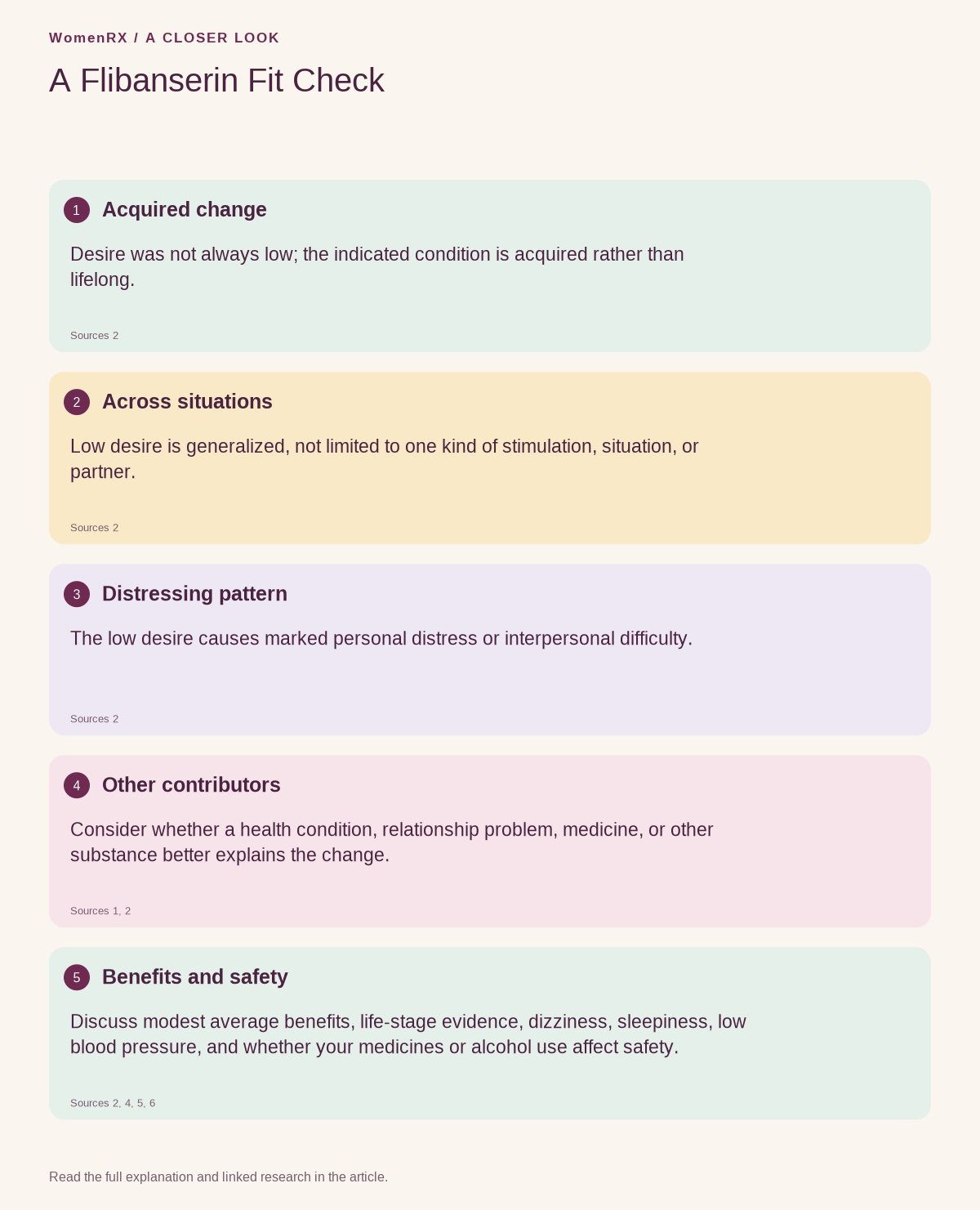
A Flibanserin Fit Check
Acquired change: Desire was not always low; the indicated condition is acquired rather than lifelong.2
Across situations: Low desire is generalized, not limited to one kind of stimulation, situation, or partner.2
Distressing pattern: The low desire causes marked personal distress or interpersonal difficulty.2
Other contributors: Consider whether a health condition, relationship problem, medicine, or other substance better explains the change.12
Benefits and safety: Discuss modest average benefits, life-stage evidence, dizziness, sleepiness, low blood pressure, and whether your medicines or alcohol use affect safety.2456
Read the figure as text
Use these distinctions to organize a discussion about whether the diagnosis, evidence, and safety considerations fit your situation.- Acquired change: Desire was not always low; the indicated condition is acquired rather than lifelong.2
- Across situations: Low desire is generalized, not limited to one kind of stimulation, situation, or partner.2
- Distressing pattern: The low desire causes marked personal distress or interpersonal difficulty.2
- Other contributors: Consider whether a health condition, relationship problem, medicine, or other substance better explains the change.12
- Benefits and safety: Discuss modest average benefits, life-stage evidence, dizziness, sleepiness, low blood pressure, and whether your medicines or alcohol use affect safety.2456
More questions, answered
Does the evidence apply after menopause?
The US indication is for women younger than 65, but the pivotal efficacy trials described in the prescribing information enrolled premenopausal women. A smaller open-label study included naturally postmenopausal participants but cannot establish benefit compared with placebo. 2 4
Sources you can check
- Sexual Health | MedlinePlusAccessed 2026-09-25Return to first citation
- ADDYI (FLIBANSERIN) TABLET, FILM COATED [SPROUT PHARMACEUTICALS, INC.] | US prescribing information and patient instructionsAccessed 2026-09-25Return to first citation
- Flibanserin Efficacy and Safety in Premenopausal Women With Generalized Acquired Hypoactive Sexual Desire Disorder.Fisher WA, Pyke RE. · Sexual medicine reviews · 2017Return to first citation
- Flibanserin for Hypoactive Sexual Desire Disorder: An Open-Label Safety Study.Simon JA, Derogatis L, Portman D, Brown L, Yuan J, Kissling R. · The journal of sexual medicine · 2018Return to first citation
- Flibanserin for Premenopausal Hypoactive Sexual Desire Disorder: Pooled Analysis of Clinical Trials.Simon JA, Thorp J, Millheiser L. · Journal of women's health (2002) · 2019Return to first citation
- Evaluation of safety for flibanserin.Clayton AH, Brown L, Kim NN. · Expert opinion on drug safety · 2020Return to first citation