Bremelanotide: What to Review Before an Online Visit
Bremelanotide is intended for a specific pattern of distressing low desire, and blood pressure and heart health are central to deciding whether it’s appropriate.
Bremelanotide (Vyleesi) is indicated for premenopausal women with acquired, generalized low sexual desire that causes marked distress or interpersonal difficulty, not for every change in desire. An online clinician should assess whether that pattern fits, review blood pressure and cardiovascular history, and discuss side effects and use. Uncontrolled high blood pressure and known cardiovascular disease are reasons the medicine must not be used. 25
First, does the indication fit?
A change in desire can be upsetting, but low desire alone doesn’t establish hypoactive sexual desire disorder (HSDD). Distress is part of the condition, and bremelanotide’s indication is narrow: it’s for premenopausal women with acquired, generalized HSDD that causes marked distress or interpersonal difficulty. It isn’t a treatment for every cause or situation involving low desire. 25
In an online assessment, expect to talk about what changed, whether the low desire is a broader pattern or tied to particular situations, and how much it bothers you. These details help the clinician consider whether your experience resembles the population the medicine is intended for. The pivotal trials studied premenopausal women with acquired, generalized HSDD, so their findings shouldn’t automatically be applied to people outside that group. 23
The trials found statistically significant improvements in desire and distress compared with placebo over 24 weeks. That doesn’t mean everyone benefits or that the change will feel large in everyday life; a review describes the overall clinical benefit as modest. It’s reasonable to ask what improvement would matter to you and how you and the clinician will judge whether treatment is helping. 36
Blood pressure and heart health come first
Bremelanotide temporarily raises blood pressure and lowers heart rate after a dose. In clinical studies, the largest increases were 6 mmHg in systolic and 3 mmHg in diastolic pressure, typically peaking 2 to 4 hours afterward; readings usually returned to baseline within 12 hours. It’s contraindicated if you have uncontrolled hypertension or known cardiovascular disease. The prescribing information also says it isn’t recommended for people at high cardiovascular risk and calls for cardiovascular risk assessment and well-controlled blood pressure before treatment, with periodic reassessment during treatment. 2
Be ready to share any blood pressure readings you have, whether you take blood-pressure medicine, and any heart or blood-vessel diagnosis. A reading alone doesn’t tell the whole story: high blood pressure often has no symptoms, and diagnosis generally relies on repeated readings at separate appointments. 1 If you don’t know your usual blood pressure, ask how the clinician wants to assess it before deciding about treatment.
Give the clinician your full medication list, including nonprescription medicines. A safety review reported that most studied drug interactions weren’t considered clinically significant, but bremelanotide lowered concentrations of indomethacin and naltrexone. That finding is a reason to ask specifically about these medicines, not a reason to stop one on your own. 7
Know the route, timing, and common side effects
Vyleesi is a subcutaneous injection in the abdomen or thigh, used as needed at least 45 minutes before anticipated sexual activity. The labeled dose is 1.75 mg, and you shouldn’t use more than one dose within 24 hours. The duration of effect and best timing haven’t been fully characterized, so ask the prescriber what to expect rather than assuming the effect lasts for a set period. 2
Nausea is the side effect most likely to affect whether treatment feels tolerable. In the integrated double-blind phase 3 trials, nausea occurred in 40.0% of participants taking bremelanotide versus 1.3% taking placebo; flushing occurred in 20.3% versus 1.3%, and headache in 11.3% versus 1.9%. The prescribing information reports that 18% of participants taking bremelanotide stopped treatment because of adverse reactions, compared with 2% taking placebo. 27
Ask how to report side effects and when your blood pressure and response to treatment will be reviewed. The medication information calls for periodic blood-pressure and cardiovascular-risk assessment, but the available trial results don’t establish one follow-up schedule that fits every person. 24
A useful discussion guide
Before the visit, consider writing down when the change in desire began, whether it occurs across situations, and whether it causes distress or relationship difficulty. Bring recent blood-pressure readings if you have them, along with your diagnoses and medication list. Then ask:
- Does my experience match the specific indication, or could another factor better explain the change?
- Is my blood pressure controlled, and do my heart or blood-vessel history or other risks rule this out?
- What side effects should I watch for, and how should I report them?
- When will we review my blood pressure, tolerability, and whether I’m getting a meaningful benefit?
An online visit can make room for these questions, but a prescription is not a given. The decision depends on whether the indication fits and whether the cardiovascular safety requirements can be met.
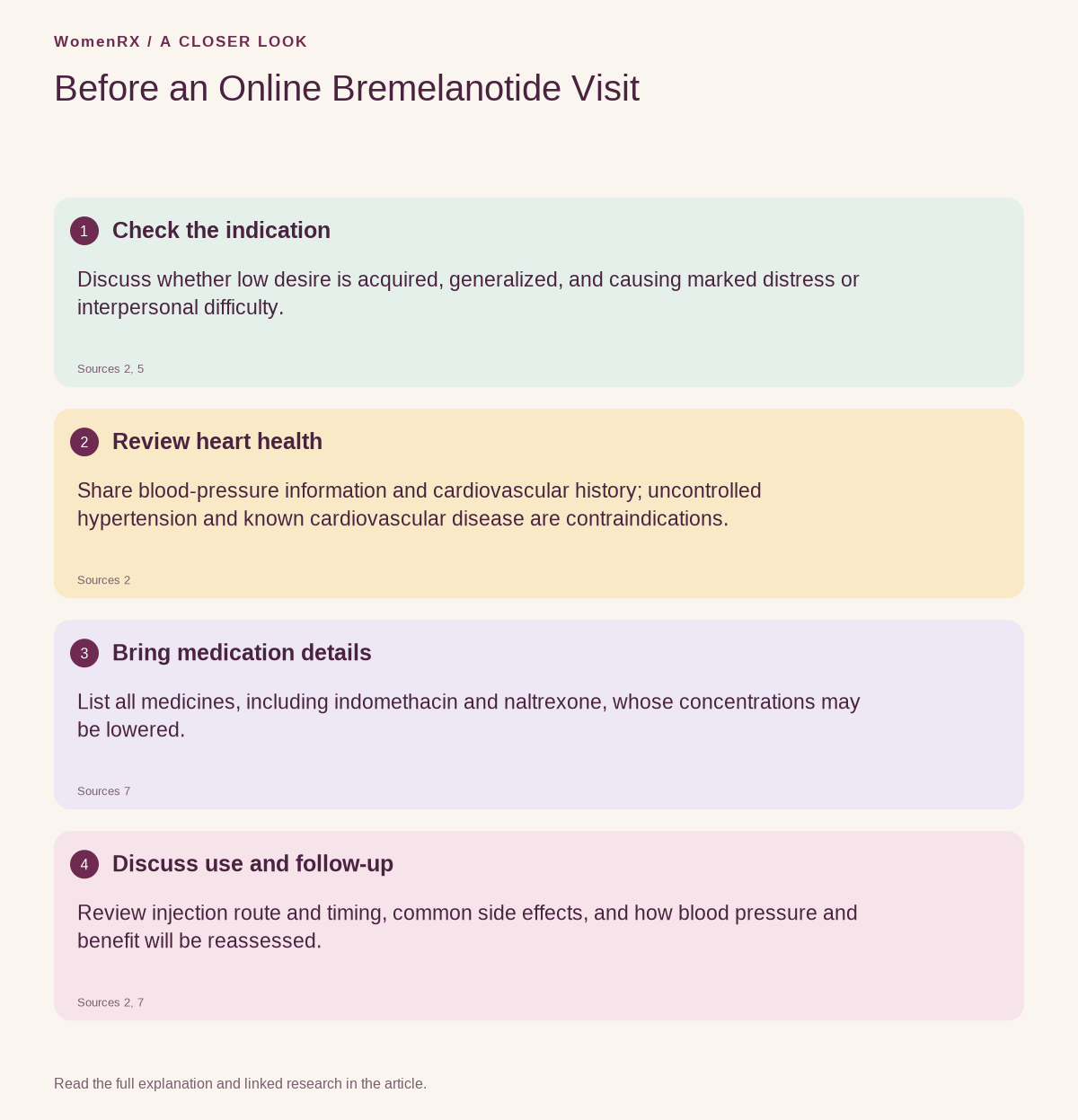
Before an Online Bremelanotide Visit
Check the indication: Discuss whether low desire is acquired, generalized, and causing marked distress or interpersonal difficulty.25
Review heart health: Share blood-pressure information and cardiovascular history; uncontrolled hypertension and known cardiovascular disease are contraindications.2
Bring medication details: List all medicines, including indomethacin and naltrexone, whose concentrations may be lowered.7
Discuss use and follow-up: Review injection route and timing, common side effects, and how blood pressure and benefit will be reassessed.27
Read the figure as text
Use these discussion points to organize the visit. They are not a diagnostic or eligibility score.- Check the indication: Discuss whether low desire is acquired, generalized, and causing marked distress or interpersonal difficulty.25
- Review heart health: Share blood-pressure information and cardiovascular history; uncontrolled hypertension and known cardiovascular disease are contraindications.2
- Bring medication details: List all medicines, including indomethacin and naltrexone, whose concentrations may be lowered.7
- Discuss use and follow-up: Review injection route and timing, common side effects, and how blood pressure and benefit will be reassessed.27
More questions, answered
Can bremelanotide treat any kind of low sexual desire?
No. Its indication is for premenopausal women with acquired, generalized HSDD causing marked distress or interpersonal difficulty. Low desire without distress, or a different pattern, doesn’t automatically fit that indication. 25
What if I have high blood pressure?
Uncontrolled hypertension is a contraindication. The prescribing information calls for blood pressure to be well controlled before treatment and periodically checked during treatment; a clinician also needs to consider cardiovascular risk. 2
Sources you can check
- High Blood Pressure | Hypertension | MedlinePlusAccessed 2026-09-25Return to first citation
- VYLEESI (BREMELANOTIDE) INJECTION [COSETTE PHARMACEUTICALS, INC.] | US prescribing information and patient instructionsAccessed 2026-09-25Return to first citation
- Bremelanotide for the Treatment of Hypoactive Sexual Desire Disorder: Two Randomized Phase 3 Trials.Kingsberg SA, Clayton AH, Portman D, Williams LA, Krop J, Jordan R, Lucas J, Simon JA. · Obstetrics and gynecology · 2019Return to first citation
- Long-Term Safety and Efficacy of Bremelanotide for Hypoactive Sexual Desire Disorder.Simon JA, Kingsberg SA, Portman D, Williams LA, Krop J, Jordan R, Lucas J, Clayton AH. · Obstetrics and gynecology · 2019Return to first citation
- Clinical trial evidence on emerging pharmacological therapies for hypoactive sexual desire disorder in women: a systematic review and analysis of completed studies registered on ClinicalTrials.gov.Ashour AM. · Frontiers in medicine · 2026Return to first citation
- An evaluation of bremelanotide injection for the treatment of hypoactive sexual desire disorder.Cipriani S, Alfaroli C, Maseroli E, Vignozzi L. · Expert opinion on pharmacotherapy · 2023Return to first citation
- Safety Profile of Bremelanotide Across the Clinical Development Program.Clayton AH, Kingsberg SA, Portman D, Sadiq A, Krop J, Jordan R, Lucas J, Simon JA. · Journal of women's health (2002) · 2022Return to first citation