What to Expect at an Online Women's Health Visit
A virtual visit may lead to advice, testing, follow-up, or a plan to be seen in person.
An online women's health appointment may help address a concern remotely, or it may point to a next step that needs testing or an in-person examination. In one single-center obstetrics and gynecology study, teleconsultations led to several different outcomes, including diagnosis, testing, referral, and follow-up. You can start by sharing the concern you want help with, but there’s no one script or guaranteed outcome. 3
Start with the concern that brought you in
An online women's health visit doesn't have to be about pregnancy or reproductive health. It might be about a gynecologic concern, breastfeeding support, or an ongoing condition unrelated to reproduction. Teleconsultations have been studied in obstetrics and gynecology and in breastfeeding care; primary-care telemedicine has also been studied in adults with multiple chronic conditions, though that review did not report a women's subgroup. The focus of your appointment depends on the service and your concern. 1 2 3
For example, you might bring up a question about sexual health, a change in vaginal discharge if that's relevant to your anatomy, a pregnancy concern, or follow-up for an ongoing condition. You can begin by naming what you most want help with, then share the details you think are relevant. You may choose to share when the concern started, what has changed, and whether you've had care for it before. Depending on your concern, your health history, medications, or whether pregnancy is possible may also be relevant. These are examples of details you might share, not a required checklist. You can also say what you hope to get out of the visit. If there's a question you don't want to answer or a term you don't understand, say so.
The next step depends on what can be assessed remotely
A video or phone conversation can give the clinician information, but it doesn't provide every kind of examination or test. In a prospective observational study at one obstetrics and gynecology center in India, researchers reported that clinicians made a diagnosis in 77.4% of consultations. The study's table also reported that 15.7% needed a physical examination and 5.8% needed investigations. These findings describe that center's pandemic-era service, not what will happen in your appointment or a guarantee that a remote diagnosis is possible. 3
Depending on the concern, a visit may end with an explanation or advice, a test being arranged, a recommendation for an in-person examination, a referral, or another appointment. In the same study, follow-up was advised for 52.5% of patients. Those outcomes show why an online visit can be one step in care rather than a complete substitute for in-person care. 3
If the clinician recommends an in-person visit or test, ask what question that next step is meant to answer and what will happen afterward. You can also ask whether there are alternatives if the proposed next step is difficult for you to arrange. A recommendation for more assessment doesn't mean the online conversation was pointless; it can clarify what still needs to be checked.
Some visits are for counseling and follow-up
Not every appointment is about diagnosing a new symptom. A remote visit may also involve follow-up or counseling. For example, a cross-sectional survey of breastfeeding teleconsultations in Saudi Arabia found that 80% of surveyed participants reported satisfaction with the service. That result reflects a particular country's breastfeeding service and survey, not a promise that every patient will prefer remote care or get the same result. The study authors also identified in-person assessment or specialist referral as an area for further work. 2
You can make the conversation more useful by asking what the clinician thinks is most likely, what remains uncertain, and what would change the plan. If a test, examination, or follow-up is suggested, ask what information it will add. Those questions help you understand not only the next step, but why it's the next step.
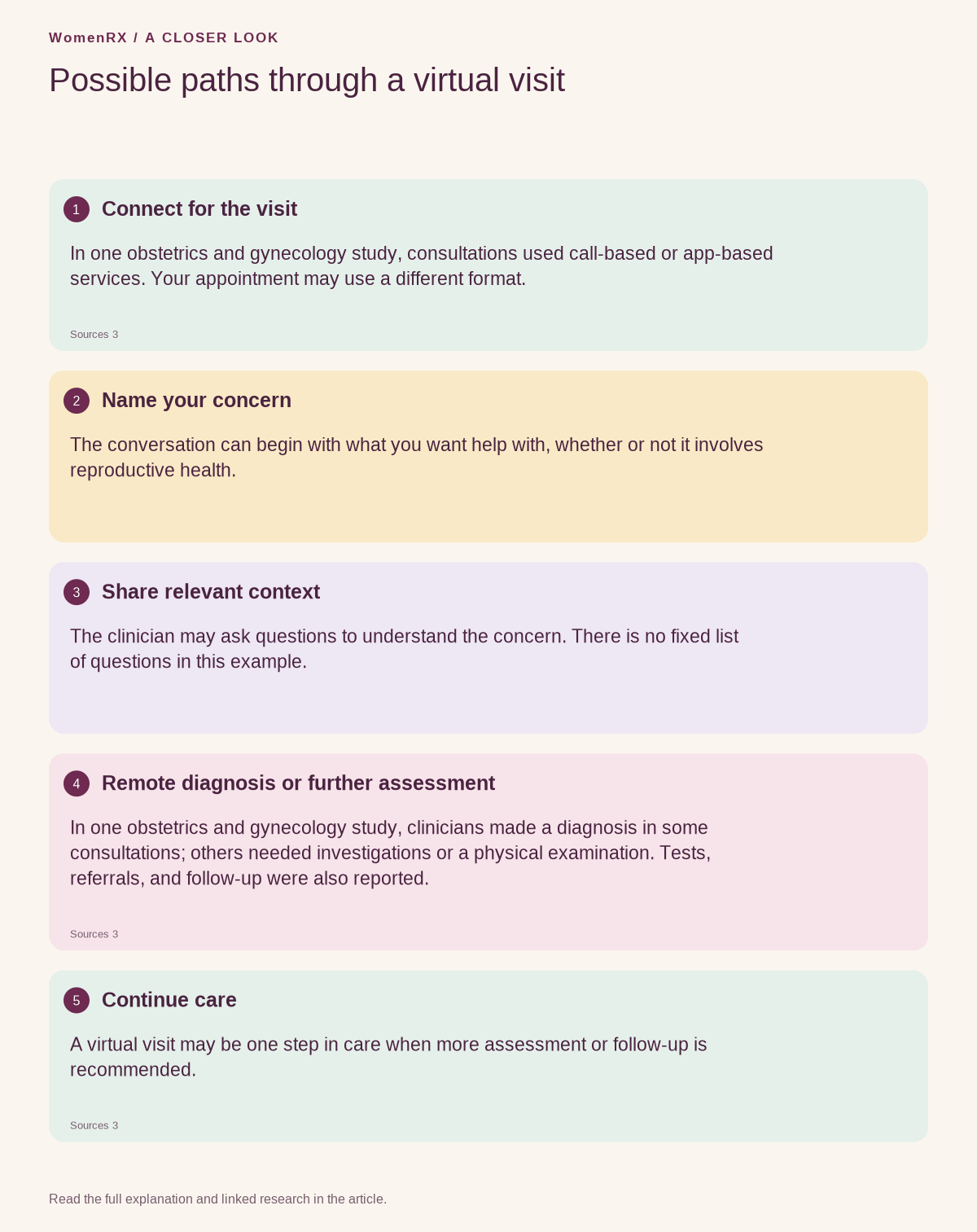
Possible paths through a virtual visit
Connect for the visit: In one obstetrics and gynecology study, consultations used call-based or app-based services. Your appointment may use a different format.3
Name your concern: The conversation can begin with what you want help with, whether or not it involves reproductive health.
Share relevant context: The clinician may ask questions to understand the concern. There is no fixed list of questions in this example.
Remote diagnosis or further assessment: In one obstetrics and gynecology study, clinicians made a diagnosis in some consultations; others needed investigations or a physical examination. Tests, referrals, and follow-up were also reported.3
Continue care: A virtual visit may be one step in care when more assessment or follow-up is recommended.3
Read the figure as text
A virtual appointment may take different paths. This figure depicts possible parts of the visit, not a required sequence or a prediction of what will happen.- Connect for the visit: In one obstetrics and gynecology study, consultations used call-based or app-based services. Your appointment may use a different format.3
- Name your concern: The conversation can begin with what you want help with, whether or not it involves reproductive health.
- Share relevant context: The clinician may ask questions to understand the concern. There is no fixed list of questions in this example.
- Remote diagnosis or further assessment: In one obstetrics and gynecology study, clinicians made a diagnosis in some consultations; others needed investigations or a physical examination. Tests, referrals, and follow-up were also reported.3
- Continue care: A virtual visit may be one step in care when more assessment or follow-up is recommended.3
More questions, answered
Can a clinician do an examination during an online appointment?
A remote appointment doesn't provide every kind of hands-on examination. In one single-center obstetrics and gynecology study, some consultations needed an in-person physical examination, while others were managed remotely or led to other next steps. Whether an examination is needed depends on the concern and what can be assessed online. 3
Does an online visit always end with a diagnosis?
No. A clinician may be able to assess the concern remotely, or may recommend testing, an in-person examination, referral, or follow-up. One single-center study illustrates these different outcomes, but it can't predict what will happen in an individual visit. 3
Sources you can check
- [Effectiveness of interventions based on telemedicine on health outcomes in patients with multimorbidity in Primary Care: A systematic review].Pascual-de la Pisa B, Palou-Lobato M, Márquez Calzada C, García-Lozano MJ. · Atencion primaria · 2020Return to first citation
- Telemedicine Breastfeeding Consultation: The Saudi Experience.AlHreashy FA, AlObeid GA, Elbashir BMA, Alshathry AS. · Cureus · 2023Return to first citation
- Utility of telemedicine for providing Obstetrics and Gynecology services during the COVID-19 pandemic-A single center experience from a tertiary care teaching hospital located in South India.Sharmila V, Yedla D, Babu TA, Tripathi M, Kalidoss VK. · Journal of education and health promotion · 2023Return to first citation