How to Ask About Addyi in an Online Visit
An online evaluation should look at the pattern of your low desire, what else may be affecting it, and whether Addyi’s benefits and risks fit your situation.
Tell the clinician when your desire changed, whether the change happens across situations, and how it affects you. Addyi is indicated for women younger than 65 with a specific pattern of low desire called acquired, generalized hypoactive sexual desire disorder (HSDD), not for every experience of low desire. Bring your medication list and ask how the service handles interaction checks, follow-up, and pharmacy questions. 1

Start with what changed for you
You don’t need to arrive at an online visit with a diagnosis. You do need room to explain the concern in your own terms. A straightforward opening might be: “My desire has changed, and it’s bothering me. I’d like to understand what might be behind it and whether Addyi is an option.”
The condition Addyi is indicated to treat has a particular pattern. Acquired means low desire developed after a time when it wasn’t a problem. Generalized means it isn’t limited to one partner, situation, or type of stimulation. The low desire also causes marked distress or interpersonal difficulty. Think about when the change began, where you notice it, and what makes it troubling to you. If desire feels different in different circumstances, that’s useful to say rather than trying to make your experience fit a definition. 1
The current U.S. indication is for women younger than 65. The pivotal efficacy trials described in the prescribing information enrolled premenopausal women; the information also reports a separate study in postmenopausal women under 65. Menopause status is therefore worth sharing, but it isn’t the only factor in an eligibility discussion. 1
Make space for other possible causes
An evaluation should consider more than desire itself. The prescribing information distinguishes the condition Addyi treats from low desire due to a co-existing medical or psychiatric condition, relationship problems, or the effects of a medication or other drug. Chronic illness and medicines can affect sexual health, and desire concerns can involve biological, psychological, and social factors. 1 2 5
Before the visit, you might jot down changes that happened around the same time as your desire changed, such as a new health concern, a shift in mood, a medication change, or a change in your relationship. These are starting points for a conversation, not a test you have to pass. For example, if sex has become uncomfortable or the change seems tied to one situation, say that plainly. It may lead to a more useful discussion than focusing on a prescription alone. 1 4
Ask for a medication and alcohol review
Have a list of your prescription medicines, nonprescription medicines, and supplements ready. Ask how the clinician will check it against Addyi before making a decision. The prescribing information warns that strong CYP2C19 inhibitors can increase flibanserin exposure and the risks of low blood pressure, fainting, and central nervous system depression. You don’t have to identify potential interactions yourself; the useful move is to make sure the clinician has an accurate list. 1
Mention how often you drink alcohol, too. Drinking while taking flibanserin may increase the risk of sedation, low blood pressure, and fainting. That’s a safety question to discuss openly, not a reason to guess whether alcohol caused your low desire. 3
It’s also reasonable to ask what benefit you might notice and what side effects could make treatment less appealing. In a meta-analysis of randomized trials, premenopausal women taking flibanserin had an average of 0.69 more satisfying sexual events per month than women taking placebo. The review also found higher risks of dizziness, fatigue, nausea, and sleepiness with flibanserin. An average trial result can help frame the tradeoff, but it cannot predict your own response. 3
Find out what happens after the video call
Before booking, look for a service that lets you give a full history and ask questions rather than promising Addyi upfront. Ask who will conduct the evaluation and how you can provide your medication list. If treatment is offered, ask how you would report side effects or concerns about benefit, and who would respond.
Dispensing deserves a practical question as well: “If I receive a prescription, which pharmacy would get it, and whom do I contact if there’s a problem filling it?” If Addyi isn’t a fit, ask what the clinician thinks is worth addressing next. Those answers tell you more about the care you’ll receive than a promise of a quick prescription.
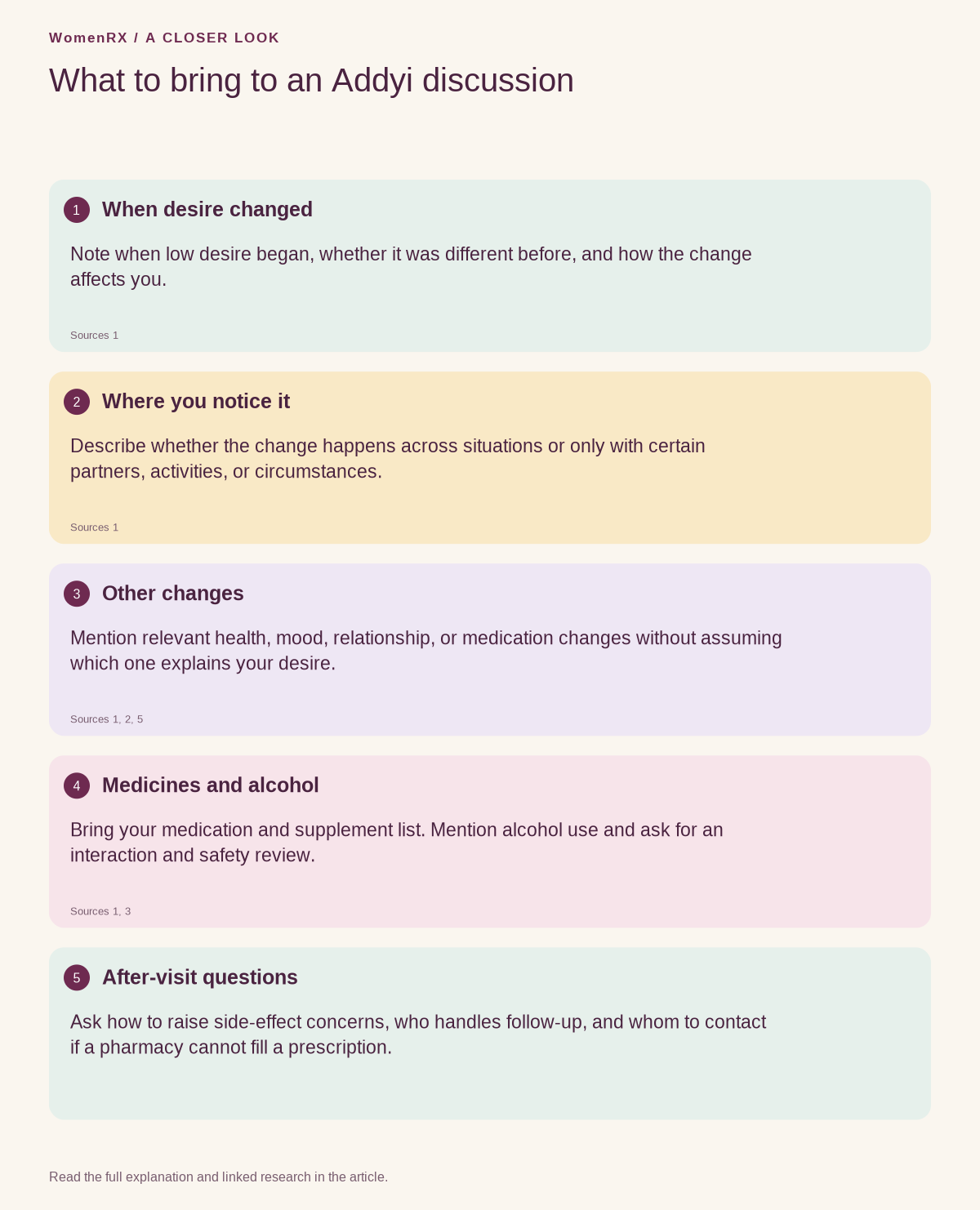
What to bring to an Addyi discussion
When desire changed: Note when low desire began, whether it was different before, and how the change affects you.1
Where you notice it: Describe whether the change happens across situations or only with certain partners, activities, or circumstances.1
Other changes: Mention relevant health, mood, relationship, or medication changes without assuming which one explains your desire.125
Medicines and alcohol: Bring your medication and supplement list. Mention alcohol use and ask for an interaction and safety review.13
After-visit questions: Ask how to raise side-effect concerns, who handles follow-up, and whom to contact if a pharmacy cannot fill a prescription.
Read the figure as text
Use these prompts to organize an online conversation. They are not a diagnostic test or a guarantee of a prescription.- When desire changed: Note when low desire began, whether it was different before, and how the change affects you.1
- Where you notice it: Describe whether the change happens across situations or only with certain partners, activities, or circumstances.1
- Other changes: Mention relevant health, mood, relationship, or medication changes without assuming which one explains your desire.125
- Medicines and alcohol: Bring your medication and supplement list. Mention alcohol use and ask for an interaction and safety review.13
- After-visit questions: Ask how to raise side-effect concerns, who handles follow-up, and whom to contact if a pharmacy cannot fill a prescription.
More questions, answered
Can I still bring up Addyi if my low desire happens only in certain situations?
Yes. Describe the pattern as it is. Addyi’s indicated condition is generalized, meaning the low desire is not limited to particular situations, stimulation, or partners. A situation-specific change still deserves a thoughtful discussion of what may be contributing. 1
Sources you can check
- ADDYI (FLIBANSERIN) TABLET, FILM COATED [SPROUT PHARMACEUTICALS, INC.] | US prescribing information and patient instructionsAccessed 2026-09-25Return to first citation
- Sexual Health | MedlinePlusAccessed 2026-09-25Return to first citation
- Role of flibanserin in managing hypoactive sexual desire disorder in women: A systematic review and meta-analysis.Kamrul-Hasan ABM, Hannan MA, Alam MS, Aalpona FTZ, Nagendra L, Selim S, Dutta D. · Medicine · 2024Return to first citation
- Effects of Flibanserin on Subdomain Scores of the Female Sexual Function Index in Women With Hypoactive Sexual Desire Disorder.Simon JA, Clayton AH, Goldstein I, Kingsberg SA, Shapiro M, Patel S, Kim NN. · Sexual medicine · 2022Return to first citation
- What Women Want? The State of the Art regarding the Treatment of Young Women with Hypoactive Sexual Desire Disorder.de Oliveira L, Vignozzi L, Giraldi A, Varod S, Corona G, Reisman Y. · Pharmacology · 2024Return to first citation