Can an Online Visit Address Your Sexual-Health Concern?
An online visit can be a useful first step, but symptoms, tests, and examination needs determine what happens next.
Yes. A remote visit can give you space to describe a concern, discuss possible next steps, and sometimes arrange testing or follow-up. But an online conversation cannot replace a swab, blood test, pregnancy test, or hands-on examination when one is needed. Services vary, so ask how testing, results, and in-person care are handled before you rely on a platform. 1 3 5 6
Start with the kind of help you need
Sexual-health concerns can be discussed online, but “addressed” may mean different things: talking through a change in desire, reviewing contraception, arranging an STI test, or deciding whether pelvic symptoms need an examination. A remote visit can be a starting point, not a promise that the cause can be diagnosed or treated without any in-person care.
You can raise changes in desire, arousal, comfort, or sexual function, including changes you’ve noticed after childbirth or around menopause. Those details may help a clinician understand the situation, but a video or phone call alone may not establish why a change is happening. The available evidence on telehealth covers different sexual and reproductive services, and much of it is low quality; it does not establish that every sexual concern can be resolved remotely. 6
A practical route from concern to care
If you mainly need a conversation
A remote appointment can be a place to describe what has changed, when it began, and what you want help with. Contraceptive care is offered by many publicly supported US family-planning clinics through telehealth, but the services available differ by clinic. If you’re considering a specific service, ask whether that clinic provides it online or uses the visit to arrange another kind of care. 5
If you have new pelvic discomfort, a sore, or unusual discharge, say so plainly. Depending on the concern, a clinician may recommend testing or an examination rather than advice alone. 1 2
If an STI is possible
A clinician may be able to talk through your exposure and symptoms remotely, but many STIs have no symptoms, and symptoms alone can’t reliably rule one out. Diagnosis may involve blood testing, a sample from a sore or genital fluid, or an examination. Some telehealth services offer self-collection kits or help arrange testing, but clinic offerings vary. Ask where the sample is collected, what infections the test covers, and how you’ll receive results. 1 5 6
An online visit is less useful if it ends without a clear testing plan when testing is needed. In one study of direct-to-consumer STI consultations in China, clinicians often failed to refer standardized patients with syphilis or herpes scenarios for testing. That finding describes those services and cases, not the quality of US telehealth overall. It does reinforce a practical question to ask: “If you can’t confirm this online, how will I get tested?” 4
If pelvic pain or possible PID is part of the picture
Pelvic inflammatory disease (PID) can have mild or no symptoms, and there isn’t one test that confirms it. Assessment may include a physical or pelvic examination, samples, blood or urine tests, imaging, and a pregnancy test. If pregnancy is possible, mention that early, since it can affect the evaluation. An online clinician may help you decide where to go, but suspected PID needs prompt clinical assessment rather than a remote-only plan. 2 3
Severe or worsening pelvic pain, especially when movement or touch makes it hurt, calls for immediate evaluation in an emergency department. Don’t wait for a routine online appointment to sort that out. 3
Make the handoff part of the plan
Before ending the visit, get specific about what happens next. If testing is recommended, ask where to go or whether a self-collection option is appropriate, which tests are being ordered, and how results will reach you. Ask who will explain a result and what to do if you don’t hear back. If treatment is discussed, clarify whether it depends on test results or an examination, and how follow-up will happen.
A good next step may be an appointment at a clinic, a lab visit, or a remote follow-up. Telehealth can expand access to sexual and reproductive services, but what it can do depends on the service, the clinic, and whether testing and referrals are connected to the visit. 5 6
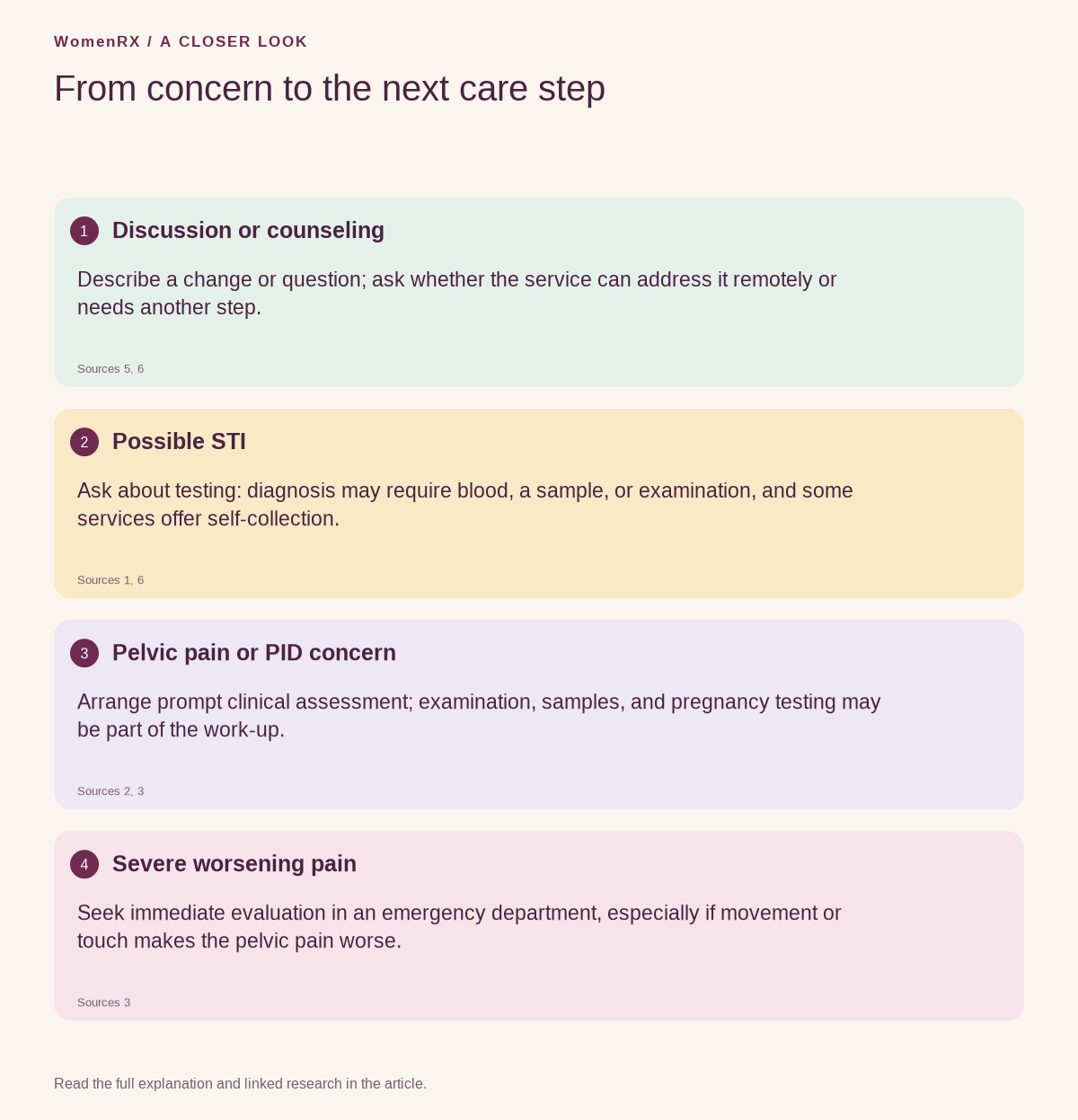
From concern to the next care step
Discussion or counseling: Describe a change or question; ask whether the service can address it remotely or needs another step.56
Possible STI: Ask about testing: diagnosis may require blood, a sample, or examination, and some services offer self-collection.16
Pelvic pain or PID concern: Arrange prompt clinical assessment; examination, samples, and pregnancy testing may be part of the work-up.23
Severe worsening pain: Seek immediate evaluation in an emergency department, especially if movement or touch makes the pelvic pain worse.3
Read the figure as text
A remote visit can start the conversation; symptoms and the kind of evidence needed determine whether testing or an examination comes next.- Discussion or counseling: Describe a change or question; ask whether the service can address it remotely or needs another step.56
- Possible STI: Ask about testing: diagnosis may require blood, a sample, or examination, and some services offer self-collection.16
- Pelvic pain or PID concern: Arrange prompt clinical assessment; examination, samples, and pregnancy testing may be part of the work-up.23
- Severe worsening pain: Seek immediate evaluation in an emergency department, especially if movement or touch makes the pelvic pain worse.3
More questions, answered
Can an online visit diagnose an STI?
A clinician can discuss symptoms and risk remotely, but an STI diagnosis may require a blood test or a sample from a sore or genital fluid. Some infections cause no symptoms, so ask whether testing is recommended and how to arrange it. 1
Should I mention that I might be pregnant?
Yes, if you have pelvic pain or possible PID. A clinician may ask whether pregnancy is possible, and a pregnancy test may be part of the assessment. 3
Sources you can check
- Sexually Transmitted Infections | MedlinePlusAccessed 2026-09-25Return to first citation
- Pelvic Inflammatory Disease | PID | MedlinePlusAccessed 2026-09-25Return to first citation
- Pelvic inflammatory disease - NHSAccessed 2026-09-25Return to first citation
- The quality of telemedicine consultations for sexually transmitted infections in China.Si Y, Xue H, Liao H, Xie Y, Xu DR, Smith MK, Yip W, Cheng W, Tian J, Tang W, Sylvia S. · Health policy and planning · 2024Return to first citation
- Telehealth use among publicly funded family planning clinics in the United States: Results from a national survey.Haas M, Osias P, Mueller J, VandeVusse A. · Contraception · 2025Return to first citation
- Telehealth for Sexual and Reproductive Healthcare: Evidence Map of Effectiveness, Patient and Provider Experiences and Preferences, and Patient Engagement Strategies.Parikh RR, Shetty NU, Singhal C, Patel P, Manghani P, Pillai AA, Chocontá-Piraquive LA, Butler ME. · Clinics and practice · 2026Return to first citation