What to Check Before Choosing Online Menopause Care
A useful online visit should do more than name menopause: it should clarify what needs evaluating, compare options, and explain how follow-up works.
Online care can be a convenient way to discuss menopause symptoms and treatment, but don’t assume every question can be settled remotely. Before booking, check how the clinician assesses your history, discusses both hormone and nonhormone options, arranges an in-person exam or referral if needed, and follows up. Treatment choices depend on your symptoms, health history, and, for hormone therapy, timing relative to menopause. 4 5 6
Start with what the visit can actually do
An online appointment can give you time to describe symptoms, ask questions, and discuss possible next steps. In a UK hospital service evaluation, 504 people who had telephone gynecology appointments responded to a survey; 89% rated the experience “good” or “very good.” Menopause follow-up patients were among the groups who benefited most. But this was a survey of selected gynecology patients, not proof that every menopause concern can be assessed or managed remotely. 4
Before you book, look for a clear explanation of who provides the consultation, what the visit includes, and how the service handles questions that need testing, an examination, or another kind of care. Ask: If an online assessment isn’t enough, who arranges the next step, and where does that happen? A service should be able to explain its process rather than promise that every concern can be resolved by video or phone.
Bring the details that shape the conversation
Write down your main concern and what you want help with: for example, hot flashes, sleep disruption, vaginal or urinary symptoms, or a question about hormone therapy. Note when symptoms began and how they affect your day. If you’re in perimenopause, include changes in your periods as well as symptoms. If you’re postmenopausal, note roughly how long it has been since your final period. This timing can matter when discussing systemic hormone therapy: the North American Menopause Society’s 2022 position statement says the benefit-risk balance is generally more favorable for women younger than 60 or within 10 years of menopause onset, when there are no contraindications. Individual health history and treatment goals still matter. 5
You don’t need to arrive with a diagnosis or a perfect record. The point is to give the clinician enough context to discuss what might explain your symptoms and whether any further evaluation is appropriate.
Look for a real comparison of options
Hormone therapy is not the only treatment discussion worth having. The 2022 position statement describes hormone therapy as the most effective treatment for vasomotor symptoms, such as hot flashes, and genitourinary symptoms of menopause. It also says the balance of benefits and risks varies with factors including the type, dose, route, duration, timing, and use of a progestogen, and recommends individualized decisions with periodic reassessment. 5
If hormone therapy isn’t a fit for you, or you’d rather not use it, there are evidence-supported nonhormone options for vasomotor symptoms. The 2023 position statement lists options including cognitive behavioral therapy, clinical hypnosis, certain prescription medications, and weight loss, with different evidence levels across those approaches. Ask which options address your particular symptoms and what tradeoffs the clinician wants you to consider. 6
Be specific about the type of treatment being discussed. Low-dose vaginal estrogen is an option for bothersome genitourinary symptoms not relieved by over-the-counter therapies for some women who don’t have an indication for systemic hormone therapy. It is a different treatment discussion from systemic hormone therapy for symptoms such as hot flashes. 5
If systemic estrogen is being considered and you have a uterus, ask how the clinician has considered the uterine lining and whether a progestogen is relevant to the plan. Don’t assume findings for one estrogen treatment apply to every product or route. For example, a trial in postmenopausal women with an intact uterus found less endometrial hyperplasia with one specific progesterone-plus-estrogen regimen than with that estrogen alone; that result does not establish the same outcome for every formulation or treatment. 1
Make sure there’s a way to move beyond the screen
Some concerns may call for an examination or specialist input. For example, urinary leakage, prolapse symptoms, recurrent urinary infections, or sexual-function concerns can involve pelvic floor problems that need targeted evaluation. A review of pelvic floor dysfunction in menopause describes assessment and management as individualized; a qualitative study of postmenopausal sexual health also identified physical examination as one way to assess possible physical contributors. Ask the online clinician which parts of your concern can be assessed remotely and what would prompt an in-person evaluation or referral. 2 3
That question is especially useful if a service advertises a single, quick treatment pathway. You want to know whether the clinician can pause the treatment discussion to consider another explanation or arrange a different kind of assessment, not simply whether a prescription is available.
Ask how follow-up works
Before ending the first visit, find out how you’ll review whether a plan is helping, who you contact with questions, and how the treatment’s benefits and risks will be revisited if you start hormone therapy. Periodic reevaluation is part of the menopause society’s guidance on continuing hormone therapy. 5
A practical final question is: What would make you change this plan, and how will we decide together? A thoughtful answer should connect your symptoms and preferences to the options discussed, while making clear how the service can arrange further assessment when a remote visit isn’t enough.
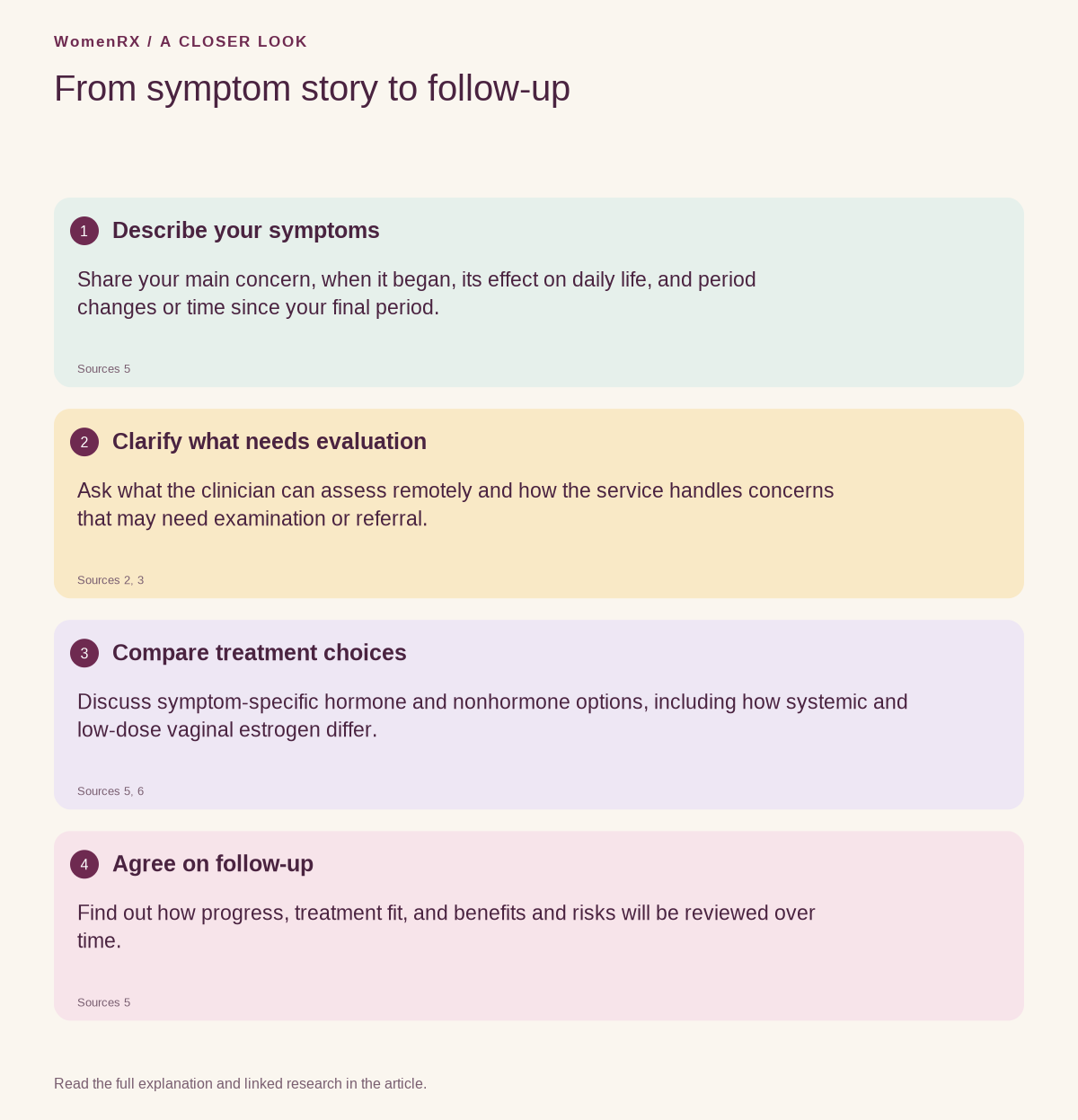
From symptom story to follow-up
Describe your symptoms: Share your main concern, when it began, its effect on daily life, and period changes or time since your final period.5
Clarify what needs evaluation: Ask what the clinician can assess remotely and how the service handles concerns that may need examination or referral.23
Compare treatment choices: Discuss symptom-specific hormone and nonhormone options, including how systemic and low-dose vaginal estrogen differ.56
Agree on follow-up: Find out how progress, treatment fit, and benefits and risks will be reviewed over time.5
Read the figure as text
Use this sequence to check whether an online menopause service can connect your concerns to evaluation, a considered treatment discussion, and continued care.- Describe your symptoms: Share your main concern, when it began, its effect on daily life, and period changes or time since your final period.5
- Clarify what needs evaluation: Ask what the clinician can assess remotely and how the service handles concerns that may need examination or referral.23
- Compare treatment choices: Discuss symptom-specific hormone and nonhormone options, including how systemic and low-dose vaginal estrogen differ.56
- Agree on follow-up: Find out how progress, treatment fit, and benefits and risks will be reviewed over time.5
Sources you can check
- PROMETRIUM (PROGESTERONE) CAPSULE [ACERTIS PHARMACEUTICALS, LLC] | US prescribing information and patient instructionsAccessed 2026-09-25Return to first citation
- Pelvic floor dysfunction in menopause: screening, evaluation and management.Misasi G, Ozcivit Erkan IB, Russo E, Pisacreta E, Fidecicchi T, Montt Guevara MM, Simoncini T. · Expert review of endocrinology & metabolism · 2026Return to first citation
- Strategies to promote the provision of sexual health services during menopause: a qualitative study from the perspective of menopausal women and healthcare providers in Isfahan city, Iran.Moradi M, Noroozi M, Mostafavi F, Beigi M. · BMC health services research · 2025Return to first citation
- Patient experience of telephone consultations in gynaecology: a service evaluation.Khan ZM, Kershaw V, Madhuvrata P, Radley SC, Connor ME. · BJOG : an international journal of obstetrics and gynaecology · 2021Return to first citation
- The 2022 hormone therapy position statement of The North American Menopause Society.“The 2022 Hormone Therapy Position Statement of The North American Menopause Society” Advisory Panel. · Menopause (New York, N.Y.) · 2022Return to first citation
- The 2023 nonhormone therapy position statement of The North American Menopause Society.Menopause (New York, N.Y.) · 2023Return to first citation