Choosing Minoxidil Online: What to Check First
The right online route depends on why you’re losing hair and whether you’re considering a scalp treatment or an oral medication.
Start with the pattern of hair loss, not a product listing. Topical minoxidil is an at-home scalp treatment, but buying it doesn’t give you a diagnosis. Check whether the specific product you’re considering requires a prescription and who will supply it.4 Oral minoxidil for hair loss is an off-label prescription option. Ask who will review your health history, select your dose, and explain how to take it. Neither route promises regrowth.24

First, make sure minoxidil fits the hair loss
A widening part or gradual thinning across the scalp can be a sign of female pattern hair loss. Sudden heavy shedding, distinct patches, or a scaly or inflamed scalp may point to a different cause. Hair loss can also be linked to thyroid disease, a nutrient deficiency, or hair practices that pull on the follicles. Treatment is more useful when it addresses the cause rather than the word “hair loss” alone.64
This distinction matters during life transitions. Shedding a few months after childbirth is often temporary and related to falling estrogen levels; many women regain their usual fullness without treatment. But postpartum shedding can occur alongside less obvious hereditary thinning. If your hair hasn’t regained its usual fullness by your child’s first birthday, a dermatology assessment can help look for another cause.54
If thinning becomes noticeable around menopause, describe how your hair is changing, such as a gradually widening part versus increased shedding. Ask a clinician to assess the pattern and consider other possible causes rather than assuming the timing explains it.64
An online assessment should make room for those details and for a closer look when needed. In a two-year study of one hospital’s dermatology e-consultation service, 58% of consultations for hair loss led to a recommendation for in-person evaluation. That figure isn’t a prediction for your visit, but it’s a reminder that photos and a questionnaire won’t answer every hair-loss question.1
If you choose topical minoxidil
Topical minoxidil is an at-home treatment you apply to your scalp as directed. Buying it online doesn’t necessarily include a diagnosis or ongoing care. Check the directions for the specific product you buy rather than assuming all topical versions have the same routine. Also check whether that product requires a prescription and who will supply it.4
It also helps to know what the commitment looks like before you order. The American Academy of Dermatology says visible results from topical minoxidil usually take about 6 to 12 months. Some people see regrowth, but not everyone does. If it helps, continued use is needed to keep the benefit; stopping it can lead to renewed thinning or shedding.4
That makes a follow-up question practical even when you’re buying it yourself: Who can reassess the diagnosis if the thinning changes or you’re unsure whether it’s helping? A clinician may need to examine your scalp or consider testing when the cause isn’t clear.4
If you’re considering oral minoxidil
Oral minoxidil is a different decision, not simply topical minoxidil without the application step. Its use for hair loss is off-label and involves a prescriber. A clinical review reports unwanted hair growth, temporary shedding, and swelling among possible adverse effects, and identifies pregnancy as a contraindication. Before ordering, ask who will select your dose and give you instructions for taking it. Tell the prescriber if you have pericardial disease, uncontrolled hypertension, or kidney or liver impairment so they can assess whether oral minoxidil is appropriate for you.2
Ask what effects they want you to report and how they’ll reassess both benefit and tolerability. Look for an actual follow-up plan rather than assuming the service will contact you automatically.2
If an online pharmacy is dispensing a prescription medicine, the FDA says safer signs include requiring a prescription, having a licensed pharmacist available for questions, and holding a state pharmacy license. You can check that license through your state board of pharmacy. A site willing to sell prescription medicine without a prescription is a warning sign, not a convenient shortcut.3
Check the full cost, not just the medication price. As listed on September 26, 2026, Nurx advertised oral minoxidil at $48 for a three-month supply, with an $80 consultation fee and a $3 support fee in each month one or more orders are processed. Nurx says medication costs vary with the prescribed treatment. That’s one service’s listed price, not evidence that oral treatment costs less than buying topical minoxidil; check what you would actually be charged before ordering.7
The clinical review identifies pregnancy as a contraindication for oral minoxidil.2 If you’re pregnant or breastfeeding, ask a clinician about the specific treatment you’re considering, whether oral or topical; don’t assume their safety considerations are interchangeable.
The useful comparison isn’t which route sounds easiest at checkout. It’s whether you understand the likely cause of your hair loss, the instructions for the treatment you’d actually use, and who will help if your scalp changes, side effects appear, or the expected benefit doesn’t materialize.42
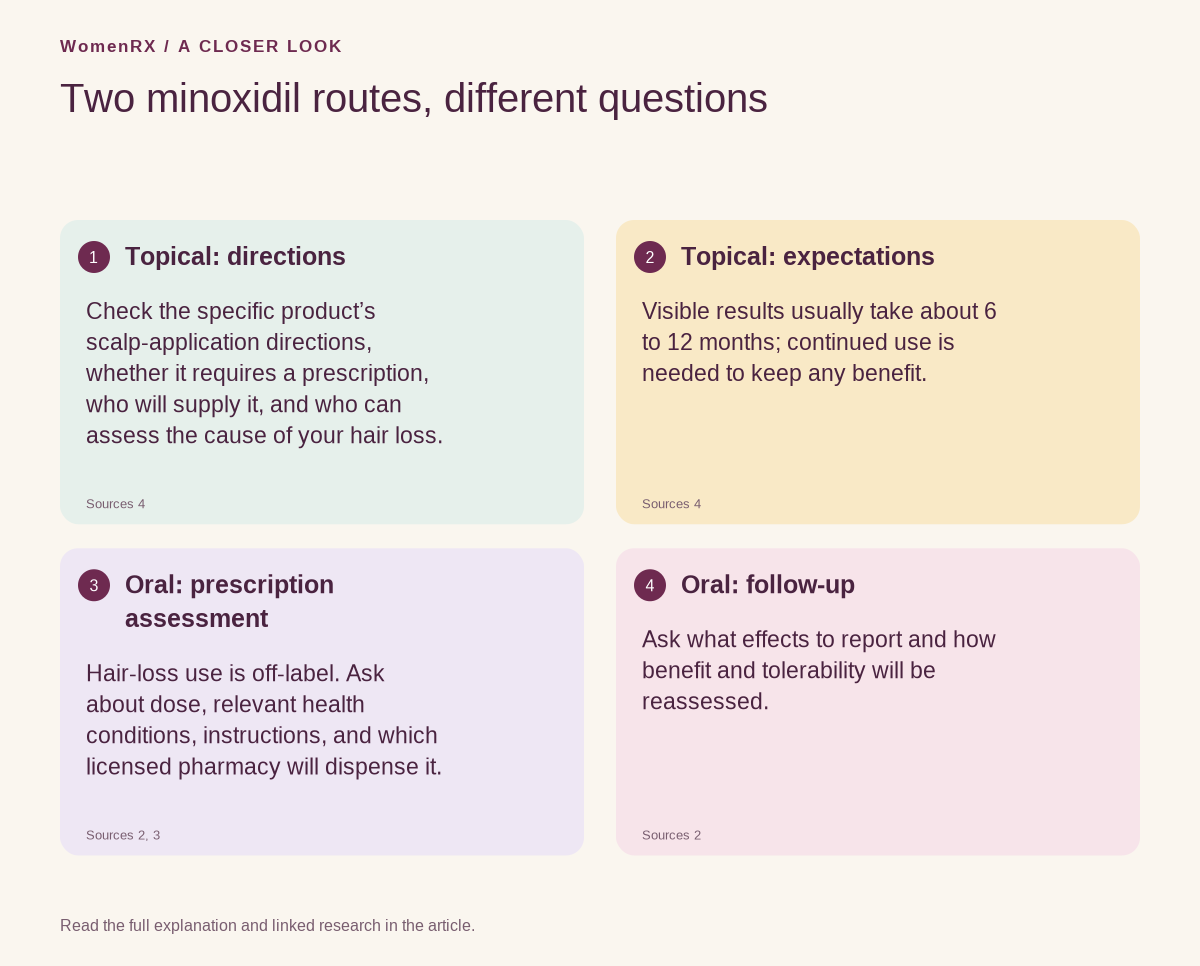
Two minoxidil routes, different questions
Topical: directions: Check the specific product’s scalp-application directions, whether it requires a prescription, who will supply it, and who can assess the cause of your hair loss.4
Topical: expectations: Visible results usually take about 6 to 12 months; continued use is needed to keep any benefit.4
Oral: prescription assessment: Hair-loss use is off-label. Ask about dose, relevant health conditions, instructions, and which licensed pharmacy will dispense it.23
Oral: follow-up: Ask what effects to report and how benefit and tolerability will be reassessed.2
Read the figure as text
Use these distinctions to see what an online purchase or assessment should make clear before you start.- Topical: directions: Check the specific product’s scalp-application directions, whether it requires a prescription, who will supply it, and who can assess the cause of your hair loss.4
- Topical: expectations: Visible results usually take about 6 to 12 months; continued use is needed to keep any benefit.4
- Oral: prescription assessment: Hair-loss use is off-label. Ask about dose, relevant health conditions, instructions, and which licensed pharmacy will dispense it.23
- Oral: follow-up: Ask what effects to report and how benefit and tolerability will be reassessed.2
Sources you can check
- Optimizing Dermatological Care Triage in a Safety-Net Hospital: Retrospective Analysis of Diagnoses and In-Person Referrals.Shih A, Riopelle A, Ordan A, Sanchez S, Bhawan J, Lam CS. · Southern medical journal · 2024Return to first citation
- Oral Minoxidil for Alopecia Treatment: Risks, Benefits, and Recommendations.Ong MM, Li Y, Lipner SR. · American journal of clinical dermatology · 2026Return to first citation
- How to Buy Medicines Safely From an Online Pharmacy | FDAAccessed 2026-09-25Return to first citation
- Hair loss: Diagnosis and treatmentAccessed 2026-09-25Return to first citation
- Hair loss in new moms: Dermatologist tipsAccessed 2026-09-25Return to first citation
- Hair loss: Who gets and causesAccessed 2026-09-25Return to first citation
- Oral Minoxidil for Women’s Hair Loss - Nurx.comAccessed 2026-09-26Return to first citation