Choosing Berberine Safely: What to Check First
A clear label can tell you what a product claims to contain, but it can’t confirm the contents or show that berberine suits your health goal or medicines.
Before buying berberine, check the label for the plant source, berberine amount per serving, and other ingredients, then look for evidence tied to your specific health goal. Product content can vary, and berberine can affect how some medicines work. Have a pharmacist or prescriber review your medicines and health conditions first, especially if you take several medicines or are pregnant, breastfeeding, or planning pregnancy. 123
Start with the goal, not the bottle
Write down what you want berberine to do, then ask whether studies tested that outcome in people like you using a clearly described product. Evidence for one condition or one measured result doesn’t establish a benefit for every goal. For example, a critical review reports improvements in blood-sugar measures but says berberine lacks evidence for cardiovascular or kidney outcomes. A change in a lab measure isn’t the same as proof that a supplement prevents complications or improves how you feel. 3
That distinction also helps you spot marketing that stretches the evidence. If a product promises broad metabolic benefits, look for human studies of the specific outcome and product, not just a proposed mechanism or research in cells or animals. A systematic review of three trials in people with schizophrenia and metabolic syndrome found improvements in some metabolic measures, but not all; those results apply to that particular group and don’t settle what to expect for other people. 4
Read the label, then account for its limits
Check whether the label identifies the plant source, states the berberine amount per serving, and lists other ingredients. Compare the serving information across products rather than relying on phrases like “high potency” or “premium.” Those phrases don’t establish what a product contains.
The label is a starting point, not a content test. Reviews report variability in botanical identity and alkaloid content, as well as contamination or substitution in botanical products. A separate critical review flags commercial potency variability in berberine products and argues for batch-level characterization. That means a familiar ingredient name or a precise-looking amount on the front of a bottle can’t, on its own, confirm the product’s contents. 13
Treat medicine interactions as a real part of the decision
Berberine isn’t necessarily inert just because it’s sold as a supplement. A review describes effects on drug-metabolizing enzymes and transporters, along with possible additive effects such as low blood sugar, low blood pressure, or QT prolongation. For many proposed interactions, the evidence is mechanistic rather than confirmation of harm in people. But at least some interactions have been measured in humans: in renal-transplant recipients, berberine was associated with higher cyclosporine exposure, including an AUC 34.5% higher and a trough level 29.3% above control. 1
That example is a reason to get a medication-specific review, not a prediction that the same change will happen with every drug. Before starting, give a pharmacist or prescriber the full list of prescription medicines, over-the-counter products, and supplements you take. Ask specifically whether berberine could affect any of them and whether your health conditions change the risk. The interaction evidence is uneven, so a general online list can’t replace a review of your own medicines. 12
Include life stage and health conditions
If you’re pregnant, breastfeeding, or planning to conceive, make this part of the conversation before considering berberine. A toxicology review of Berberis plants and their alkaloids identifies pregnancy status and embryonic-development effects among safety concerns, but it doesn’t provide a human risk estimate for berberine supplements. It also doesn’t answer the specific safety questions for breastfeeding or trying to conceive. Don’t read that uncertainty as proof of safety; ask for advice that takes your life stage into account. 2
Mention health conditions that affect your liver or kidneys, too. The same review lists liver and kidney function among factors that may influence toxicity. That doesn’t tell us how much an individual’s risk changes, but it makes those conditions relevant to the product decision. 2
A useful pre-purchase conversation
Bring the product label or a photo of it and ask three focused questions: Is there evidence for my specific goal? Could this interact with any medicine or supplement I take? Does my health or life stage change the safety question? If those answers aren’t clear, waiting to buy is a reasonable next step. The point isn’t to find a bottle that makes every uncertainty disappear; it’s to avoid treating a variable product or a possible interaction as a small detail.
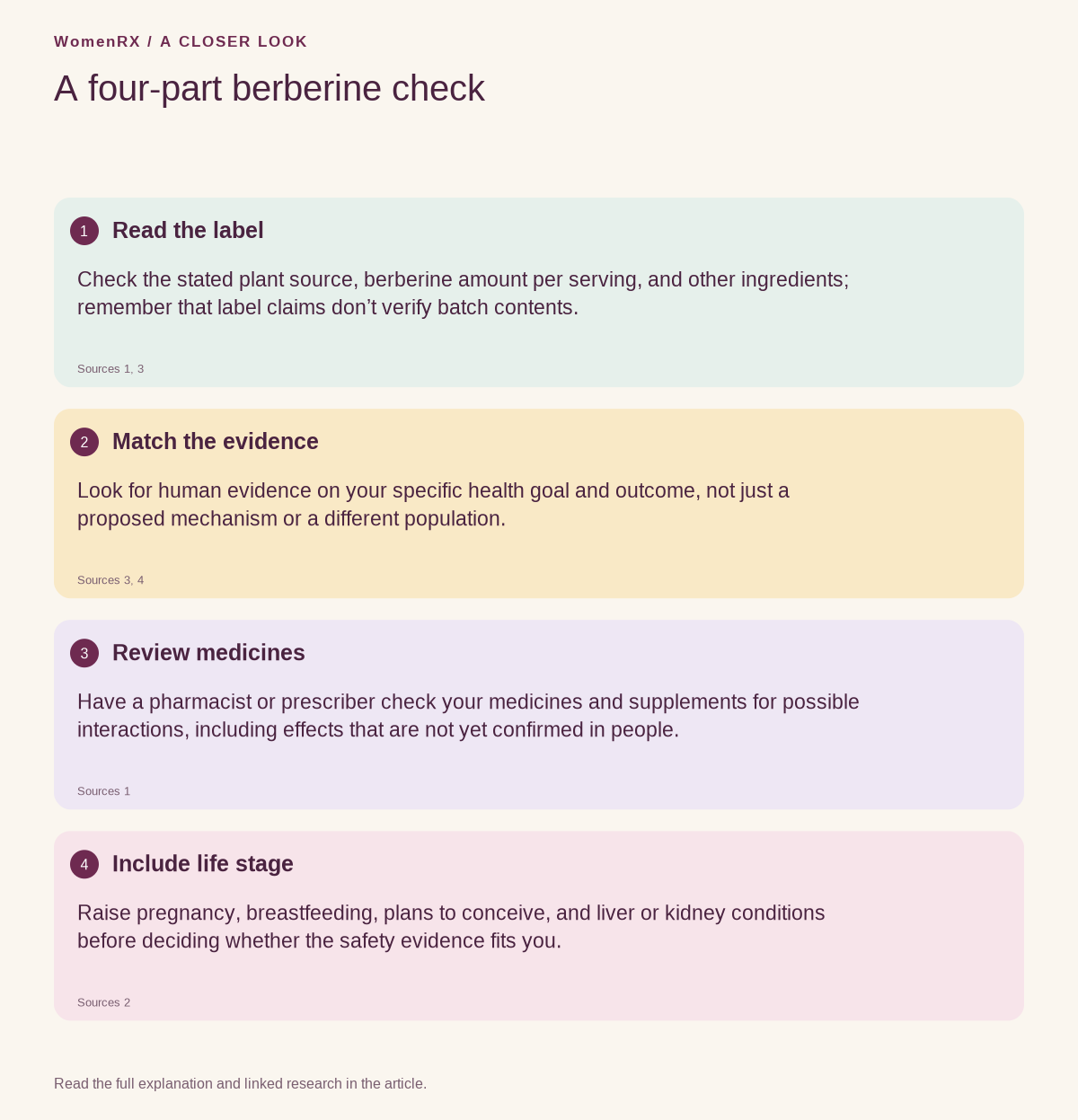
A four-part berberine check
Read the label: Check the stated plant source, berberine amount per serving, and other ingredients; remember that label claims don’t verify batch contents.13
Match the evidence: Look for human evidence on your specific health goal and outcome, not just a proposed mechanism or a different population.34
Review medicines: Have a pharmacist or prescriber check your medicines and supplements for possible interactions, including effects that are not yet confirmed in people.1
Include life stage: Raise pregnancy, breastfeeding, plans to conceive, and liver or kidney conditions before deciding whether the safety evidence fits you.2
Read the figure as text
Use these questions to separate label claims from evidence and the personal safety details that need review.- Read the label: Check the stated plant source, berberine amount per serving, and other ingredients; remember that label claims don’t verify batch contents.13
- Match the evidence: Look for human evidence on your specific health goal and outcome, not just a proposed mechanism or a different population.34
- Review medicines: Have a pharmacist or prescriber check your medicines and supplements for possible interactions, including effects that are not yet confirmed in people.1
- Include life stage: Raise pregnancy, breastfeeding, plans to conceive, and liver or kidney conditions before deciding whether the safety evidence fits you.2
More questions, answered
Does a precise amount on the label guarantee that much berberine is in the bottle?
No. A label states what the product claims to contain. Reviews describe variability in botanical identity and alkaloid content, so the label alone can’t verify the contents of a particular batch. 13
Should I check with someone even if I take only one prescription medicine?
Yes, it’s worth asking about that specific medicine. Interaction evidence varies: some proposed effects are mechanistic, while a change in cyclosporine exposure has been reported in people. A pharmacist or prescriber can assess your actual medication rather than relying on a broad interaction list. 1
Sources you can check
- Berberine-Drug Interactions: Mechanisms, Clinical Relevance and Risk Stratification-A Narrative Review.Dumitru CN, Marcu T, Dumitru AO, Tudor SS, Ferțu ID, Elisei AM, Goroftei L. · Pharmaceuticals (Basel, Switzerland) · 2026Return to first citation
- Balancing efficacy and risk: A toxicological review and safety transformation of Berberis plants and their alkaloids.Ma J, Lan X, Luo X, Jing Y, Yin Y, Du H, Li Q, Fan G. · Phytomedicine : international journal of phytotherapy and phytopharmacology · 2026Return to first citation
- Defined Natural Products as Adjunctive Therapies: Evidence-Gated Polypharmacology Across Molecular Targets, Human Exposure, Clinical Signals, and Safety Boundaries.Seo Y, Woo J. · International journal of molecular sciences · 2026Return to first citation
- Adjunctive berberine for schizophrenia with metabolic syndrome: a systematic review and meta-analysis.Xie K, Tian W, Zhang Y, Zhang Y, Li J, Cao D, Pan W. · Frontiers in psychiatry · 2026Return to first citation