Who Should Check Before Taking Berberine?
Berberine can affect how some medicines work, so the first question is how it fits with the treatment you already take.
Check with a clinician or pharmacist before taking berberine if you use prescription medicines, especially glucose-lowering treatment or cyclosporine. A human interaction has been documented with cyclosporine; other proposed interactions are less certain. Digestive effects also occur in berberine trials. If you’re pregnant or breastfeeding, don’t assume that metabolic-health research answers the safety question for you or your baby.584
Start with the treatment you already take
Berberine is often discussed in terms of blood sugar, but a change in a lab result isn’t the same as proof that it can take the place of diabetes care. A review of natural products found improvements in measures of glucose control with berberine, but not evidence that it prevents cardiovascular or kidney outcomes. Diabetes treatment is tailored to the type of diabetes and may include medicines, glucose checks, and lifestyle changes. Don’t replace an agreed treatment plan with a supplement on the strength of a metabolic claim.63
If you take insulin or another glucose-lowering medicine, make berberine part of a medication review before adding it. Low blood glucose is already a risk with insulin and some other diabetes medicines. A review of berberine interactions identifies additive glucose-lowering effects as a potential concern, but that doesn’t tell us the size of the risk for your particular combination.25
Some interactions are documented; others are plausible
The clearest named example in the interaction review is cyclosporine: its exposure increased in renal-transplant recipients who also received berberine. That finding matters because a change in the amount of a medicine reaching your bloodstream can matter even when the supplement itself is poorly absorbed. The review describes other possible interactions through the gut and the systems that process medicines, but notes that human evidence exists for only a few specific drug pairs. It isn’t a reason to assume berberine interacts with every prescription, or that an unstudied combination is safe.5
A focused review is more useful than trying to memorize an interaction list. Bring the exact berberine product and a list of your prescription medicines, over-the-counter medicines, and other supplements. Ask: Is there a known interaction with anything I take? Could adding berberine change my glucose plan? Would any medicine need closer monitoring? This is especially worth doing if you take several medicines or one whose effect needs careful monitoring.5
What digestive effects should you expect?
Stomach symptoms are a practical reason to think twice, not a minor detail to push through. In a systematic review of trials involving people with nonalcoholic fatty liver disease, gastrointestinal reactions were the main adverse effects reported in the studies that recorded them. Reports included nausea, diarrhea, constipation, and reflux. Those trials involved particular participants and treatment combinations, so they don’t establish how likely each symptom is for someone taking berberine on its own.8
If you already have frequent diarrhea or a sensitive stomach, factor that into the decision. And if diarrhea lasts more than a few days, don’t automatically attribute it to a supplement: persistent diarrhea can have other causes.1
Pregnancy, breastfeeding, and PCOS change the question
Research in women with polycystic ovary syndrome (PCOS) has examined metabolic and reproductive-health measures.7 A network meta-analysis included berberine studies, but its authors cautioned that the berberine adverse-event findings relied on a single trial and that some trial reports described adverse events unclearly. It doesn’t establish safety during pregnancy or breastfeeding.7
If you’re pregnant, planning a pregnancy, or breastfeeding, raise that specifically before using berberine. Breastfeeding decisions deserve their own review because substances can pass into breast milk, but that general fact does not establish whether berberine does, or at what level.4 The sensible question isn’t whether berberine is “natural.” It’s whether there’s enough information to justify adding it to your current care when your circumstances may change who is exposed.
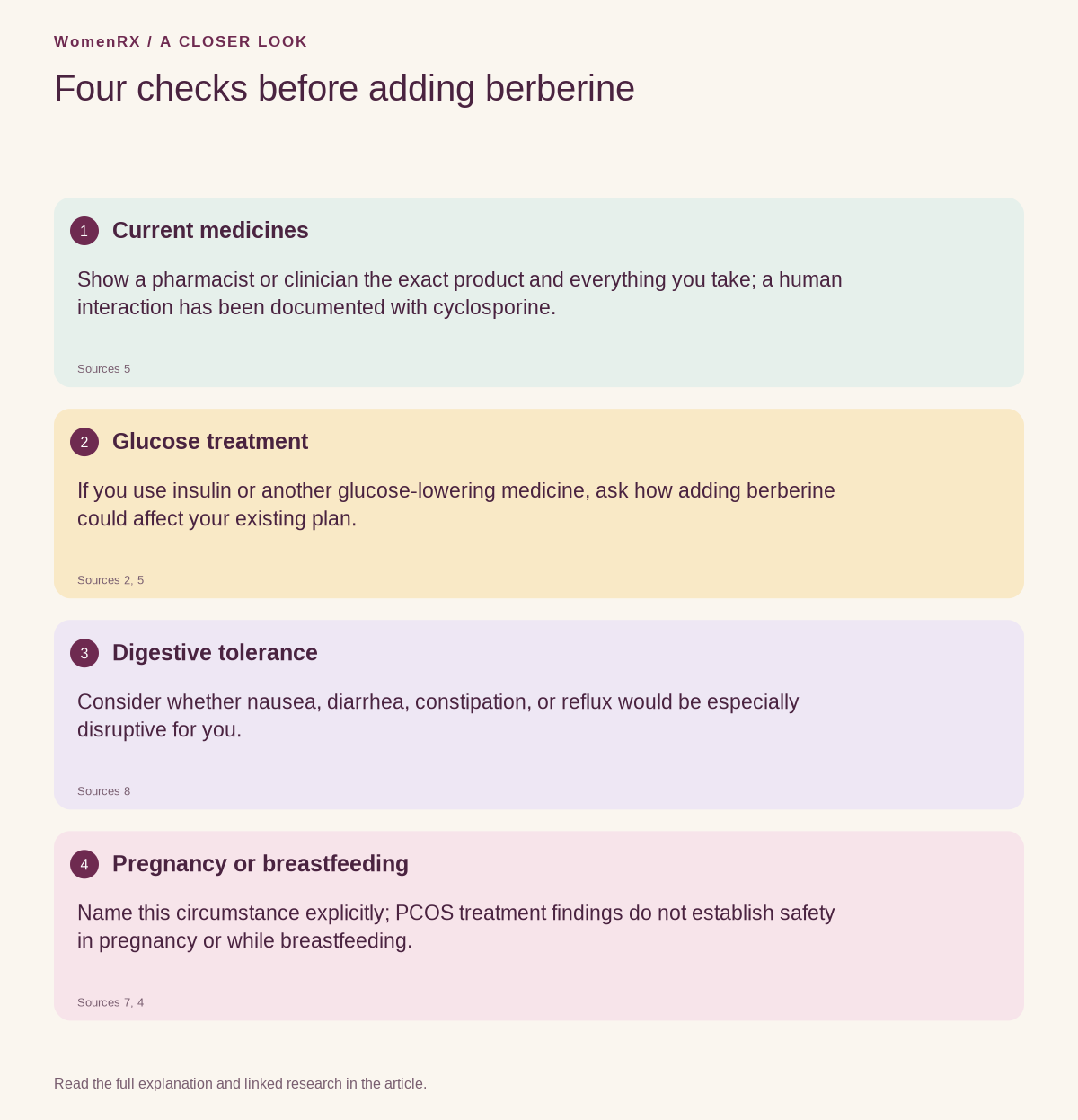
Four checks before adding berberine
Current medicines: Show a pharmacist or clinician the exact product and everything you take; a human interaction has been documented with cyclosporine.5
Glucose treatment: If you use insulin or another glucose-lowering medicine, ask how adding berberine could affect your existing plan.25
Digestive tolerance: Consider whether nausea, diarrhea, constipation, or reflux would be especially disruptive for you.8
Pregnancy or breastfeeding: Name this circumstance explicitly; PCOS treatment findings do not establish safety in pregnancy or while breastfeeding.74
Read the figure as text
Use these distinct questions to see where a supplement might complicate your current care. This is a conversation guide, not an interaction test.- Current medicines: Show a pharmacist or clinician the exact product and everything you take; a human interaction has been documented with cyclosporine.5
- Glucose treatment: If you use insulin or another glucose-lowering medicine, ask how adding berberine could affect your existing plan.25
- Digestive tolerance: Consider whether nausea, diarrhea, constipation, or reflux would be especially disruptive for you.8
- Pregnancy or breastfeeding: Name this circumstance explicitly; PCOS treatment findings do not establish safety in pregnancy or while breastfeeding.74
More questions, answered
Does berberine research in PCOS mean it can replace metformin?
No. Trials in women with PCOS have examined metabolic and hormonal measures, but the berberine comparisons and adverse-event information were limited. Those findings don’t establish that switching from a prescribed treatment will meet your particular goals.7
Sources you can check
- Diarrhea | MedlinePlusAccessed 2026-09-25Return to first citation
- Hypoglycemia: MedlinePlusAccessed 2026-09-25Return to first citation
- Diabetes - NHSAccessed 2026-09-25Return to first citation
- Breastfeeding | Benefits of Breastfeeding | MedlinePlusAccessed 2026-09-25Return to first citation
- Berberine-Drug Interactions: Mechanisms, Clinical Relevance and Risk Stratification-A Narrative Review.Dumitru CN, Marcu T, Dumitru AO, Tudor SS, Ferțu ID, Elisei AM, Goroftei L. · Pharmaceuticals (Basel, Switzerland) · 2026Return to first citation
- Defined Natural Products as Adjunctive Therapies: Evidence-Gated Polypharmacology Across Molecular Targets, Human Exposure, Clinical Signals, and Safety Boundaries.Seo Y, Woo J. · International journal of molecular sciences · 2026Return to first citation
- Comparative efficacy of oral insulin sensitizers metformin, thiazolidinediones, inositol, and berberine in improving endocrine and metabolic profiles in women with PCOS: a network meta-analysis.Zhao H, Xing C, Zhang J, He B. · Reproductive health · 2021Return to first citation
- The clinical efficacy and safety of berberine in the treatment of non-alcoholic fatty liver disease: a meta-analysis and systematic review.Nie Q, Li M, Huang C, Yuan Y, Liang Q, Ma X, Qiu T, Li J. · Journal of translational medicine · 2024Return to first citation