Berberine After 40: What the Research Actually Says
Berberine has been studied in adults with metabolic concerns, but age 40 or menopause hasn’t been shown to make it more useful.
The research doesn’t show that turning 40, entering perimenopause, or being postmenopausal creates a special reason to take berberine. Adult studies have examined outcomes such as cholesterol, blood sugar, and weight, but age-specific results for midlife women are limited. One review found no relationship between age and berberine’s effect on obesity measures, which doesn’t prove the effect is identical at every age. 1 3
What “after 40” does, and doesn’t, tell you
Age can shape health risks, but it isn’t evidence that a supplement will work better. The berberine studies summarized here mainly focus on adults with metabolic concerns and outcomes such as cholesterol, blood sugar, or body measurements. They don’t establish that women over 40 respond differently from younger adults, or that perimenopause or menopause changes the potential benefit.
That distinction matters when a product is marketed specifically to midlife women. A study in adults may be relevant to an adult woman with the condition being studied, but it isn’t automatically evidence for an age-specific or menopause-related benefit.
What the studies measure
For cholesterol, a 2023 review pooled 18 randomized, placebo-controlled trials involving 1,788 adults. Across the studies, which lasted 4 to 24 weeks, berberine was associated with small average reductions in LDL cholesterol and triglycerides. The review reported a difference in HDL findings between women and men, but that is a sex-based result, not evidence that women over 40 or women after menopause benefit more. These trials measured blood lipids, not whether berberine prevents heart attacks or strokes. 1
For blood sugar, an umbrella review of meta-analyses reported improvements in measures including fasting blood glucose and HbA1c in adults with metabolic disorders. Those findings concern metabolic measures; they don’t show that berberine is a menopause treatment or that it is useful for someone without the health issue being studied. 2
Weight-related evidence offers one direct look at age. A 2026 review of 23 randomized trials reported modest average reductions in weight, BMI, and waist circumference, but not waist-to-hip ratio. Its meta-regression found no association between age and berberine use. That analysis doesn’t establish that effects are exactly the same across ages, and it doesn’t answer whether the results apply specifically to midlife women. 3
The age gap is not the same as proof of no effect
The studies summarized here don’t provide a clear comparison of women in their 40s, 50s, and older age groups, or report results by perimenopausal and postmenopausal status. That leaves a real evidence gap: there isn’t a sound basis here for saying berberine works better, works less well, or works differently because of menopause.
There is also a difference between improving a short-term measurement and improving health in the long run. The lipid review called for larger trials assessing clinical outcomes, and its trials lasted no longer than 24 weeks. A change in a lab result alone doesn’t establish protection from future disease. 1
A more useful way to judge whether it’s relevant
Start with the outcome, not the age label. If you’re considering berberine because of a cholesterol, blood-sugar, or weight concern, ask whether evidence for that specific outcome applies to your situation. Don’t assume research on one measure, such as cholesterol, demonstrates benefits for menopause symptoms or general “metabolic health.”
It’s also reasonable to separate a measurable health goal from a broad marketing promise. The adult studies do offer evidence about some metabolic measures, but they don’t establish a special benefit for women after 40. So age alone isn’t a research-backed reason to use berberine; the condition and outcome you’re trying to address are more relevant.
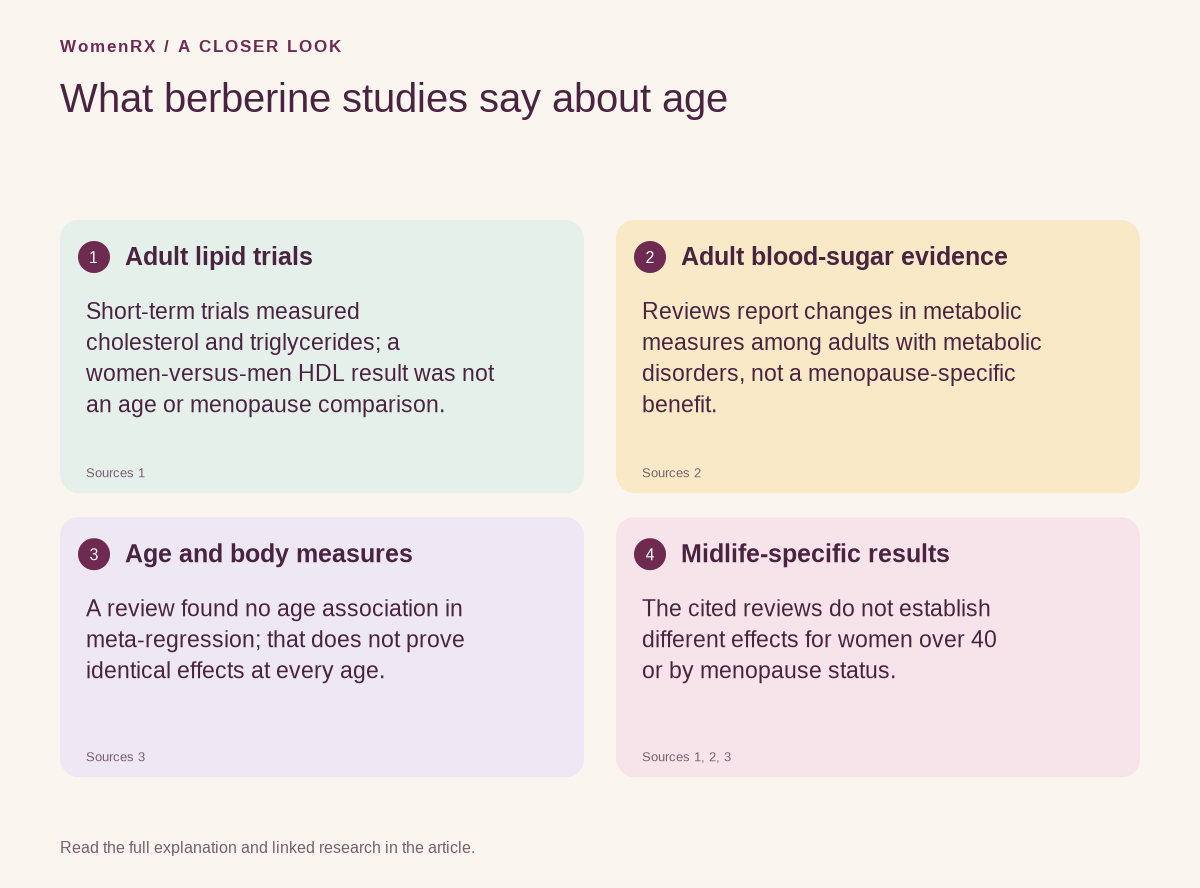
What berberine studies say about age
Adult lipid trials: Short-term trials measured cholesterol and triglycerides; a women-versus-men HDL result was not an age or menopause comparison.1
Adult blood-sugar evidence: Reviews report changes in metabolic measures among adults with metabolic disorders, not a menopause-specific benefit.2
Age and body measures: A review found no age association in meta-regression; that does not prove identical effects at every age.3
Midlife-specific results: The cited reviews do not establish different effects for women over 40 or by menopause status.123
Read the figure as text
The evidence speaks to some adult metabolic measures, but offers little direct information about midlife or menopause-specific effects.- Adult lipid trials: Short-term trials measured cholesterol and triglycerides; a women-versus-men HDL result was not an age or menopause comparison.1
- Adult blood-sugar evidence: Reviews report changes in metabolic measures among adults with metabolic disorders, not a menopause-specific benefit.2
- Age and body measures: A review found no age association in meta-regression; that does not prove identical effects at every age.3
- Midlife-specific results: The cited reviews do not establish different effects for women over 40 or by menopause status.123
More questions, answered
Does the finding about women’s HDL results mean berberine works better after menopause?
No. The review reported a difference in HDL results between women and men, but it did not establish that age or menopause explains that difference. A sex-based subgroup result shouldn’t be treated as a result for women over 40 specifically. 1
Sources you can check
- Overall and Sex-Specific Effect of Berberine for the Treatment of Dyslipidemia in Adults: A Systematic Review and Meta-Analysis of Randomized Placebo-Controlled Trials.Blais JE, Huang X, Zhao JV. · Drugs · 2023Return to first citation
- The Effect of Berberine Supplementation on Glycemic Control and Inflammatory Biomarkers in Metabolic Disorders: An Umbrella Meta-analysis of Randomized Controlled Trials.Nazari A, Ghotbabadi ZR, Kazemi KS, Metghalchi Y, Tavakoli R, Rahimabadi RZ, Ghaheri M. · Clinical therapeutics · 2024Return to first citation
- The effect of berberine on obesity indices: a systematic review and meta-analysis.Elahi Vahed I, Shahir-Roudi E, Nojumi S, Golmohammadi S, Moradi Shahrebabak M, Sharafi Tafreshi Moghadam N, Bagheryan AS, Moftakhar M, Shamsipour F, Jafari M, Soltaninejad H, Rahma... · International journal of obesity (2005) · 2026Return to first citation