How to Check Berberine’s Glucose and Weight Claims
A promising glucose result for one berberine preparation doesn’t prove that another product will help with weight.
Check the exact ingredients and amount on the label, then look for human research on the outcome the product promises. Berberine has shown improvements in glucose markers in some studies, but those findings don’t establish weight loss from a retail supplement. If you take medicines or are pregnant, trying to conceive, or breastfeeding, get guidance on your specific product before using it. 2 3
First, separate the two promises
“Glucose support” and “weight management” can appear side by side on a berberine label, but they’re different claims. Research showing a change in blood sugar markers doesn’t show that a product helps people lose weight. For a weight claim, look for a human study that measured body weight and tested a comparable ingredient, rather than accepting a glucose study as a stand-in.
There is a reason glucose appears in the marketing. A 2024 umbrella analysis of earlier reviews reported improvements in several glucose measures among adults taking berberine, while noting that findings across the earlier reviews had been inconsistent. That supports a closer look at the research, not an assumption that every formulation works alike. 3
Read the label alongside the study
Identify the preparation. Write down the stated form of berberine and every other active ingredient. This matters because a trial may test a specific preparation rather than the ingredient in the bottle you’re considering. For example, a phase 2 trial tested berberine ursodeoxycholate, also called HTD1801. Its results cannot simply be transferred to a different berberine formulation. 4
Compare the amount, without treating it as instructions. Check the amount per serving and the label’s suggested number of servings. Then see what the relevant study actually tested. In a 12-week, placebo-controlled pilot trial, researchers gave a named berberine preparation to 34 people with prediabetes at 500 mg three times daily. That was the study protocol, not a recommended amount for you or proof that a differently formulated product will have the same effect. 2
Find the outcome behind the claim. If the label promises glucose support, did the study measure glucose or HbA1c? If it promises weight management, did the study measure body weight, and what happened compared with a control group? Also check who participated. Results in people with prediabetes or type 2 diabetes shouldn’t be presented as if they establish an effect in everyone. 2 4
Ask what the testing disclosure covers. Does the company say who tested the product, what they tested, and whether the test was on the finished product rather than only an ingredient? A clear disclosure helps you evaluate what the company has checked. It isn’t a clinical trial, and it doesn’t establish that the product delivers either advertised benefit.
Check the full label against your medicines. Bring all the ingredients to a pharmacist, not just the word “berberine.” If you take medicine for blood sugar, a useful question is whether a supplement being considered for glucose effects changes anything about your care plan. NIH’s Office of Dietary Supplements warns that some weight-loss supplement ingredients can interfere with medicines, but that general warning does not identify a specific interaction for the product in your hand. 1 2
What a glucose result can and can’t tell you
The small prediabetes pilot reported improvements in glucose-control markers in its berberine group compared with placebo after 12 weeks. It doesn’t establish long-term outcomes or tell you what will happen with another formulation. The reported results also aren’t broken out by sex, so they don’t tell us whether women responded differently. 2
The HTD1801 trial involved 113 adults with type 2 diabetes in China and lasted 12 weeks. It found greater HbA1c reductions with that specific preparation than with placebo. Seventy-two participants were men, and the reported results do not establish a separate effect for women. It was a glucose-focused trial of a distinct formulation, not proof of weight loss from an ordinary retail berberine supplement. 4
Pregnancy, trying to conceive, and breastfeeding need a separate decision. These glucose studies do not establish whether berberine products are appropriate in those situations. If one applies to you, ask your obstetric clinician about the full product before buying or using it rather than relying on results from adults studied for glucose outcomes. 2 4
The most useful comparison is between this bottle and that study: preparation, amount, participants, and measured outcome. A mismatch doesn’t automatically tell you the product has no effect. It tells you the cited result isn’t enough to substantiate its claim.
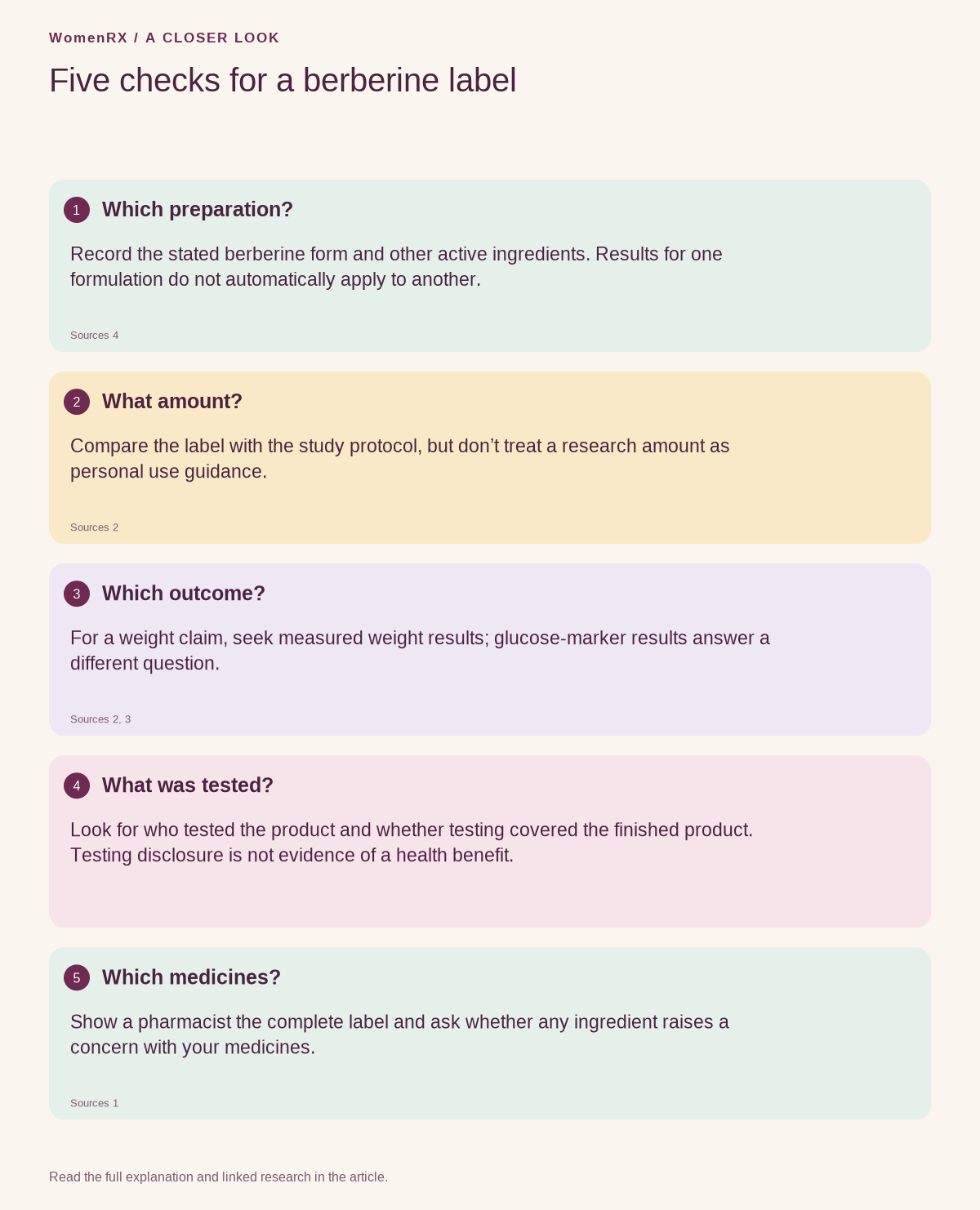
Five checks for a berberine label
Which preparation?: Record the stated berberine form and other active ingredients. Results for one formulation do not automatically apply to another.4
What amount?: Compare the label with the study protocol, but don’t treat a research amount as personal use guidance.2
Which outcome?: For a weight claim, seek measured weight results; glucose-marker results answer a different question.23
What was tested?: Look for who tested the product and whether testing covered the finished product. Testing disclosure is not evidence of a health benefit.
Which medicines?: Show a pharmacist the complete label and ask whether any ingredient raises a concern with your medicines.1
Read the figure as text
Use these questions to distinguish what a bottle says from what a study tested.- Which preparation?: Record the stated berberine form and other active ingredients. Results for one formulation do not automatically apply to another.4
- What amount?: Compare the label with the study protocol, but don’t treat a research amount as personal use guidance.2
- Which outcome?: For a weight claim, seek measured weight results; glucose-marker results answer a different question.23
- What was tested?: Look for who tested the product and whether testing covered the finished product. Testing disclosure is not evidence of a health benefit.
- Which medicines?: Show a pharmacist the complete label and ask whether any ingredient raises a concern with your medicines.1
More questions, answered
Is a named berberine trial evidence for a different brand?
Not on its own. Check whether the ingredient form, other active ingredients, amount, study participants, and measured outcome match. Trials of named preparations establish results for what researchers tested, not every product bearing the word “berberine.” 2 4
Sources you can check
- Dietary Supplements for Weight Loss - Health Professional Fact SheetAccessed 2026-09-25Return to first citation
- Efficacy and safety of HIMABERB® Berberine on glycemic control in patients with prediabetes: double-blind, placebo-controlled, and randomized pilot trial.Panigrahi A, Mohanty S. · BMC endocrine disorders · 2023Return to first citation
- The Effect of Berberine Supplementation on Glycemic Control and Inflammatory Biomarkers in Metabolic Disorders: An Umbrella Meta-analysis of Randomized Controlled Trials.Nazari A, Ghotbabadi ZR, Kazemi KS, Metghalchi Y, Tavakoli R, Rahimabadi RZ, Ghaheri M. · Clinical therapeutics · 2024Return to first citation
- Berberine Ursodeoxycholate for the Treatment of Type 2 Diabetes: A Randomized Clinical Trial.Ji L, Ma J, Ma Y, Cheng Z, Gan S, Yuan G, Liu D, Li S, Liu Y, Xue X, Bai J, Wang K, Cai H, Li S, Liu K, Yu M, Liu L. · JAMA network open · 2025Return to first citation