Can You Get Hair Loss Assessed and Treated Online?
An online visit can be a useful first step, but the right treatment depends on why your hair is changing.
Yes. A remote clinician can review your history and scalp images, discuss possible causes, and sometimes recommend treatment. But an online assessment may lead to an in-person exam, blood test, or scalp biopsy if the cause remains unclear. If your usual fullness hasn’t returned by your baby’s first birthday, a dermatology assessment can investigate another cause. 9111
What an online visit can do
Hair loss isn’t one condition. Gradual thinning, noticeable shedding, and distinct bald patches can point toward different explanations, and the treatment that fits one may not fit another. A remote visit is most useful as an assessment, not simply a way to order a product. A clinician can consider your account of what changed alongside images of your hair and scalp, then decide whether there’s enough information to suggest a cause or whether you need to be examined. 911
There’s evidence that this approach can work for some people. In a retrospective study of 321 teledermatology cases already classified as non-scarring hair loss, clinicians made a definitive diagnosis remotely in 91.3%; the remaining 8.7% needed in-person evaluation, often for a biopsy or further clarification. That result describes a particular group in one health system, not the chance that any new hair-loss concern can be settled online. The study did not consistently capture long-term treatment outcomes or report a women-specific result. 9
Another two-year review, from a safety-net hospital’s electronic dermatology consultation service, found that 58% of consultations for hair loss were referred for in-person evaluation. The studies looked at different services and patient groups, so their percentages shouldn’t be treated as competing promises. Together, they show why a good online service needs a route to further care rather than assuming every case can be handled through photos. 59
Bring the story behind the photos
Before the visit, jot down when the change began and what you’re seeing: more hair coming out during washing, a gradually wider part, or a patch where hair is missing, for example. If you have earlier photos that show the change, they may help you describe its course. Tell the clinician about recent illness, childbirth, and whether close relatives have had similar thinning. Illness can be associated with temporary hair loss, while pattern hair loss often runs in families. 1311 Note any changes in your medicines, too. These details are clues, not a way to diagnose yourself.
Include changes in your periods and whether you’re in perimenopause or postmenopause when they apply to you. If you’re pregnant, say so too. These are useful parts of your history, not proof that hormones are causing the hair loss.
If you’ve recently given birth, timing is especially useful. Postpartum shedding often starts a few months after delivery as estrogen falls, usually peaks around four months, and most women regain their usual fullness by their baby’s first birthday. Postpartum shedding can also occur alongside another type of hair loss, so childbirth doesn’t settle the diagnosis by itself. 17
When online care may not be enough
If the remote clinician can’t identify the cause confidently, ask what would clarify it. A dermatologist may use blood tests or a scalp biopsy when a disease, deficiency, hormone imbalance, or infection is suspected. Hair loss can have more than one cause at once. These are reasons for a fuller evaluation, not tests everyone needs before treatment. 11
If your scalp is painful or inflamed where you’re losing hair, seek an examination rather than relying on a routine thinning-hair treatment. An inflammatory form of hair loss can call for a different approach. Likewise, a distinct bald patch shouldn’t automatically be treated as the same problem as gradual pattern thinning. 11
If postpartum fullness hasn’t returned by your baby’s first birthday, a dermatology assessment can investigate another cause. You can also seek further evaluation sooner whenever the loss worries you or an online explanation doesn’t fit what you’re seeing. Concern about hair loss is itself a reasonable reason to seek care; you don’t have to wait for it to meet a particular visual threshold. 1311
One real online-care price to compare
As checked September 26, 2026, Nurx lists $80 for its hair-loss and scalp-treatment consultation, paid when you submit the request. The fee covers one year of care, including assessment, a treatment plan, prescriptions when appropriate, follow-up and messaging. A new annual consultation is needed for renewal, and Nurx says it does not bill insurance for this consultation. Medication costs are separate. 13
That is a defined service price, not an $80 promise of a year's medicine or a guaranteed prescription. Ask for the proposed treatment's exact quantity and refill charge after the assessment. When comparing another provider, check whether its price buys a single visit, a year of follow-up or a recurring membership.
Treatment depends on the diagnosis
For female pattern hair loss, minoxidil is one treatment a clinician may discuss. Spironolactone is another possible option for some women with that diagnosis. If pregnancy is possible, raise it with the prescribing clinician: spironolactone can cause birth defects, and you must not become pregnant while taking it. 11 Neither is a catch-all answer for shedding after an illness, postpartum shedding, a bald patch, or a scalp condition. 311
A useful outcome from an online visit might be a treatment plan. It might instead be a clear reason to arrange an exam or testing. Either way, the goal is to match the next step to your pattern and history, rather than choosing a hair-growth product before anyone has considered the cause. 911
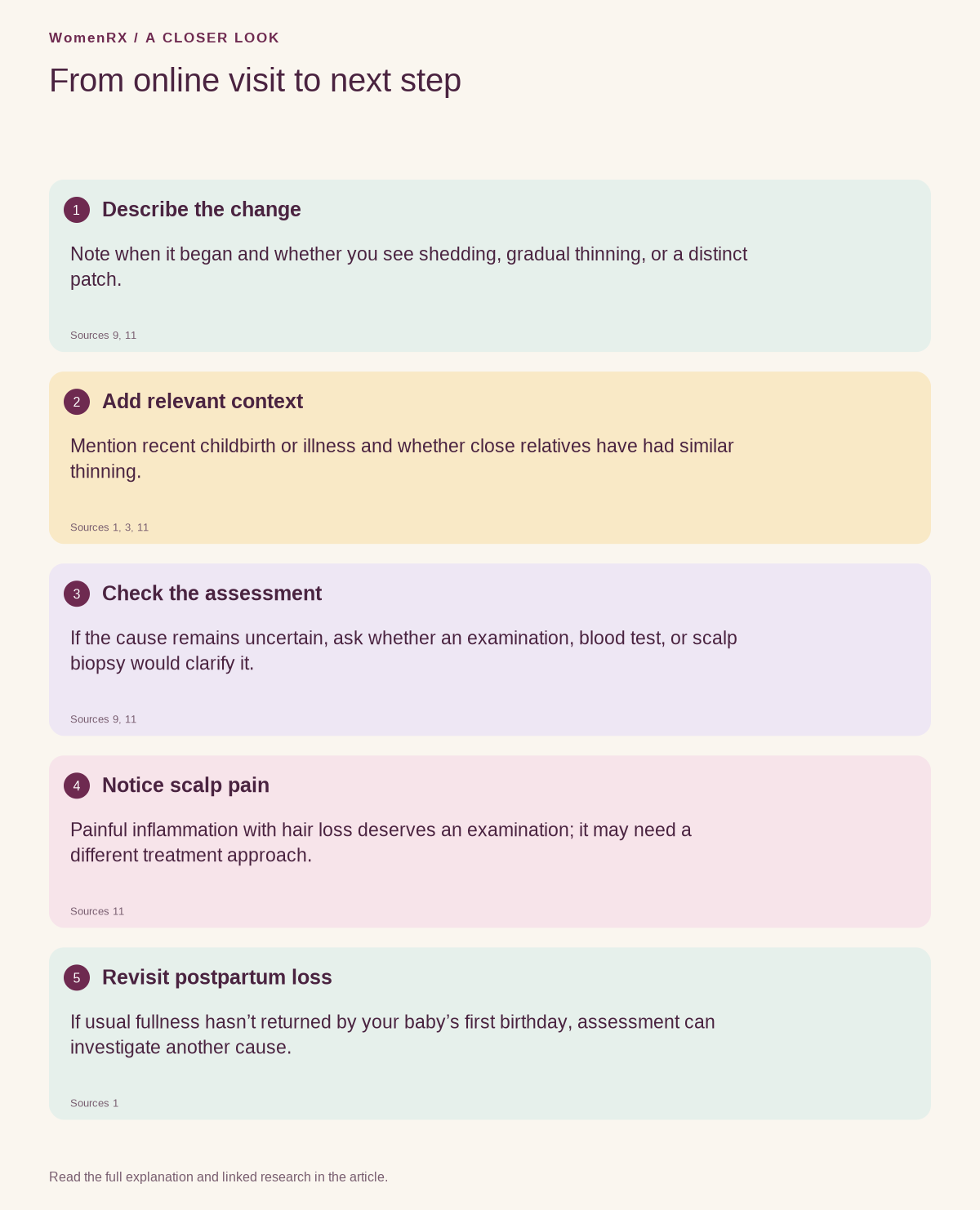
From online visit to next step
Describe the change: Note when it began and whether you see shedding, gradual thinning, or a distinct patch.911
Add relevant context: Mention recent childbirth or illness and whether close relatives have had similar thinning.1311
Check the assessment: If the cause remains uncertain, ask whether an examination, blood test, or scalp biopsy would clarify it.911
Notice scalp pain: Painful inflammation with hair loss deserves an examination; it may need a different treatment approach.11
Revisit postpartum loss: If usual fullness hasn’t returned by your baby’s first birthday, assessment can investigate another cause.1
Read the figure as text
Use your history to make a remote assessment useful, then choose follow-up based on what it can establish.- Describe the change: Note when it began and whether you see shedding, gradual thinning, or a distinct patch.911
- Add relevant context: Mention recent childbirth or illness and whether close relatives have had similar thinning.1311
- Check the assessment: If the cause remains uncertain, ask whether an examination, blood test, or scalp biopsy would clarify it.911
- Notice scalp pain: Painful inflammation with hair loss deserves an examination; it may need a different treatment approach.11
- Revisit postpartum loss: If usual fullness hasn’t returned by your baby’s first birthday, assessment can investigate another cause.1
Sources you can check
- Hair loss in new moms: Dermatologist tipsAccessed 2026-09-25Return to first citation
- Hair loss - NHSAccessed 2026-09-25Return to first citation
- Optimizing Dermatological Care Triage in a Safety-Net Hospital: Retrospective Analysis of Diagnoses and In-Person Referrals.Shih A, Riopelle A, Ordan A, Sanchez S, Bhawan J, Lam CS. · Southern medical journal · 2024Return to first citation
- Postpartum Telogen Effluvium Unmasking Additional Latent Hair Loss Disorders.Galal SA, El-Sayed SK, Henidy MMH. · The Journal of clinical and aesthetic dermatology · 2024Return to first citation
- Asynchronous Teledermatology for Non-Scarring Alopecia: A Retrospective Study.Afolabi A, Brown E, Ha EK, English JC. · Telemedicine reports · 2025Return to first citation
- Hair loss: Diagnosis and treatmentAccessed 2026-09-25Return to first citation
- Nurx: Hair Loss and Scalp Treatment CostsAccessed 2026-09-26Return to first citation