Can You Discuss Vaginal Estrogen Through Telehealth?
A remote visit can be a useful first conversation about vaginal or urinary symptoms, but some symptoms need an in-person assessment before treatment is chosen.
Yes. A telehealth clinician can ask about your symptoms, menopause stage, medical history, and what you’ve already tried; telemedicine may help with evaluating and following genitourinary symptoms of menopause. But dryness, pain, and urinary changes can have other causes. Visible skin changes or symptoms that don’t fit or improve may call for an examination. If you already use vaginal estrogen, mention unexpected or changing bleeding. 3 5 6 7

A remote conversation can be a reasonable first step
Vaginal dryness, burning or irritation, pain with sex, urinary urgency, and discomfort when urinating can occur with genitourinary syndrome of menopause (GSM), which is related to reduced estrogen after menopause. Similar symptoms can occur for other reasons, too. A review of GSM describes telemedicine as a possible setting for diagnosis, starting treatment, and follow-up, so an initial conversation doesn’t always require an office visit. It also doesn’t mean a prescription is guaranteed or that an examination will never be needed. 4 5
The point of the visit is to work out whether your symptoms fit GSM, whether another cause needs attention, and what treatment options make sense for you. You can prepare by describing what you notice in everyday terms, rather than trying to name the cause yourself.
Describe the symptoms and their pattern
Before the visit, consider when the symptoms began, where you feel them, and what brings them on or eases them. For example, mention whether discomfort is mostly at the vaginal opening or feels deeper during sex, whether it occurs only with penetration or at other times, and whether you also have urinary symptoms. These distinctions can help because intercourse-related pain may involve GSM, but can also relate to pelvic-floor tenderness, vulvar conditions, inflammation, or other pelvic causes. 6
It’s also useful to say whether symptoms are changing, whether you’ve noticed a visible sore, rash, or skin change, and what moisturizers, lubricants, or other treatments you’ve tried. Vulvar skin conditions can resemble GSM, so persistent or unusual skin symptoms may call for a focused examination rather than assuming low estrogen is the explanation. 7
If you have urinary symptoms, describe what they are and whether you’ve had repeated urinary tract infections. Recurrent UTIs can be part of the broader menopause-related picture, but urinary symptoms still need to be assessed in context. 4 8
Give the clinician the context that affects the discussion
Share whether you’re in perimenopause or postmenopause and your relevant medical history. If you already use vaginal estrogen, mention any bleeding that has started or changed during treatment. Mention a history of breast cancer and any current cancer treatment, including an aromatase inhibitor. Decisions about low-dose vaginal estrogen after breast cancer are individualized; the review describes a shared decision with oncology input as appropriate, with particular caution around aromatase inhibitor treatment. 3 4
You can also tell the clinician what matters to you: whether you prefer a cream, tablet, or vaginal ring, how comfortable you feel using an insert, and whether you want to discuss nonhormonal options first. Vaginal estrogen comes in different local forms, and symptom relief may take time; an NHS medicine reference says it can take up to three months to work fully. Ask what follow-up makes sense for the option being considered and what to do if symptoms persist or worsen. 1 2
When a remote visit may not be enough
An examination may help distinguish GSM from skin conditions, infection, pelvic-floor problems, or another cause of pain. It may also be needed when symptoms are unusual, persistent, worsening, or not responding as expected. If there’s visible vulvar change or a lesion, mention it clearly; when the diagnosis is uncertain, a focused examination can be important, and some cases may need further evaluation. 6 7
If you’re using vaginal estrogen, tell the clinician about heavy or unexpected bleeding, or bleeding that changes after several months of use. Bleeding can occur as a side effect, but it shouldn’t simply be assumed to be caused by treatment; the clinician can decide whether you need an examination or further assessment. 3
Ask how the plan will be checked
Before ending the visit, make sure you understand which symptoms the proposed treatment is meant to address, what alternatives are available, and when to follow up. Vaginal estrogen is used for local vaginal symptoms; it does not treat other menopause symptoms such as hot flashes. If the main concern is urinary, sexual, or vulvar pain, ask how the clinician will tell whether the plan is helping that particular problem and what would prompt an in-person visit. 1 6
If you’re comparing online offers, check the amount billed as well as the advertised monthly figure. For example, on September 25, 2026, Alloy advertised estradiol vaginal cream at $39.99 per month, with one tube described as a three-month supply billed at $119.97. Its page said delivery and doctor access were included at no additional charge. Those are that offer’s terms, not a guarantee that the same tube, cost, or treatment will suit you. Ask what the quoted price covers and whether a separate visit or any further assessment would cost extra. 9
A useful telehealth outcome isn’t necessarily a prescription. It’s a clear next step: a treatment discussion when the symptom pattern fits, or an examination or further assessment when the history suggests another explanation.
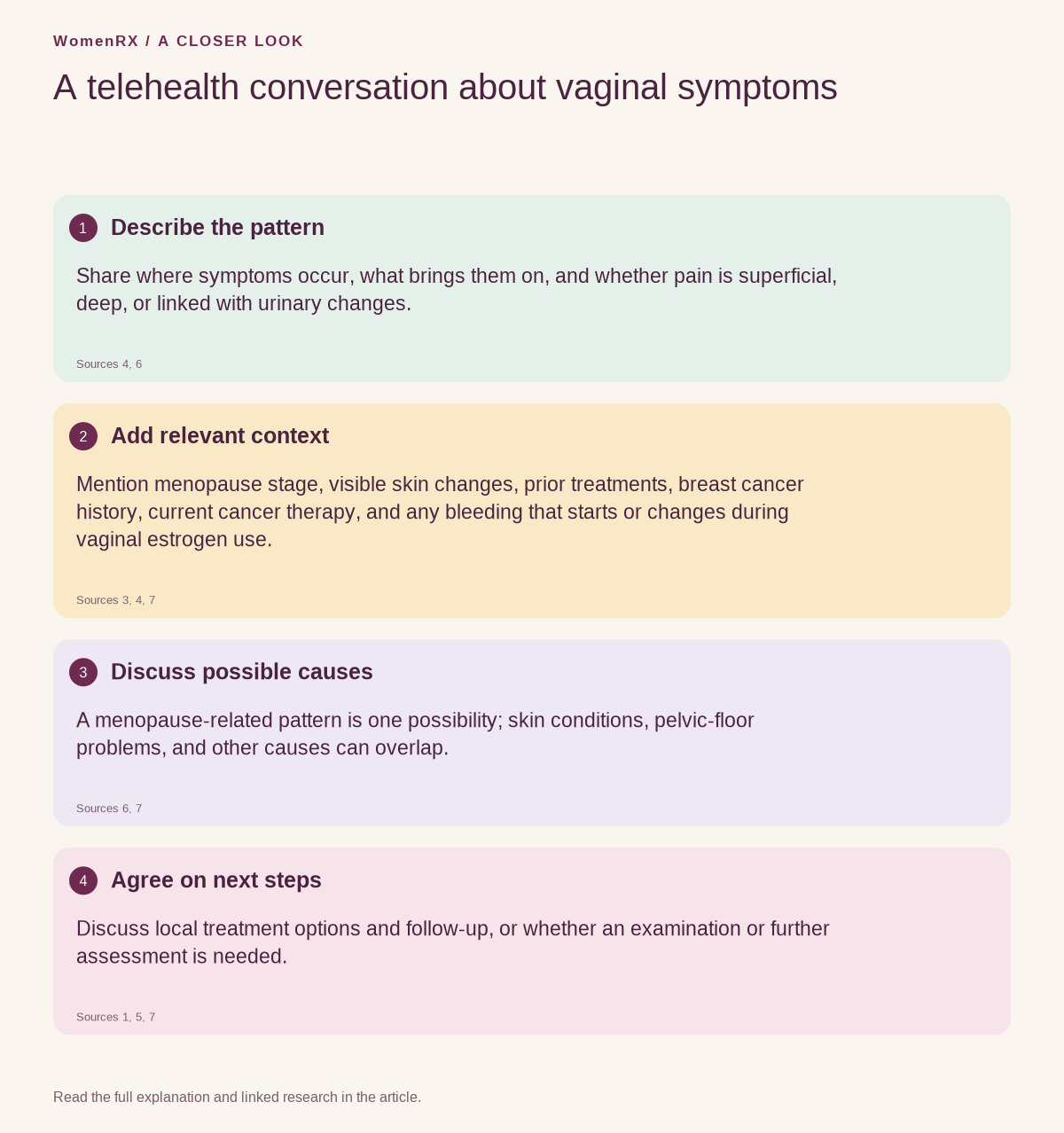
A telehealth conversation about vaginal symptoms
Describe the pattern: Share where symptoms occur, what brings them on, and whether pain is superficial, deep, or linked with urinary changes.46
Add relevant context: Mention menopause stage, visible skin changes, prior treatments, breast cancer history, current cancer therapy, and any bleeding that starts or changes during vaginal estrogen use.347
Discuss possible causes: A menopause-related pattern is one possibility; skin conditions, pelvic-floor problems, and other causes can overlap.67
Agree on next steps: Discuss local treatment options and follow-up, or whether an examination or further assessment is needed.157
Read the figure as text
Use this as a conversation map, not a diagnostic test: symptoms and history shape whether a remote discussion is enough or an examination is worth considering.- Describe the pattern: Share where symptoms occur, what brings them on, and whether pain is superficial, deep, or linked with urinary changes.46
- Add relevant context: Mention menopause stage, visible skin changes, prior treatments, breast cancer history, current cancer therapy, and any bleeding that starts or changes during vaginal estrogen use.347
- Discuss possible causes: A menopause-related pattern is one possibility; skin conditions, pelvic-floor problems, and other causes can overlap.67
- Agree on next steps: Discuss local treatment options and follow-up, or whether an examination or further assessment is needed.157
More questions, answered
Does vaginal estrogen treat hot flashes too?
No. Vaginal estrogen is used for local symptoms such as vaginal dryness and irritation; it does not treat other menopause symptoms such as hot flashes. 1
What if I’ve had breast cancer?
Say so during the visit, and mention any current endocrine treatment. Whether low-dose vaginal estrogen is appropriate is an individualized decision; oncology input is especially relevant for people taking aromatase inhibitors. 4
Sources you can check
- About vaginal oestrogen - NHSAccessed 2026-09-25Return to first citation
- Common questions about vaginal oestrogen - NHSAccessed 2026-09-25Return to first citation
- Side effects of vaginal oestrogen - NHSAccessed 2026-09-25Return to first citation
- Case-Based Perspectives on the Management of Genitourinary Syndrome of Menopause.Cyriac J, Sood R. · Clinics and practice · 2026Return to first citation
- The genitourinary syndrome of menopause.Phillips NA, Bachmann GA. · Menopause (New York, N.Y.) · 2021Return to first citation
- Assessment and management of dyspareunia in peri- and postmenopausal women: A phenotype-based gynecologic approach.Broul M, Vančo M, Banýrová J, Hujová A. · International journal of gynaecology and obstetrics: the official organ of the International Federation of Gynaecology and Obstetrics · 2026Return to first citation
- A Practical Management Approach to Vulvar Dermatoses and Genitourinary Syndrome of Menopause.Negris O, Ghafari-Saravi A, Mauskar MM. · Obstetrics and gynecology · 2026Return to first citation
- Vaginal Estrogen for Urinary Tract Infection Prevention: A Narrative Review of Evidence, Guidelines, and Regulatory Gaps.Ghasoub R, Mackay W, Shepherd A. · Gynecologic and obstetric investigation · 2026Return to first citation
- Alloy vaginal estradiol price and billingAccessed 2026-09-25Return to first citation