After Vaginal Estrogen Helps, What Should You Expect Next?
Feeling better doesn’t automatically mean you need to stop: the next step is a product-specific plan for maintenance and review.
After symptoms improve, ask how to continue your particular vaginal estrogen product and when to review the plan. There isn’t one maintenance schedule or a fixed stop date that fits everyone; formulations differ, and menopause-related symptoms can return if treatment stops. Periodic reassessment helps you weigh continued relief, side effects, and any changes in your health or preferences. 2 3 5
Improvement is a point to reassess, not an automatic finish line
Vaginal estrogen can ease menopause-related vaginal dryness and irritation, but feeling better doesn’t necessarily mean those symptoms will stay away without treatment. If you stop, symptoms may return. That possibility doesn’t mean you must continue forever; it means stopping, continuing, or changing the plan is a decision to make around your symptoms and circumstances. 1 2
A useful follow-up question is: “Now that I’m feeling better, what is the maintenance plan for this exact product, and when should we revisit it?” The answer may differ for a tablet, cream, gel, pessary, or ring. Their instructions and maintenance regimens aren’t interchangeable, so don’t borrow a schedule from a different product or change yours based on another person’s experience. 3
What to cover at a review
Bring the name of your product and describe what has improved and what hasn’t. For example, you might say that dryness has eased but sex is still uncomfortable, or that urinary irritation has improved but keeps returning. Those details help clarify whether the current treatment is meeting your goal or whether the plan needs another look.
It’s also useful to mention bothersome side effects, missed or difficult-to-use doses, and any changes in your health or preferences since treatment began. A menopause position statement from The North American Menopause Society recommends individualizing hormone therapy and periodically reevaluating its benefits and risks. It recommends low-dose vaginal estrogen for bothersome genitourinary symptoms when over-the-counter therapies haven’t helped and systemic hormone therapy isn’t otherwise indicated. That guidance supports regular reconsideration, not a single duration that applies to everyone. 5
A yearly review is one practical prompt: NHS medicine guidance recommends speaking with a prescriber at least once a year, while NAMS calls for periodic reevaluation. The right timing for you can depend on your product and history. 3 5
If symptoms come back
If dryness, irritation, or related symptoms return after a dose change or after stopping, tell your prescriber what changed and when. Symptoms returning is a reason to revisit the plan, not proof that you did anything wrong. Your prescriber may discuss continuing, adjusting, or switching treatment; guidance also notes that a gradual dose reduction may be suggested when stopping, but that isn’t a universal requirement. 2
If treatment hasn’t helped enough, or side effects are making it hard to use, ask whether the product or approach should be reconsidered. Different vaginal estrogen products have different instructions, and a clinician or pharmacist can help assess a possible switch. 2 3
New or unexpected vaginal bleeding after you’ve been using vaginal estrogen for a while deserves medical assessment. Don’t treat bleeding as simply a sign that symptoms are returning. 4
A simple plan to leave with
Before the review ends, make sure you know which product and instructions you’re following, what to do if symptoms return, and when you’ll revisit the decision. If your priorities change, such as wanting to stop or finding the regimen difficult, say so. The aim is a plan that continues to address your symptoms without assuming either that improvement means treatment must end or that treatment must continue indefinitely. 2 3 5
From symptom relief to the next review
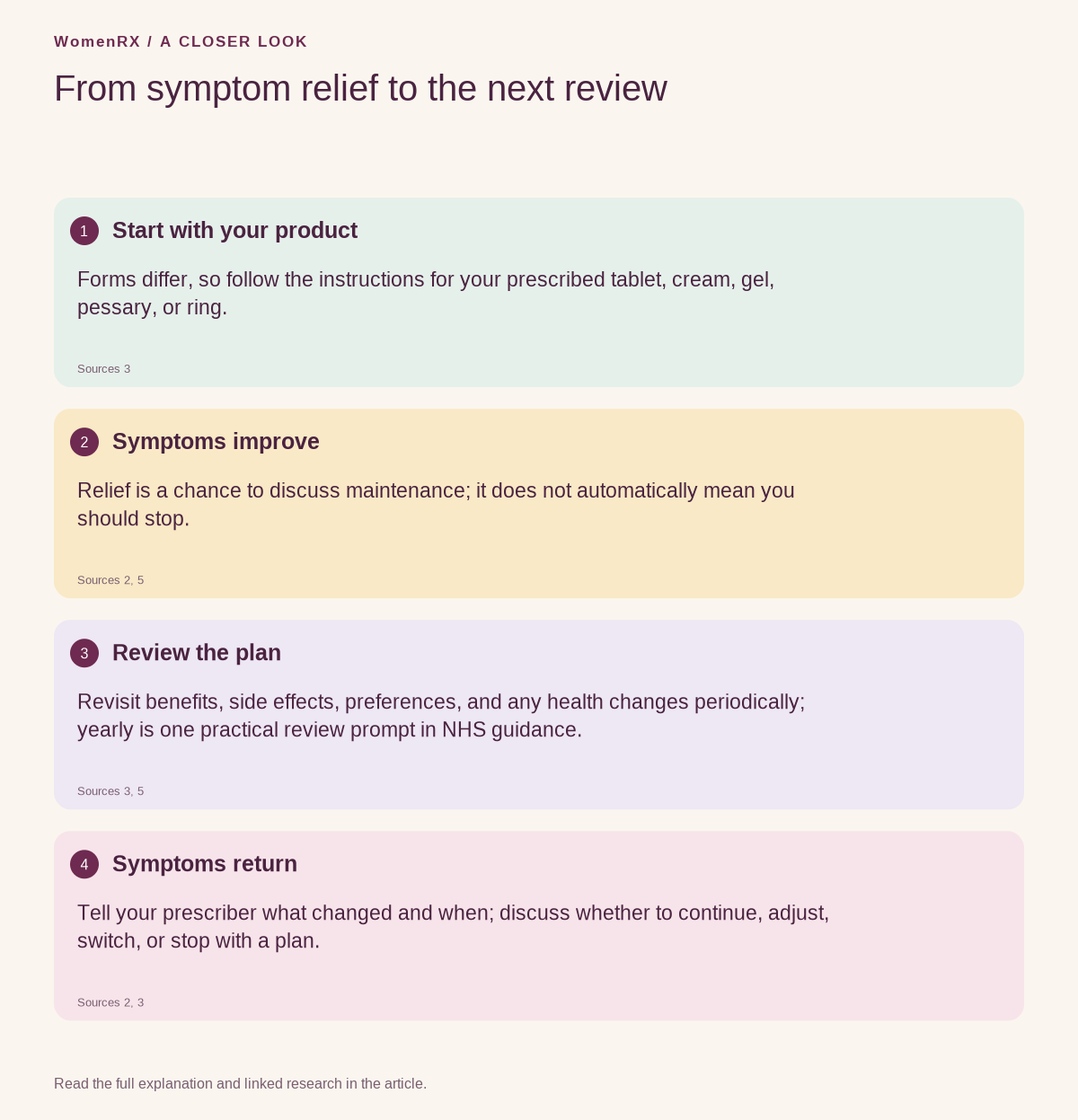
Start with your product: Forms differ, so follow the instructions for your prescribed tablet, cream, gel, pessary, or ring.3
Symptoms improve: Relief is a chance to discuss maintenance; it does not automatically mean you should stop.25
Review the plan: Revisit benefits, side effects, preferences, and any health changes periodically; yearly is one practical review prompt in NHS guidance.35
Symptoms return: Tell your prescriber what changed and when; discuss whether to continue, adjust, switch, or stop with a plan.23
Read the figure as text
A sequence of decisions, not a universal treatment clock: follow the instructions for your specific product and agree on review timing with your prescriber.- Start with your product: Forms differ, so follow the instructions for your prescribed tablet, cream, gel, pessary, or ring.3
- Symptoms improve: Relief is a chance to discuss maintenance; it does not automatically mean you should stop.25
- Review the plan: Revisit benefits, side effects, preferences, and any health changes periodically; yearly is one practical review prompt in NHS guidance.35
- Symptoms return: Tell your prescriber what changed and when; discuss whether to continue, adjust, switch, or stop with a plan.23
More questions, answered
Does feeling better mean I can stop vaginal estrogen?
Not necessarily. Symptoms may return after stopping, but that doesn’t mean everyone needs to continue indefinitely. Discuss the pros and cons of stopping or changing the plan with your prescriber. 2 5
Should I reduce the amount gradually if I want to stop?
There isn’t one rule for every product or person. Guidance says a prescriber may suggest reducing the dose gradually, so ask for a plan rather than changing your regimen on your own. 2
Sources you can check
- About vaginal oestrogen - NHSAccessed 2026-09-25Return to first citation
- Common questions about vaginal oestrogen - NHSAccessed 2026-09-25Return to first citation
- How and when to use vaginal oestrogen - NHSAccessed 2026-09-25Return to first citation
- Side effects of vaginal oestrogen - NHSAccessed 2026-09-25Return to first citation
- The 2022 hormone therapy position statement of The North American Menopause Society.“The 2022 Hormone Therapy Position Statement of The North American Menopause Society” Advisory Panel. · Menopause (New York, N.Y.) · 2022Return to first citation