Is Vaginal Estrogen Safe? What Changes the Answer
Low-dose vaginal estrogen has limited absorption into the bloodstream, but the product, your cancer history, and any postmenopausal bleeding matter.
For many postmenopausal women, low-dose vaginal estrogen is an option for dryness and irritation, with much less hormone reaching the rest of the body than with systemic hormone therapy. That doesn’t make every product or personal history interchangeable. A history of hormone-sensitive cancer calls for an individualized discussion, and any bleeding after menopause should be checked rather than assumed to be dryness. 3516
Local treatment is different from whole-body hormone therapy
When estrogen levels fall after menopause, vaginal tissue can become dry and irritated. Vaginal estrogen treats those symptoms where the medicine is applied. It comes in several forms, including tablets, creams, gels, and rings. It isn’t intended to treat hot flashes, mood changes, or sleep problems. 3
The safety distinction is about exposure, not a promise of zero exposure. With low-dose vaginal treatment, relatively little estrogen reaches the rest of the body. That’s one reason its risks shouldn’t simply be copied from studies of systemic hormone therapy. At the same time, hormone-therapy risks vary by type, dose, route, and other factors. The North American Menopause Society recommends low-dose vaginal estrogen as an option for bothersome vaginal symptoms that haven’t improved with over-the-counter treatments when systemic hormone therapy isn’t indicated. 35
This distinction also matters if you have a uterus. Guidance for local vaginal estrogen says a progestogen generally isn’t needed alongside it because little estrogen reaches the rest of the body. That statement concerns local treatment; it isn’t a rule to apply to every estrogen product or dose. 35
What absorption studies can, and can’t, settle
A blood hormone measurement answers a narrower question than “Is this safe for me over time?” For example, a meta-analysis of studies involving postmenopausal women with estrogen receptor-positive breast cancer who were taking aromatase inhibitors found no change in measured serum estradiol or luteinizing hormone after eight weeks of local hormonal treatment. It did not establish that absorption is impossible with every product, or resolve long-term cancer outcomes. 7
A 2026 review describes systemic absorption from vaginal estrogen as minimal and reports no demonstrated increase in breast cancer incidence, recurrence, or breast-cancer mortality overall. It also identifies an important unresolved question: among survivors taking aromatase inhibitors, findings on recurrence remain controversial. The review notes a lack of head-to-head comparisons of vaginal-estrogen formulations in breast cancer survivors. So an overall reassuring finding cannot tell you that a particular cream, tablet, or ring has been shown equally safe for every cancer history. 6
If you’ve had hormone-sensitive cancer, the useful conversation is specific: What cancer did you have? Are you taking an aromatase inhibitor or another cancer treatment? Which vaginal symptom needs relief, what have you tried, and which exact product is being considered? Vaginal moisturizers and lubricants are options for symptom relief, though they may not provide enough relief for everyone. This is a decision to make with the clinicians who know your cancer history, rather than a yes-or-no rule based only on the word vaginal. 456
Bleeding needs its own answer
There’s a difference between discussing a possible treatment side effect and explaining away bleeding that hasn’t been evaluated. Vaginal estrogen can cause bleeding, particularly early in treatment. But any bleeding after menopause, even a single episode or a small amount, should be checked. If bleeding is happening before you start treatment, get it assessed before deciding it’s simply due to dryness. If it starts while you’re using vaginal estrogen, don’t automatically attribute it to the medicine. 21
Bleeding can have several causes, including thinning of vaginal tissue, polyps, changes in the uterine lining, and, less commonly, cancer. An assessment is what distinguishes among them. 1
Other possible side effects include headache and vaginal or abdominal discomfort. Many people have no side effects or only minor ones, but persistent or bothersome symptoms are a reason to discuss whether the treatment or product is a good fit. 23
Match the decision to the symptom and the history
If your main problem is vaginal dryness or irritation, a moisturizer or lubricant may be enough, or low-dose vaginal estrogen may be worth discussing if it isn’t. If your main problem is hot flashes, vaginal estrogen is the wrong tool for that symptom. And if you have postmenopausal bleeding or a history of hormone-sensitive cancer, those facts change the conversation before a product is chosen. The most useful question isn’t simply “Is vaginal estrogen safe?” It’s “What do we know about this product for my symptom and my history?” 45316
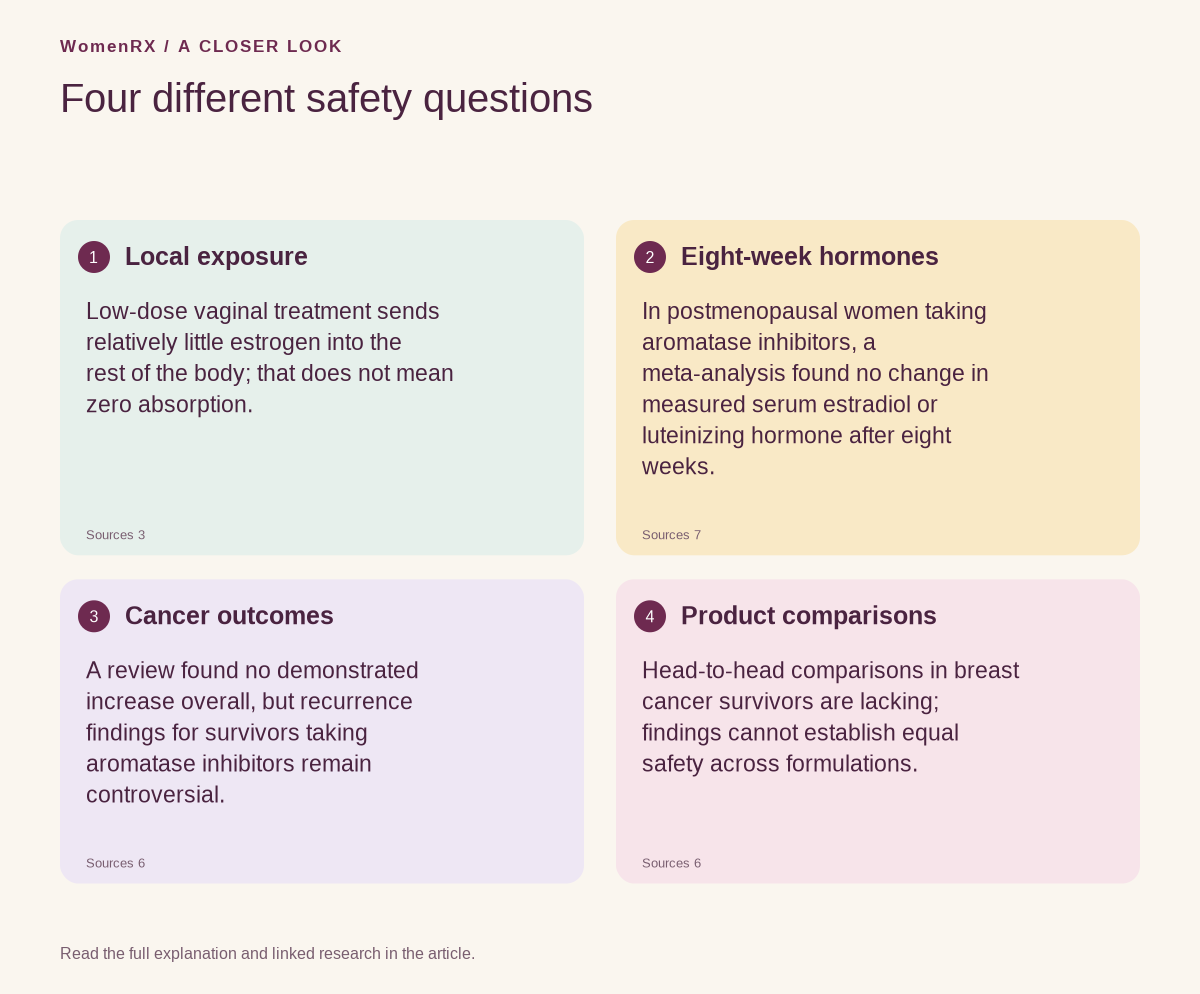
Four different safety questions
Local exposure: Low-dose vaginal treatment sends relatively little estrogen into the rest of the body; that does not mean zero absorption.3
Eight-week hormones: In postmenopausal women taking aromatase inhibitors, a meta-analysis found no change in measured serum estradiol or luteinizing hormone after eight weeks.7
Cancer outcomes: A review found no demonstrated increase overall, but recurrence findings for survivors taking aromatase inhibitors remain controversial.6
Product comparisons: Head-to-head comparisons in breast cancer survivors are lacking; findings cannot establish equal safety across formulations.6
Read the figure as text
A result about absorption, a symptom, or a cancer outcome answers a different question. These findings should not be treated as interchangeable.- Local exposure: Low-dose vaginal treatment sends relatively little estrogen into the rest of the body; that does not mean zero absorption.3
- Eight-week hormones: In postmenopausal women taking aromatase inhibitors, a meta-analysis found no change in measured serum estradiol or luteinizing hormone after eight weeks.7
- Cancer outcomes: A review found no demonstrated increase overall, but recurrence findings for survivors taking aromatase inhibitors remain controversial.6
- Product comparisons: Head-to-head comparisons in breast cancer survivors are lacking; findings cannot establish equal safety across formulations.6
More questions, answered
Will vaginal estrogen help with hot flashes?
No. Local vaginal estrogen is used for vaginal symptoms such as dryness and irritation; it doesn’t treat hot flashes or sleep problems. Those symptoms call for a separate treatment discussion. 3
Does a history of breast cancer always rule it out?
The evidence doesn’t support a blanket answer for every survivor. A review found no demonstrated increase in recurrence overall, but recurrence findings remain controversial for survivors taking aromatase inhibitors, and direct comparisons between vaginal-estrogen formulations are lacking. Your cancer treatment and the exact product under consideration matter. 6
Sources you can check
- Postmenopausal bleeding - NHSAccessed 2026-09-25Return to first citation
- Side effects of vaginal oestrogen - NHSAccessed 2026-09-25Return to first citation
- About vaginal oestrogen - NHSAccessed 2026-09-25Return to first citation
- Common questions about vaginal oestrogen - NHSAccessed 2026-09-25Return to first citation
- The 2022 hormone therapy position statement of The North American Menopause Society.“The 2022 Hormone Therapy Position Statement of The North American Menopause Society” Advisory Panel. · Menopause (New York, N.Y.) · 2022Return to first citation
- Safety of vaginal estrogen in breast cancer survivors: Current evidence on systemic absorption and oncologic outcomes.Mainar LB, Nieto-Pascual L, Bravo EI, García-Ramos BO, Llaneza IP, Vilanova CT, Lloret AM, Alsina JC. · Maturitas · 2026Return to first citation
- The Safety of Local Hormonal Treatment for Vulvovaginal Atrophy in Women With Estrogen Receptor-positive Breast Cancer Who Are on Adjuvant Aromatase Inhibitor Therapy: Meta-analysis.Pavlović RT, Janković SM, Milovanović JR, Stefanović SM, Folić MM, Milovanović OZ, Mamillapalli C, Milosavljević MN. · Clinical breast cancer · 2019Return to first citation