Does Low-Dose Vaginal Estrogen Affect Weight?
Low-dose vaginal estrogen is designed to treat vaginal symptoms locally, but the evidence doesn’t establish a precise weight effect for these products.
There’s no good evidence that estrogen is a proven cause of weight gain, but that broad finding doesn’t prove that every low-dose vaginal product has no effect. Vaginal estrogen is intended for local symptoms, and little of it gets into the rest of the body. Guidance doesn’t provide a direct weight comparison between vaginal and systemic estrogen. 1 2 3
The short answer
Low-dose vaginal estrogen isn’t known to cause weight gain, but “not known to” is different from proving it can never affect weight. A clinical reference says there’s no good evidence that taking estrogen causes weight gain. It does not give a weight-specific comparison of low-dose vaginal estrogen with systemic hormone therapy. 2
That distinction matters if you notice a change on the scale after starting treatment. Weight can change around menopause, too, so timing alone can’t show that a medication caused the change. 2
Local treatment and systemic therapy aren’t interchangeable
Vaginal estrogen comes in forms inserted into the vagina, including tablets, creams, gels, and rings. It’s used for menopause-related vaginal dryness and irritation. It’s called local treatment because it’s intended to act in the vaginal area, and little of the medicine gets into the rest of the body. It doesn’t treat symptoms such as hot flashes or sleep problems. 1
Systemic hormone therapy is a different treatment approach. The North American Menopause Society’s position statement describes hormone therapy as an effective treatment for hot flashes and genitourinary symptoms, and recommends low-dose vaginal estrogen for bothersome genitourinary symptoms that haven’t improved with over-the-counter treatment when there isn’t an indication for systemic therapy. The statement says hormone-therapy risks differ by type, dose, duration, route, timing, and whether a progestogen is used. Those differences are a reason not to assume evidence about one kind of therapy applies equally to another. 3
What the weight evidence can and can’t tell you
The general statement that estrogen hasn’t been shown to cause weight gain is reassuring, but it isn’t proof of zero effect for each product or each person. The clinical guidance cited here doesn’t report a direct comparison of weight outcomes for low-dose vaginal estrogen versus systemic therapy. So it can’t tell you that the two have identical weight effects, or give a reliable estimate of a weight change from vaginal treatment. 2 3
If weight changes while you’re using vaginal estrogen, the timing is worth noticing, but it doesn’t establish cause and effect. Weight gain is also common around menopause. Keep the focus on the reason for treatment: local vaginal estrogen is meant to relieve vaginal dryness and irritation, not manage weight or broader menopause symptoms. 1 2
A practical way to weigh the decision
If you’re considering vaginal estrogen for vaginal symptoms, compare it with systemic therapy based on the symptoms you want treated and the treatment’s route and intended reach. Low-dose vaginal estrogen is a local option for vaginal symptoms; systemic hormone therapy may be considered for broader symptoms such as hot flashes. The available weight guidance doesn’t support choosing between them on the assumption that one is guaranteed to cause weight gain or that the other is guaranteed not to. 1 3
If you’re already using it and are concerned about weight, note when the change began and whether anything else changed around the same time. That can help you have a more specific conversation about whether the treatment is still meeting your needs, without treating a change in weight as proof that vaginal estrogen caused it.
Vaginal versus systemic estrogen
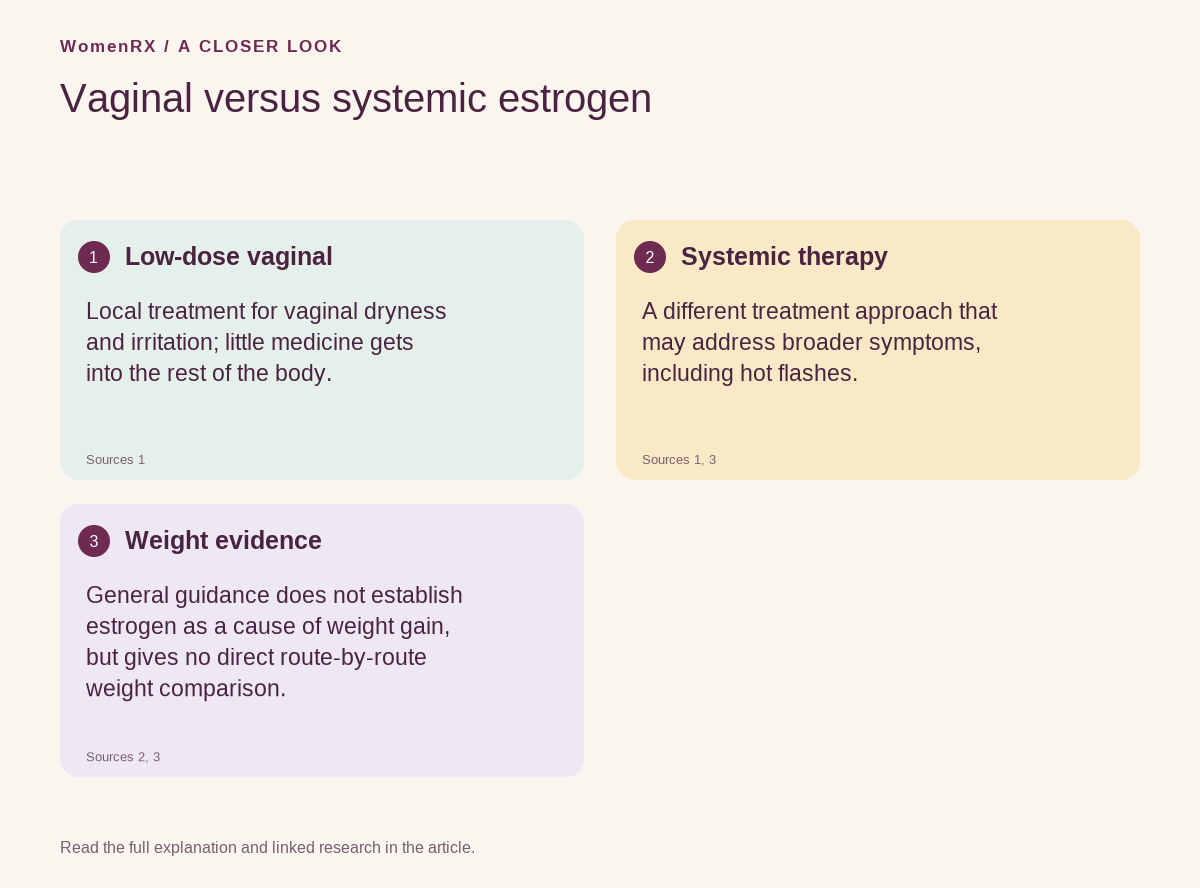
Low-dose vaginal: Local treatment for vaginal dryness and irritation; little medicine gets into the rest of the body.1
Systemic therapy: A different treatment approach that may address broader symptoms, including hot flashes.13
Weight evidence: General guidance does not establish estrogen as a cause of weight gain, but gives no direct route-by-route weight comparison.23
Read the figure as text
The route and treatment target help clarify what can and cannot be inferred about weight.- Low-dose vaginal: Local treatment for vaginal dryness and irritation; little medicine gets into the rest of the body.1
- Systemic therapy: A different treatment approach that may address broader symptoms, including hot flashes.13
- Weight evidence: General guidance does not establish estrogen as a cause of weight gain, but gives no direct route-by-route weight comparison.23
Sources you can check
- About vaginal oestrogen - NHSAccessed 2026-09-25Return to first citation
- Common questions about vaginal oestrogen - NHSAccessed 2026-09-25Return to first citation
- The 2022 hormone therapy position statement of The North American Menopause Society.“The 2022 Hormone Therapy Position Statement of The North American Menopause Society” Advisory Panel. · Menopause (New York, N.Y.) · 2022Return to first citation