Does Vaginal Estrogen Affect Weight? What Studies Measure
A weight change that begins during treatment doesn’t prove the treatment caused it, and findings from systemic hormone therapy don’t directly answer what low-dose vaginal estrogen does.
Low-dose vaginal estrogen is intended to treat vaginal symptoms, and little of it reaches the rest of the body. Guidance says there’s no good evidence that estrogen causes weight gain, but weight gain is common around menopause. Neither a scale change nor research on systemic estrogen alone can show whether vaginal estrogen caused a change in weight, fluid, or body composition. 1 2
First, separate local treatment from systemic therapy
Low-dose vaginal estrogen is used for menopause-related vaginal symptoms such as dryness and irritation. It’s considered local treatment, and little of the medicine gets into the rest of the body. It isn’t intended to treat symptoms such as hot flashes or sleep problems. Systemic hormone therapy, including estrogen delivered through the skin, is a different exposure, so findings about it don’t automatically apply to a vaginal product. 1
That distinction matters if your weight changes after starting treatment. The timing may be worth noticing, but it doesn’t establish the cause. Weight can change for reasons that overlap with menopause and with ordinary changes over time.
What the weight research actually measured
One clinical trial followed 86 early postmenopausal women using non-oral estradiol: 40 received estradiol by nasal spray for two months, and 46 used estradiol gel on the skin for three months. Both groups also used vaginal micronized progesterone. The trial measured weight, waist circumference, and BMI, and reported no change in those measures during treatment. This is evidence about short-term systemic estradiol treatment, not low-dose vaginal estrogen. 4
A separate six-month comparison included 26 postmenopausal women taking tibolone and 31 receiving transdermal estrogen gel with progestogen. Its abstract described a favorable change in body weight in the transdermal-estrogen group compared with the tibolone group. It doesn’t provide a result that can be transferred to low-dose vaginal estrogen, and it doesn’t establish that vaginal estrogen causes weight loss or prevents weight gain. 3
These studies also illustrate why the outcome matters. A scale measures total weight. A waist measurement is a different measure, and neither one tells you by itself whether a change came from body fat, lean tissue, or fluid. Those questions require different measurements; a scale reading alone can’t answer them.
What the guidance does, and doesn’t, settle
Guidance says there’s no good evidence that estrogen causes weight gain, while also noting that weight gain is common around menopause. That broad statement is useful context, but it isn’t a direct measurement of weight changes in users of low-dose vaginal products. 2
The available findings described above don’t settle whether low-dose vaginal estrogen affects weight, fluid retention, or body composition. That uncertainty isn’t a reason to assume it does or doesn’t: it means that a change during treatment can’t be attributed to the product from timing alone.
Make a change easier to interpret
If you’re noticing a shift, look at the pattern rather than one reading. For example, use the same scale under similar conditions and note when the change began, which type of estrogen you use, and whether other routines or circumstances changed around the same time. A record can clarify whether you’re seeing a continuing trend, but it can’t identify the cause on its own.
Keep the treatment’s purpose in view, too. Vaginal estrogen is used for vaginal symptoms, and relief of those symptoms doesn’t tell you whether weight or body composition has changed. If you’re weighing whether to continue treatment, consider the vaginal symptoms it’s helping as well as the weight pattern; symptoms may return after stopping. 1 2
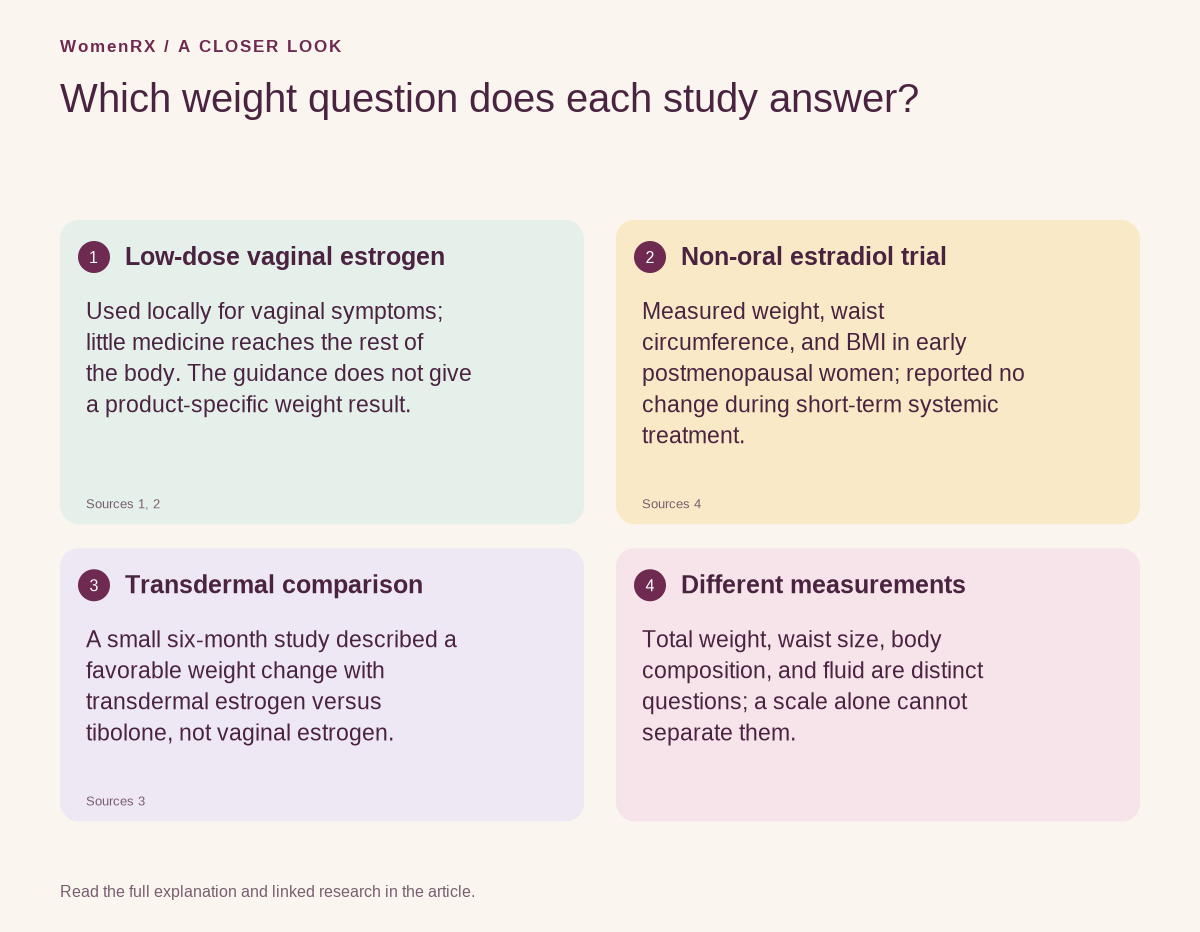
Which weight question does each study answer?
Low-dose vaginal estrogen: Used locally for vaginal symptoms; little medicine reaches the rest of the body. The guidance does not give a product-specific weight result.12
Non-oral estradiol trial: Measured weight, waist circumference, and BMI in early postmenopausal women; reported no change during short-term systemic treatment.4
Transdermal comparison: A small six-month study described a favorable weight change with transdermal estrogen versus tibolone, not vaginal estrogen.3
Different measurements: Total weight, waist size, body composition, and fluid are distinct questions; a scale alone cannot separate them.
Read the figure as text
Compare the local treatment with the systemic treatments studied, and keep total weight separate from other measurements.- Low-dose vaginal estrogen: Used locally for vaginal symptoms; little medicine reaches the rest of the body. The guidance does not give a product-specific weight result.12
- Non-oral estradiol trial: Measured weight, waist circumference, and BMI in early postmenopausal women; reported no change during short-term systemic treatment.4
- Transdermal comparison: A small six-month study described a favorable weight change with transdermal estrogen versus tibolone, not vaginal estrogen.3
- Different measurements: Total weight, waist size, body composition, and fluid are distinct questions; a scale alone cannot separate them.
More questions, answered
Can a study of estrogen gel tell me what vaginal estrogen will do?
Not directly. Estrogen gel used on the skin is systemic treatment, while low-dose vaginal estrogen is intended to act locally, with little medicine reaching the rest of the body. A short study of one form doesn’t establish the weight effect of the other. 1 4
If the scale changes, can I tell whether it’s fluid or body fat?
Not from weight alone. A scale reports total weight, not what accounts for a change. The research findings described here don’t establish whether low-dose vaginal estrogen affects fluid retention or body composition.
Sources you can check
- About vaginal oestrogen - NHSAccessed 2026-09-25Return to first citation
- Common questions about vaginal oestrogen - NHSAccessed 2026-09-25Return to first citation
- Comparison of the Efficacy of Tibolone and Transdermal Estrogen in Treating Menopausal Symptoms in Postmenopausal Women.Kim HK, Jeon SH, Ryu KJ, Kim T, Park H. · Journal of menopausal medicine · 2019Return to first citation
- Effects of micronized progesterone added to non-oral estradiol on lipids and cardiovascular risk factors in early postmenopause: a clinical trial.Casanova G, Spritzer PM. · Lipids in health and disease · 2012Return to first citation