What “Natural Estrogen Cream” Might Actually Mean
“Natural” doesn’t tell you what hormone a cream contains, how it’s regulated, or whether it’s meant to treat vaginal symptoms or menopause symptoms throughout your body.
A vaginal estrogen cream prescribed for menopause symptoms is a specific hormone medicine, not simply any cream marketed as “natural.” For example, prescription Estrace contains estradiol and is labeled for moderate to severe vulvar and vaginal symptoms related to menopause. Compounded hormones are a different category. An unspecified retail cream’s regulatory status can’t be determined from its marketing name alone. 1 4
Start with the treatment area, not the word “natural”
Menopause-related vaginal dryness and irritation are different from symptoms such as hot flashes. Low-dose vaginal estrogen is a local treatment option for bothersome genitourinary symptoms when over-the-counter approaches haven’t helped and systemic hormone therapy isn’t otherwise indicated. Treatment choices depend on what symptoms you’re trying to address; a vaginal cream shouldn’t be assumed to treat hot flashes or other symptoms throughout the body. 5
“Natural” doesn’t tell you whether a product is local or systemic. Nor does it tell you the exact hormone, amount, or regulatory status. “Bioidentical” has a more specific meaning: the hormone has the same chemical and molecular structure as a hormone made in the body. But that term applies both to FDA-approved hormone products and to custom-compounded products marketed as bioidentical. 3 4
Three categories that can sound alike
A prescribed vaginal estrogen cream has product-specific information. For example, U.S. prescribing information for Estrace identifies estradiol as its active hormone, gives its concentration as 0.01%, and lists treatment of moderate to severe menopause-related vulvar and vaginal symptoms as its indication. That describes Estrace, not every estrogen cream. 1
A custom-compounded hormone is prepared for an individual rather than being an FDA-approved, standardized formulation. Compounded hormones are sometimes marketed as “natural” or “bioidentical.” A Practice Pearl summarizing the 2020 National Academies recommendations says the content of nonapproved compounded bioidentical preparations is uncertain and notes a lack of evidence supporting their safety and effectiveness. Those concerns don’t establish that every compounded prescription will cause harm; they do mean the marketing term alone can’t stand in for product-specific evidence. 4
A nonprescription cream advertised as “natural estrogen” is the category where a label or slogan is least useful for answering a regulatory question. The phrase “natural estrogen” does not establish the FDA status of an unspecified retail product. Don’t assume that a product is an approved estrogen medicine, or that it is not one, based on that wording alone. You need to identify the exact product and its specific regulatory information.
Local vaginal cream isn’t the same as systemic treatment
Vaginal estrogen is intended to treat symptoms in and around the vagina. A menopause position statement recommends low-dose vaginal estrogen for bothersome genitourinary symptoms not relieved by over-the-counter therapies when a woman has no indication for systemic hormone therapy. The position statement also notes that hormone therapy risks vary with factors including type, dose, route, and duration. 5
The route matters, but “local” doesn’t mean every product has identical absorption or instructions. Guidance on vaginal estrogen describes little of the medicine as reaching the rest of the body; that is not a reason to treat all creams as interchangeable or to infer that a product has no risks. 2
If the main concern is vaginal dryness or irritation, a local treatment may fit that symptom better than systemic treatment. If you’re also seeking relief from hot flashes, don’t assume a vaginal cream will address them. The intended use on the exact product information is more useful than its marketing name. 2 5
What to check before using a cream
Look for the exact active ingredient, the concentration or amount, the intended route, and the symptoms listed as its use. Then check the product-specific U.S. medicine information if the item is presented as a prescription medicine. Estrace’s prescribing information, for instance, identifies both the hormone and its intended treatment area; it also says unusual vaginal bleeding should be checked. That warning is specific to its labeling and shouldn’t be replaced by assumptions based on the word “local.” 1
For a compounded product, ask what exact hormone it contains and whether it is a custom-compounded preparation rather than an FDA-approved formulation. For a retail product that claims to contain estrogen, check its specific regulatory information rather than inferring its status from marketing terms. If its active ingredient or intended use is unclear, pause rather than guessing that “natural” means standardized, approved, or safe.
The practical comparison is simple: identify the ingredient, find out whether the item is an approved medicine or a compounded preparation, and match its route and intended treatment area to the symptom you want to treat. A shared word like “estrogen” or “bioidentical” doesn’t make two creams equivalent. 1 4 5
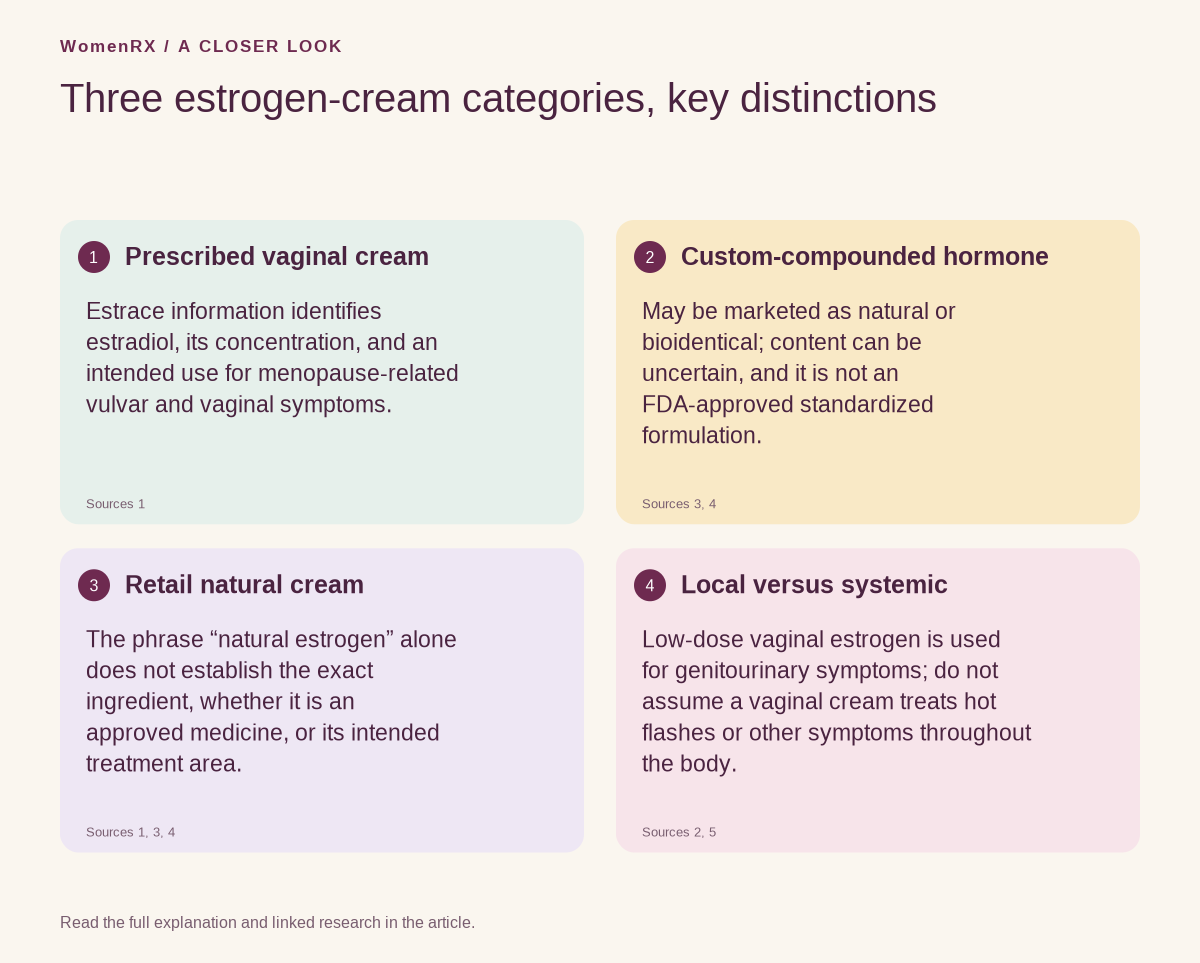
Three estrogen-cream categories, key distinctions
Prescribed vaginal cream: Estrace information identifies estradiol, its concentration, and an intended use for menopause-related vulvar and vaginal symptoms.1
Custom-compounded hormone: May be marketed as natural or bioidentical; content can be uncertain, and it is not an FDA-approved standardized formulation.34
Retail natural cream: The phrase “natural estrogen” alone does not establish the exact ingredient, whether it is an approved medicine, or its intended treatment area.134
Local versus systemic: Low-dose vaginal estrogen is used for genitourinary symptoms; do not assume a vaginal cream treats hot flashes or other symptoms throughout the body.25
Read the figure as text
The name on the front of a package is not enough. Compare the product category, hormone information, route, and intended use before deciding what a cream is meant to do.- Prescribed vaginal cream: Estrace information identifies estradiol, its concentration, and an intended use for menopause-related vulvar and vaginal symptoms.1
- Custom-compounded hormone: May be marketed as natural or bioidentical; content can be uncertain, and it is not an FDA-approved standardized formulation.34
- Retail natural cream: The phrase “natural estrogen” alone does not establish the exact ingredient, whether it is an approved medicine, or its intended treatment area.134
- Local versus systemic: Low-dose vaginal estrogen is used for genitourinary symptoms; do not assume a vaginal cream treats hot flashes or other symptoms throughout the body.25
More questions, answered
Does “bioidentical” mean the cream is unregulated?
No. “Bioidentical” describes a hormone’s molecular structure, not its regulatory category. FDA-approved hormone formulations can be bioidentical, and custom-compounded products are also marketed that way. The exact product and formulation matter. 4
Can vaginal estrogen cream treat hot flashes?
Vaginal estrogen is used for menopause-related vaginal symptoms. A vaginal product shouldn’t be assumed to treat hot flashes; treatment needs to match the symptoms and the product’s intended use. 2 5
Sources you can check
- ESTRACE (ESTRADIOL) CREAM [ALLERGAN, INC.] | US prescribing information and patient instructionsAccessed 2026-09-25Return to first citation
- About vaginal oestrogen - NHSAccessed 2026-09-25Return to first citation
- The Clinical Utility of Compounded Bioidentical Hormone Therapy: A Review of Safety, Effectiveness, and UseNational Academies of Sciences, Engineering, and Medicine; Health and Medicine Division; Board on Health Sciences Policy; Committee on the Clinical Utility of Treating Patients wit... · 2020Return to first citation
- Compounded bioidentical hormone therapy: new recommendations from the 2020 National Academies of Sciences, Engineering, and Medicine.Stuenkel CA. · Menopause (New York, N.Y.) · 2021Return to first citation
- The 2022 hormone therapy position statement of The North American Menopause Society.“The 2022 Hormone Therapy Position Statement of The North American Menopause Society” Advisory Panel. · Menopause (New York, N.Y.) · 2022Return to first citation