Vaginal Estriol Cream: What It May Treat and Safety Questions
Small studies suggest vaginal estriol may help some menopause-related symptoms, but they offer only a limited picture of its safety.
Vaginal estriol has been studied for genitourinary syndrome of menopause (GSM), including vaginal dryness, burning, and discomfort with sex. Small trials report symptom or vaginal-health improvements, but they don’t establish that every estriol product works the same way or provide a complete safety picture. One small trial found higher Candida concentration with estriol than radiofrequency, a finding that doesn’t by itself show more diagnosed yeast infections. 2 3
Start with the symptom you want to change
After menopause, lower estrogen can contribute to vaginal tissue changes and symptoms such as dryness, burning, and irritation. Genitourinary syndrome of menopause (GSM) can also involve discomfort with sex and urinary symptoms. These symptoms can overlap, so it helps to be specific about what’s bothering you: everyday dryness, friction during sex, pain, or a urinary change. 2 4 5
Vaginal estriol is a form of estrogen used in clinical studies of GSM. In a small randomized pilot study, symptoms and measures of vaginal health improved among women assigned estriol cream. But only 11 women completed the estriol group, and the trial compared estriol with energy-based treatments, not with no treatment. That’s encouraging preliminary evidence, not a guarantee of relief. 3
What the comparison with moisturizers can tell you
One randomized study assigned 32 postmenopausal women to radiofrequency, vaginal estrogen, or a moisturizer for four months. The estrogen group showed improvement in a measure of vaginal health, while the moisturizer group did not show a significant change in that measure. However, symptom scores improved in all three groups, with no one group clearly ahead on that symptom measure. 6
There’s a key limitation: the study’s estrogen group could receive either estriol cream or estradiol vaginal film. Its results don’t isolate estriol’s effect from estradiol’s. The trial was also small and lasted four months, so it can’t settle how these options compare for every person or over longer periods. 6
A moisturizer and a lubricant aren’t interchangeable questions. The trial tested an intravaginal moisturizer, not a lubricant, so it doesn’t tell us how lubricants compare with estriol. If your main concern is friction during sex rather than ongoing dryness, ask whether a lubricant is a reasonable option for that specific goal. Don’t assume evidence for one product type applies to another.
Urinary symptoms need their own goal
GSM can include urinary complaints, but improvement in a urinary questionnaire is not the same as proof that a treatment prevents or clears a urinary infection. In a pilot trial of 30 postmenopausal women, urinary symptom scores improved over three months in both the estriol and radiofrequency groups. The study was small and compared two treatments; it did not establish estriol as a treatment for urinary infections. 4
If you’re considering estriol mainly for urinary discomfort, urgency, or repeated infections, make that the focus of the discussion. The study results don’t show that every urinary symptom is caused by GSM or that vaginal estriol will address its cause.
What the safety findings do, and don’t, show
The safety evidence from small trials is limited. In one randomized pilot of 30 postmenopausal women, Candida concentration increased in the estriol group compared with the radiofrequency group. That laboratory finding doesn’t establish that more participants developed a diagnosed yeast infection, but it is a result worth discussing if you’re weighing treatment. 2
A separate pilot study reported no unexpected or serious adverse events among its participants; 11 women completed the estriol group, and outcomes were assessed 120 days after treatment began. 3 Another pilot, with 30 healthy postmenopausal participants followed over three months, reported no serious adverse effects across the estriol and radiofrequency groups. 4 These small, short studies can’t establish a complete or long-term safety profile.
Be careful not to transfer instructions or warnings between different estrogen products. The US prescribing information for Estrace is for estradiol vaginal cream, not estriol; it isn’t a substitute for the directions and safety information for the specific estriol product being considered. 1 If you’re unsure which formulation you have or what its own warnings mean, check with the prescriber or pharmacist before using it.
Questions that make the choice more useful
Ask which symptom the treatment is meant to target, and how you’ll judge whether it’s helping. Ask what directions apply to the specific product being considered: the research studies used different schedules, and those study protocols are not instructions for your own cream. Also ask what is known about that exact formulation and whether evidence from postmenopausal study participants applies to your situation. The trials described here enrolled postmenopausal women, so they don’t establish the same results for symptoms associated with other causes of low estrogen. 2 3 4 6
The practical tradeoff is that estriol has preliminary evidence for vaginal health and GSM symptoms, while the limited moisturizer comparison leaves symptom relief less clear-cut. For lubricants, these studies provide no direct comparison. The best question isn’t which option is universally best; it’s which option matches your symptom goal and what evidence applies to the product you’re considering.
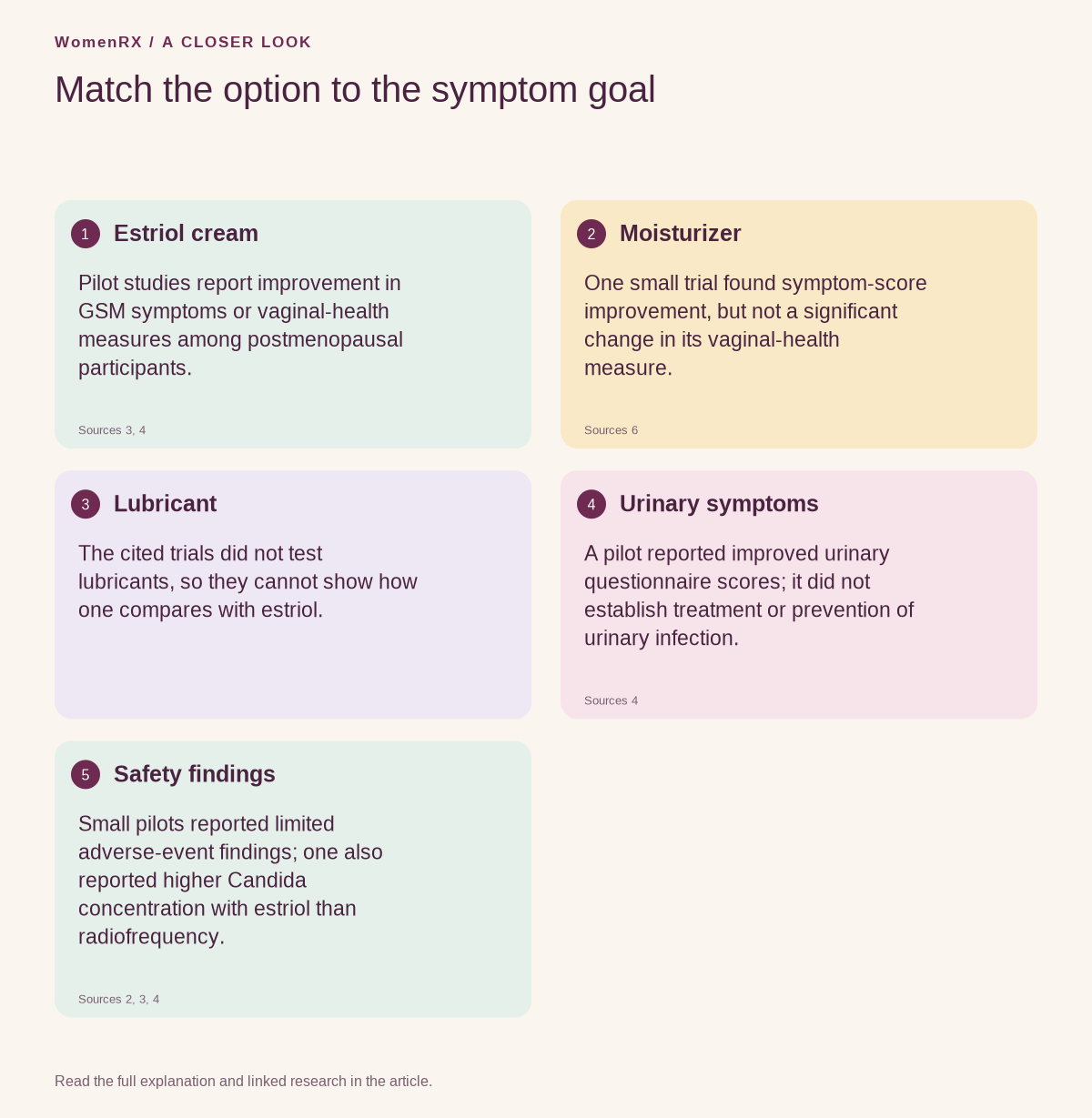
Match the option to the symptom goal
Estriol cream: Pilot studies report improvement in GSM symptoms or vaginal-health measures among postmenopausal participants.34
Moisturizer: One small trial found symptom-score improvement, but not a significant change in its vaginal-health measure.6
Lubricant: The cited trials did not test lubricants, so they cannot show how one compares with estriol.
Urinary symptoms: A pilot reported improved urinary questionnaire scores; it did not establish treatment or prevention of urinary infection.4
Safety findings: Small pilots reported limited adverse-event findings; one also reported higher Candida concentration with estriol than radiofrequency.234
Read the figure as text
These small studies offer different kinds of evidence. The comparison is about what was studied, not a ranking of treatments or a complete safety assessment.- Estriol cream: Pilot studies report improvement in GSM symptoms or vaginal-health measures among postmenopausal participants.34
- Moisturizer: One small trial found symptom-score improvement, but not a significant change in its vaginal-health measure.6
- Lubricant: The cited trials did not test lubricants, so they cannot show how one compares with estriol.
- Urinary symptoms: A pilot reported improved urinary questionnaire scores; it did not establish treatment or prevention of urinary infection.4
- Safety findings: Small pilots reported limited adverse-event findings; one also reported higher Candida concentration with estriol than radiofrequency.234
More questions, answered
Does vaginal estriol cream treat urinary infections?
The small trial described here measured urinary symptom scores, not whether estriol prevents or clears infections. It doesn’t establish vaginal estriol as a treatment for a urinary infection. 4
Are the estriol schedules in research studies instructions to follow?
No. The trials used particular study protocols, and the schedules differed between studies. They don’t establish directions for every product or person. Ask about the directions for the specific cream being considered. 3 4 6
What safety finding has been reported with estriol?
In one small pilot, Candida concentration increased in the estriol group compared with the radiofrequency group. That result does not by itself show that more women developed a diagnosed yeast infection, and the study can’t establish the risk for other products or for longer-term use. 2
Sources you can check
- ESTRACE (ESTRADIOL) CREAM [ALLERGAN, INC.] | US prescribing information and patient instructionsAccessed 2026-09-25Return to first citation
- Randomized clinical trial of vaginal microbiota in menopausal genitourinary syndrome using radiofrequency and topical estriol.Zunino AX, Torre PA, Cristina Aidé Viviani S, Guimarães ICCDV, Martins CAO, Ferreira DG, Ribeiro LO, Pérez-López FR. · Revista brasileira de ginecologia e obstetricia : revista da Federacao Brasileira das Sociedades de Ginecologia e Obstetricia · 2025Return to first citation
- Women with Genitourinary Syndrome of Menopause Treated with Vaginal Estriol, Microablative Fractional CO2 Laser and Microablative Fractional Radiofrequency: A Randomized Pilot Study.de Oliveira CD, de Mello Bianchi AMH, Campos MLP, Nogueira MCC, Sartori MGF, de Góis Speck NM. · Photobiomodulation, photomedicine, and laser surgery · 2023Return to first citation
- Efficacy and safety of fractional microablative radiofrequency versus topical estriol in treating genitourinary syndrome of menopause: A pilot study.Torre PA, Fialho SCAV, do Val Guimarães ICC, Zunino AX, Castro T, Martins CAO, Gonçalves AK. · International journal of gynaecology and obstetrics: the official organ of the International Federation of Gynaecology and Obstetrics · 2026Return to first citation
- Effects of Erbium:YAG laser combined with vaginal estriol therapy in postmenopausal women with Genitourinary Syndrome of Menopause: protocol for a randomised, double-blind, controlled trial.Souza MCDCD, de Jármy-Di Bella ZIK, Bianchi-Ferraro AMHM, Souza SDL, Amanda Rafaelly Honório M, Sobral APT, Ribeiro CDPV, Bussadori SK, Fernandes KPS, Chavantes MC, Zamuner SR. · BMJ open · 2026Return to first citation
- Comparison of the effect of noninvasive radiofrequency with vaginal estrogen and vaginal moisturizer in the treatment of vulvovaginal atrophy in postmenopausal women: a randomized clinical trial.Gueldini de Moraes AV, Costa-Paiva L, da Costa Machado H, Maciel TF, Mariano FV, Pedro AO. · Menopause (New York, N.Y.) · 2024Return to first citation