What Tretinoin Does, and What It Can Treat
Topical tretinoin is an established acne treatment, with clinical-trial evidence also supporting improvement in some signs of sun-related skin aging.
Tretinoin is a topical retinoid used to treat acne vulgaris; research also finds improvements in signs of photoaging, including wrinkles and uneven pigmentation. It affects how skin cells grow and mature, can promote collagen formation, and may influence pigmentation. Topical tretinoin can cause redness and peeling, and pregnancy deserves a separate safety conversation. 2 4
Two uses, different kinds of evidence
Tretinoin is a topical form of retinoic acid. A product-specific US label identifies acne vulgaris as an indication for tretinoin cream and says long-term use of that product for other disorders has not been established. Photoaging is a different case: randomized trials have studied tretinoin for visible changes associated with sun exposure, but that research doesn’t make every cosmetic use an established treatment. 2 4
That distinction helps set expectations. Acne treatment targets a skin condition involving clogged follicles. Photoaging research asks whether treatment can improve visible signs such as wrinkles or uneven pigmentation. Evidence for one use shouldn’t automatically be carried over to the other, or to unrelated concerns like pores, scars, or general skin “rejuvenation.” 2 3 4
How its skin effects connect to those uses
Acne involves blockage in hair follicles, including thickening of the follicle lining. Tretinoin’s influence on the growth and maturation of epidermal cells provides a biological rationale for its use, but that cell-level explanation doesn’t establish a complete, acne-specific molecular pathway. The practical point is that tretinoin is a recognized acne treatment, not that a mechanism guarantees the same result for everyone. 2 3 4
Sun exposure can degrade dermal collagen, contributing to photoaging. Tretinoin can promote new collagen formation and may reduce epidermal pigmentation through increased cell turnover and reduced tyrosinase activity. These effects offer a rationale for studying wrinkles and uneven pigmentation. A systematic review of seven randomized controlled trials found reported improvement in clinical signs including wrinkling, mottled hyperpigmentation, sallowness, and lentigines. The review also noted that formulas and outcome measures varied, which makes results harder to compare and doesn’t establish one predictable degree of improvement. 4
A small randomized trial offers a useful reminder that the mechanism is still being worked out: among 20 analyzed participants, all White women, tretinoin and a particular retinol-based formulation did not differ significantly in photoaging scores after 24 weeks. The trial’s molecular findings did not establish which changes drive clinical improvement. It’s evidence about those specific formulations and participants, not proof that they are interchangeable for all uses. 5
What researchers’ inclusion of women tells us
Women were well represented in the photoaging trials summarized by the review: four of its seven trials enrolled only women, and women made up the majority of participants in the remaining studies. That supports the relevance of the findings to women, but it doesn’t establish that women respond differently from men. A trial made up entirely of women cannot compare effects between sexes. 4
The 20-person trial also included only women, specifically White women, so it offers no direct comparison by sex and limited representation across skin tones. Those details matter when applying a study’s results beyond the people who took part. 5
Irritation is part of the tradeoff
Topical tretinoin can cause local redness and peeling, and the product label advises minimizing sunlight exposure and using sun protection when exposure can’t be avoided. The same label cautions that other drying or irritating topical products can compound irritation. This is a practical tradeoff to weigh alongside the potential acne or photoaging benefits, rather than a sign that every user will have the same reaction. 2
Pregnancy needs its own discussion
If you’re pregnant or planning a pregnancy, raise that with the clinician who would prescribe topical tretinoin and ask what they recommend for your situation. The embryo-fetal warning in the prescribing information cited here applies to oral tretinoin capsules used for acute promyelocytic leukemia. It is not a risk estimate for topical acne cream, and it shouldn’t be presented as one. The oral warning alone can’t tell you whether topical tretinoin is safe during pregnancy. 1 2
The useful takeaway is to keep the questions separate: what condition are you treating, what benefit is supported for that use, how might irritation affect day-to-day use, and what should you consider if pregnancy is relevant?
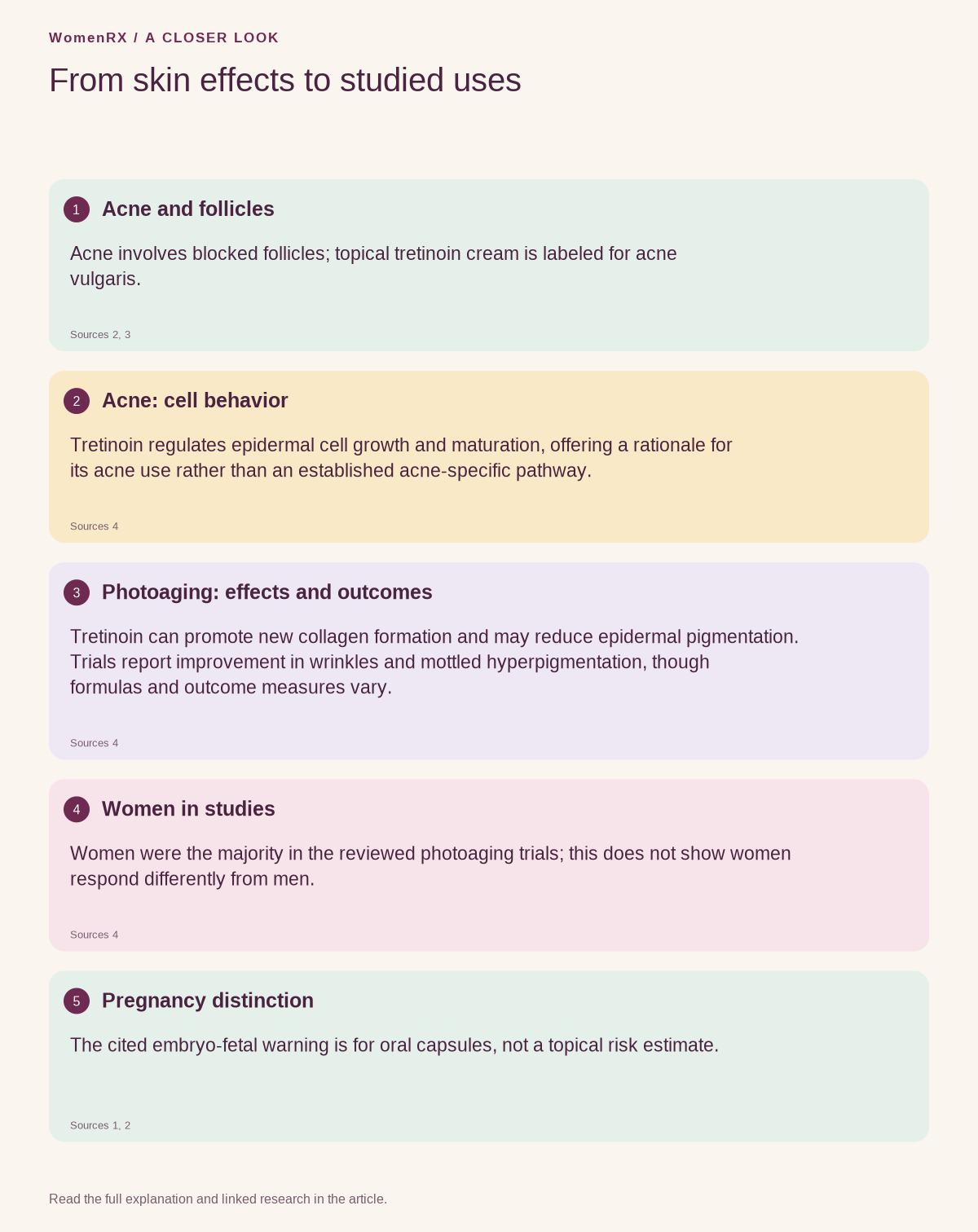
From skin effects to studied uses
Acne and follicles: Acne involves blocked follicles; topical tretinoin cream is labeled for acne vulgaris.23
Acne: cell behavior: Tretinoin regulates epidermal cell growth and maturation, offering a rationale for its acne use rather than an established acne-specific pathway.4
Photoaging: effects and outcomes: Tretinoin can promote new collagen formation and may reduce epidermal pigmentation. Trials report improvement in wrinkles and mottled hyperpigmentation, though formulas and outcome measures vary.4
Women in studies: Women were the majority in the reviewed photoaging trials; this does not show women respond differently from men.4
Pregnancy distinction: The cited embryo-fetal warning is for oral capsules, not a topical risk estimate.12
Read the figure as text
Follow the proposed skin effects to the uses studied. Trials test visible outcomes, not which mechanism causes improvement.- Acne and follicles: Acne involves blocked follicles; topical tretinoin cream is labeled for acne vulgaris.23
- Acne: cell behavior: Tretinoin regulates epidermal cell growth and maturation, offering a rationale for its acne use rather than an established acne-specific pathway.4
- Photoaging: effects and outcomes: Tretinoin can promote new collagen formation and may reduce epidermal pigmentation. Trials report improvement in wrinkles and mottled hyperpigmentation, though formulas and outcome measures vary.4
- Women in studies: Women were the majority in the reviewed photoaging trials; this does not show women respond differently from men.4
- Pregnancy distinction: The cited embryo-fetal warning is for oral capsules, not a topical risk estimate.12
More questions, answered
Does evidence for photoaging mean tretinoin treats every sign of skin aging?
No. The randomized trials summarized in a systematic review reported improvements in several visible signs, including wrinkles and mottled pigmentation, but formulas and outcome measures varied. Those findings don’t establish benefit for every cosmetic concern. 4
Is the oral tretinoin pregnancy warning the same as a topical risk estimate?
No. The cited warning is for oral tretinoin capsules used for acute promyelocytic leukemia. It should not be used to quantify risk from topical tretinoin or to establish whether topical use is safe during pregnancy. 1 2
Sources you can check
- TRETINOIN CAPSULE [PAR HEALTH USA, LLC] | US prescribing information and patient instructionsAccessed 2026-09-25Return to first citation
- TRETINOIN CREAM [REDPHARM DRUG] | US prescribing information and patient instructionsAccessed 2026-09-25Return to first citation
- Acne - NHSAccessed 2026-09-25Return to first citation
- Topical tretinoin for treating photoaging: A systematic review of randomized controlled trials.Sitohang IBS, Makes WI, Sandora N, Suryanegara J. · International journal of women's dermatology · 2022Return to first citation
- Biomarkers of Tretinoin Precursors and Tretinoin Efficacy in Patients With Moderate to Severe Facial Photodamage: A Randomized Clinical Trial.Chien AL, Kim DJ, Cheng N, Shin J, Leung SG, Nelson AM, Zang J, Suh H, Rainer B, Wallis L, Okoye GA, Loss M, Kang S. · JAMA dermatology · 2022Return to first citation