Tretinoin Results: What to Look For, and When
Judge progress by the reason you started tretinoin, not by redness or a single before-and-after photo.
For acne, look for fewer breakouts over time; acne treatments can take several months to improve symptoms. 3 For photoaging, compare a specific concern, such as fine wrinkles or uneven tone. Studies report improvement in these features, but not a guaranteed result for you. 4 6 Redness and peeling are irritation, not proof of progress. 1
First, decide what “working” means for you
Tretinoin is used for acne, and it’s also studied for visible signs of photoaging. Those are different goals, so a useful check-in starts with the change you’re hoping to see. Pick one or two things to assess, such as how often new acne spots appear or whether fine lines look less noticeable. Don’t treat irritation as a measure of success. 1 4
If you’re treating acne
Look for a gradual change in breakouts, not an overnight clear-up. Acne treatments can take several months to improve symptoms. The NHS describes a six-week course as usually required for topical retinoids, though your own treatment plan may differ. 2 3
A practical way to assess acne is to note whether new spots are appearing less often and whether existing ones are settling, rather than judging one bad skin day. Acne can start at any age, and hormonal changes, including those around the menstrual cycle or pregnancy, can contribute to episodes in women. That normal variation can make a short-term comparison hard to interpret. 2
If acne is moderate or severe, or prescribed treatment isn’t helping, seek a review rather than simply waiting longer. If tretinoin is causing persistent or painful irritation, the product information says use may need to be reduced, paused, or stopped depending on the degree of irritation. Ask the prescriber who knows your treatment what adjustment makes sense. 1 3
If your goal is photoaging
Choose a visible feature to compare, such as fine wrinkles or uneven pigmentation. Research reviews report improvement in some photoaging outcomes with topical tretinoin, but studies assess different signs and use different methods. A systematic review also found that much of the comparative research was poor quality or potentially biased. That means results in studies don’t translate into a guaranteed change for an individual. 4 6
If progress on the feature you chose remains unclear after following your agreed treatment plan, review that goal with your prescriber rather than extending treatment indefinitely based on a single photo.
The photoaging network meta-analysis noted limited racial diversity among its included studies. 4
A small randomized study in Asian women with melasma found improvement with a cream containing tretinoin alongside two other active ingredients. Because it tested a combination treatment for melasma, it can’t tell you what tretinoin alone will do for photoaging. 5
Make photo comparisons fair
A before-and-after picture can exaggerate or hide change. Lighting, camera distance, angle, expression, makeup, and filters all affect how skin looks. If you use photos, keep those conditions as similar as you can and compare the same feature each time. Treat the image as one clue, not a verdict; your day-to-day skin can vary even when treatment hasn’t changed.
Irritation is a side effect, not a score
Redness, stinging, and peeling can happen with topical retinoids. Tretinoin cream can also cause more marked redness and peeling; severe irritation may call for using it less often, pausing it, or stopping it. Blistering or crusting is not a result to push through. Contact the prescriber if irritation is persistent, painful, or interfering with using the treatment as directed. 1 3
The product information also reports temporary light or dark patches in some people with repeated use. If you notice a new pigment change, mention it when you review the treatment, especially if it is getting worse. 1
If you’re pregnant, topical retinoids are not considered suitable during pregnancy because of possible risk to the fetus. Check with your prescriber before using tretinoin during pregnancy. 3
What to compare while using tretinoin
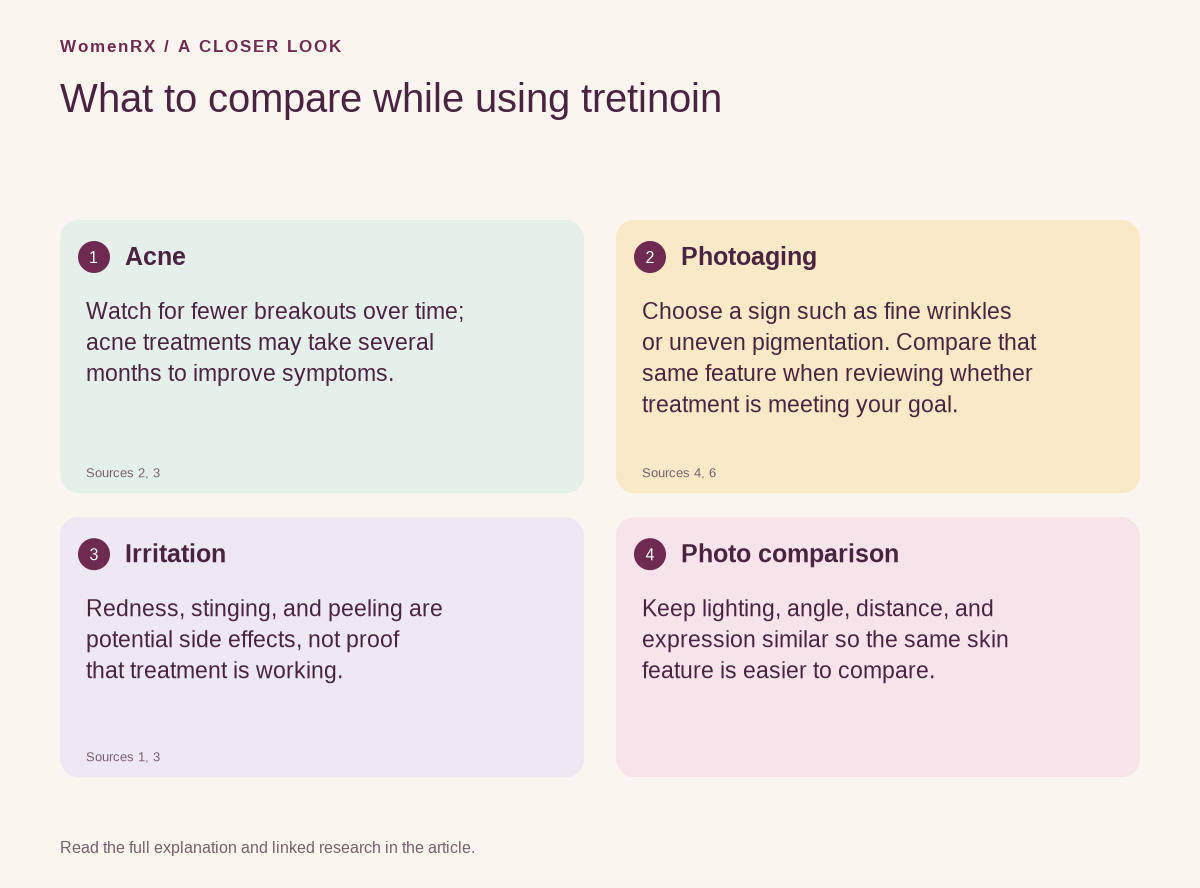
Acne: Watch for fewer breakouts over time; acne treatments may take several months to improve symptoms.23
Photoaging: Choose a sign such as fine wrinkles or uneven pigmentation. Compare that same feature when reviewing whether treatment is meeting your goal.46
Irritation: Redness, stinging, and peeling are potential side effects, not proof that treatment is working.13
Photo comparison: Keep lighting, angle, distance, and expression similar so the same skin feature is easier to compare.
Read the figure as text
The useful progress measure depends on your treatment goal; irritation and inconsistent photos can confuse the picture.- Acne: Watch for fewer breakouts over time; acne treatments may take several months to improve symptoms.23
- Photoaging: Choose a sign such as fine wrinkles or uneven pigmentation. Compare that same feature when reviewing whether treatment is meeting your goal.46
- Irritation: Redness, stinging, and peeling are potential side effects, not proof that treatment is working.13
- Photo comparison: Keep lighting, angle, distance, and expression similar so the same skin feature is easier to compare.
More questions, answered
Can I use tretinoin during pregnancy?
Topical retinoids are not considered suitable during pregnancy because of possible fetal risk. If you’re pregnant, check with your prescriber before using tretinoin. 3
Sources you can check
- TRETINOIN CREAM [REDPHARM DRUG] | US prescribing information and patient instructionsAccessed 2026-09-25Return to first citation
- Acne - NHSAccessed 2026-09-25Return to first citation
- Acne - Treatment - NHSAccessed 2026-09-25Return to first citation
- Comparative efficacy of topical interventions for facial photoaging: a network meta-analysis.Lin L, Chen X, Liu C, Wang Q, Lian W, Xu X, Guo Y, Zhong H, Zhong J, Zhao N, Cheng W, Shu P, Xu Z. · Scientific reports · 2025Return to first citation
- Prospective randomized controlled trial comparing treatment efficacy and tolerance of picosecond alexandrite laser with a diffractive lens array and triple combination cream in female asian patients with melasma.Wang YJ, Lin ET, Chen YT, Chiu PC, Lin BS, Chiang HM, Huang YH, Wang KY, Lin HY, Chang TM, Chang CC. · Journal of the European Academy of Dermatology and Venereology : JEADV · 2020Return to first citation
- Comparing Tretinoin to Other Topical Therapies in the Treatment of Skin Photoaging: A Systematic Review.Siddiqui Z, Zufall A, Nash M, Rao D, Hirani R, Russo M. · American journal of clinical dermatology · 2024Return to first citation