Tirzepatide Before-and-After Results: What to Look For
A photo can show that someone looks different, but it can’t tell you how much weight changed, what the weight was made of, or whether the result is typical.
Treat before-and-after photos as illustrations, not measurements or predictions. To judge a comparison, look for dates and context, then give more weight to recorded outcomes such as body weight, waist circumference, body composition, and physical function. Tirzepatide studies show that weight loss can include both fat and lean tissue, but individual photos can’t reveal that balance or predict your own result. 1 2
A photo is a snapshot, not a measurement
A before-and-after image may show a visible change, but it can’t establish how much weight changed, how long the change took, or what contributed to it. Clothing, pose, lighting, camera distance, and image selection can all affect how a comparison looks. Even when the photos are genuine, they don’t tell you whether the person had other changes in treatment or daily routines.
That doesn’t make photos useless. They can show that appearance changed for one person. They just can’t establish a typical result or tell you what happened to body fat, muscle, or health.
Look for the details behind the image
A more meaningful comparison gives you the time between photos and comparable views, such as similar clothing, pose, and camera angle. If the post-treatment image is shown without a date or any context, you can’t tell whether it represents a short-term or longer-term change.
Then ask what was measured alongside appearance. Body weight is one measure, but it includes fat, muscle, bone, and water. It doesn’t identify which of those changed. BMI also doesn’t separate fat from muscle or bone. Waist circumference can add information about abdominal size, while body-composition measures attempt to estimate fat and lean tissue. Each measure answers a different question. 1
When comparing reported body-composition results, check how they were measured and when. For example, bioelectrical impedance analysis was used in small real-world studies of people taking tirzepatide; these reports offer measured outcomes, but they are not the same as a posed photo or a randomized comparison. 3 4
Weight loss can include more than fat
The U.S. prescribing information says tirzepatide reduces body weight with greater loss of fat mass than lean mass. “Greater” doesn’t mean “only”: the scale alone can’t show how much of an individual’s change came from each. 2
Small real-world reports illustrate why it helps to look beyond the scale. In one 12-week study of 51 adults with obesity, bioelectrical impedance measurements showed an average weight decrease of 8.75 kg, including a decrease in fat mass of 6.87 kg and soft lean mass of 1.73 kg. Those are group averages from a short observational study, not a forecast for an individual. 4
Function can be another useful piece of the picture. In a separate report of 52 patients, 71.2% of whom were women, researchers measured weight, waist circumference, body composition, and grip strength after at least four months. Average waist circumference decreased; average grip strength changed little, and the reported change was not statistically significant. This is one small real-world study, not proof that everyone’s function will be preserved. 5
Don’t assume one result fits every woman
The available reports don’t tell us whether results are the same across menstrual cycling years, perimenopause, and postmenopause. One small study included mostly women but did not report findings by life stage. A separate real-world analysis reported sex-based comparisons, but those are not the same as comparisons by reproductive stage. 5 6
So a photo of a woman whose age or life stage is unknown can’t tell you what to expect. Even a detailed study average describes a group, not a required shape or a guaranteed amount of change.
A quick way to assess a transformation post
Before treating an image as evidence, ask:
- Are the photos dated, and is the time between them clear?
- Are the pose, clothing, and camera view reasonably comparable?
- Is there a measured change in weight or waist, not just an appearance claim?
- If body composition is mentioned, is the measurement method named?
- Is there information about function, such as strength, or only appearance?
- Does the post distinguish one person’s result from what a study found on average?
If those details are missing, the image may still show a personal change, but it can’t answer how meaningful or typical that change is. A useful comparison is more than a smaller-looking body: it gives you enough context to understand what was measured and what remains unknown.
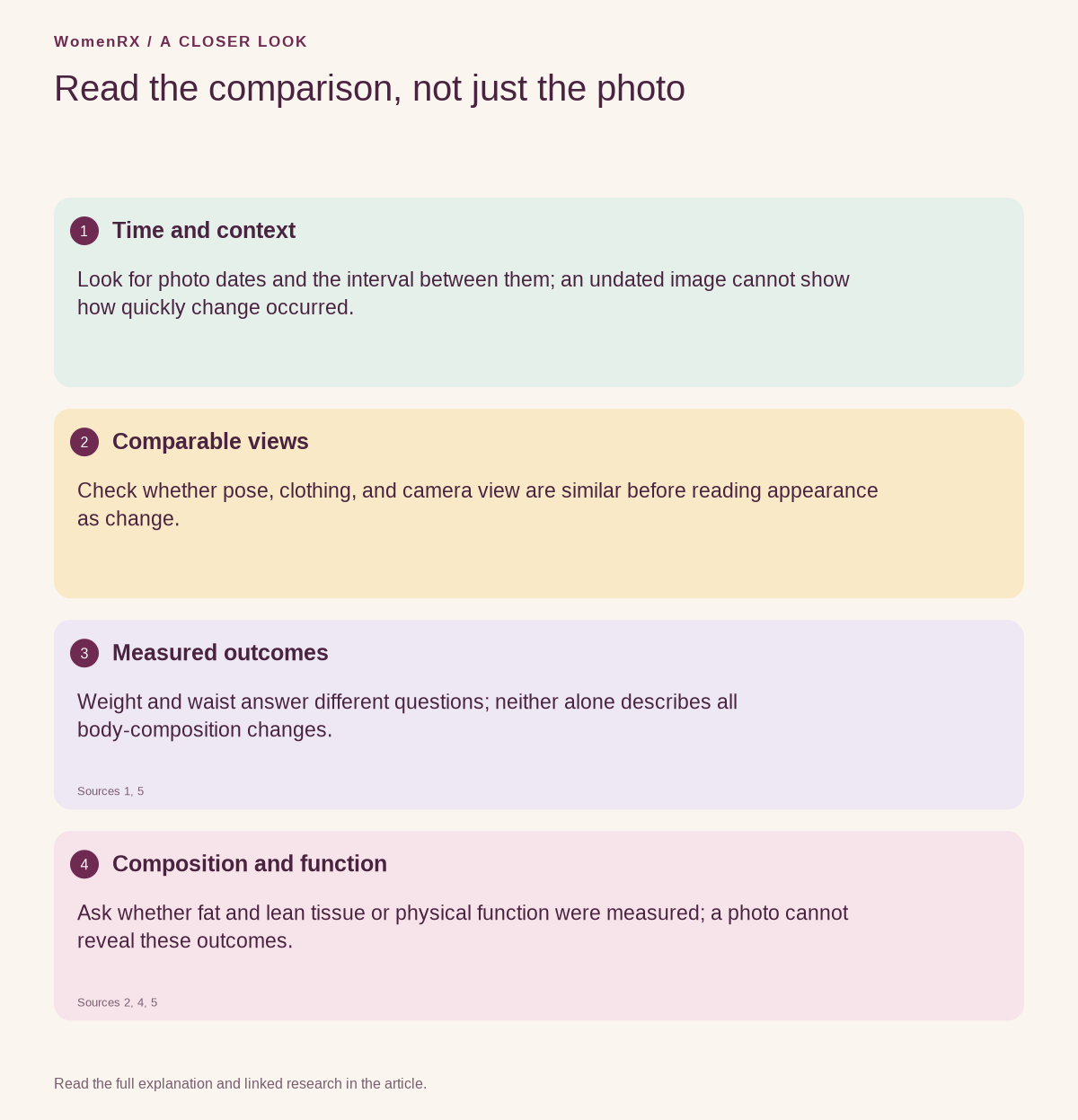
Read the comparison, not just the photo
Time and context: Look for photo dates and the interval between them; an undated image cannot show how quickly change occurred.
Comparable views: Check whether pose, clothing, and camera view are similar before reading appearance as change.
Measured outcomes: Weight and waist answer different questions; neither alone describes all body-composition changes.15
Composition and function: Ask whether fat and lean tissue or physical function were measured; a photo cannot reveal these outcomes.245
Read the figure as text
Use these checks to see whether a before-and-after image has enough context to support a meaningful comparison.- Time and context: Look for photo dates and the interval between them; an undated image cannot show how quickly change occurred.
- Comparable views: Check whether pose, clothing, and camera view are similar before reading appearance as change.
- Measured outcomes: Weight and waist answer different questions; neither alone describes all body-composition changes.15
- Composition and function: Ask whether fat and lean tissue or physical function were measured; a photo cannot reveal these outcomes.245
More questions, answered
Does a smaller number on the scale mean someone lost only body fat?
No. Weight includes fat, lean tissue, bone, and water, and the scale can’t separate them. Tirzepatide information describes greater loss of fat mass than lean mass, but that doesn’t mean lean mass never changes. 1 2
Do these results show what women can expect at different life stages?
No. The cited real-world reports don’t break results down by menstrual cycling years, perimenopause, or postmenopause. A study that includes women, or reports a difference between women and men, doesn’t by itself establish how results vary across women’s life stages. 5 6
Sources you can check
- Body Weight: MedlinePlusAccessed 2026-09-25Return to first citation
- ZEPBOUND (TIRZEPATIDE) INJECTION, SOLUTION ZEPBOUND (TIRZEPATIDE) INJECTION, SOLUTION ZEPBOUND KWIKPEN (TIRZEPATIDE) INJECTION, SOLUTION [ELI LILLY AND COMPANY] | US prescribing information and patient instructionsAccessed 2026-09-25Return to first citation
- Effects of tirzepatide therapy on body weight and body composition in adults with overweight and obesity.Corso H, Graybeal AJ, Hoelscher E, Roberson S, Curran B, Johnson C, Johnson KE. · Frontiers in endocrinology · 2026Return to first citation
- Early changes in body composition with tirzepatide in adults with obesity: a real-world BIA study.Angelopoulos N, Rizoulis A, Boniakos A, Fousteris E, Mentzelopoulou V, Zianni D, Livadas S, Paparodis R. · Nutrition (Burbank, Los Angeles County, Calif.) · 2026Return to first citation
- [Tirzepatide in real-world clinical practice: changes in body composition and muscle function in patients with obesity].Blanco Anesto J, Dotres Fallat KM, Nicolau J. · Nutricion hospitalaria · 2026Return to first citation
- Real-world effects of incretin-based Obesity medications on body composition.Bhatti R, Sadiya A, Mussa BM, Khan R, Abusnana S. · Obesity pillars · 2025Return to first citation