What One Year of Tirzepatide Results Can Tell You
One small one-year study found substantial average weight loss, but its participants had type 1 diabetes, so the result isn’t a personal forecast.
In a small, single-center study of adults with type 1 diabetes and overweight or obesity, people prescribed tirzepatide lost an average of 18.5% of their body weight over one year. That result is encouraging, but the study was retrospective and included only 62 of 184 people prescribed the drug. It can’t predict your result or stand in for a year-long trial in a broader obesity-treatment population. 3
The one-year number, in context
A one-year figure comes from a retrospective study at one center. It followed 62 adults with type 1 diabetes and overweight or obesity who were prescribed tirzepatide. At one year, the researchers reported an average loss of 18.5% of starting body weight, or more than 46 pounds. The reported mean weekly dose was 5.6 mg at three months and 9.7 mg at one year. The study also included 37 matched patients with type 1 diabetes who weren’t using other weight-loss medicines; the tirzepatide group had significantly larger declines in weight and BMI at the time points measured. 3
That is a group average, not a likely outcome for every person. The study wasn’t randomized, and the 62 treated participants were a selected subset of 184 people prescribed tirzepatide: eligibility required at least three months of use. Selection into the 62-person study cohort limits how broadly the result can be applied. The study authors called for a larger prospective randomized trial. 3
There’s another important distinction: this was a study in people with type 1 diabetes, not a general one-year trial of adults taking tirzepatide for obesity. Its result shouldn’t be used as a straightforward estimate for someone whose health, treatment context, or response differs.
A trial lasting longer than a year answers a different question
A large obesity trial described in Zepbound prescribing information ran for 72 weeks, not 52. It enrolled adults with obesity, or overweight plus a weight-related condition, and excluded people with type 2 diabetes. Participants were assigned to fixed weekly doses of 5, 10, or 15 mg or placebo; dose escalation could take up to 20 weeks. That design differs from the one-year type 1 diabetes study in both participants and follow-up time. 13
This difference in duration matters. A result measured at 72 weeks isn’t a one-year result, and a 72-week average can’t simply be divided into months to estimate your pace. It also includes time spent increasing the dose. Weight change is an endpoint measured across a group, not a promise that loss continues at a steady rate. 1
What happened when treatment continued after weight loss
A separate U.S. randomized trial helps answer a different question: what happened after people had already lost weight on tirzepatide? Participants first received open-label treatment for 60 weeks. The 378 who were then randomized had an additional 52 weeks continuing their maximum tolerated dose, switching to 5 mg, or switching to placebo. So the study’s week-112 results describe more than two years from the original baseline, not a one-year estimate for a new starter. 2
At week 112, the model-based average change from original baseline was −21.9% for those continuing their maximum tolerated dose, −16.6% for those assigned to 5 mg, and −9.9% for those assigned to placebo. These figures include the initial 60-week weight-loss period; they are not the amount lost during the second year alone. The comparison suggests that, for these selected trial participants, continuing treatment or reducing to 5 mg preserved more of the overall reduction than switching to placebo. 2
The groups also weren’t identical to people beginning treatment in everyday care: they had completed the 60-week treatment period and were eligible for randomization. Some participants could receive rescue tirzepatide under the study rules if they regained a specified share of lost weight, which is another reason to read the findings as a trial comparison, not a personal forecast. 2
Were women included in these results?
Women were included in both the 72-week obesity trial described in the prescribing information and the longer maintenance trial. In the 72-week obesity trial, 68% of participants were female. Of the 441 people enrolled in the maintenance trial’s initial weight-loss period, 288 were female. Those participation figures show that women were represented, but the reported results don’t give separate weight-loss estimates by sex or reproductive stage. They don’t establish a menopause-specific effect. 12
In the one-year type 1 diabetes study, the comparison group was matched by gender, but the reported results don’t give a women-only treatment result. 3
A useful way to apply the numbers
When you see a one-year percentage, check four details before comparing it with your own situation: who was studied, whether the result came from a randomized trial or an observational study, how long participants were actually treated, and whether the reported number describes a group average or a particular subgroup. Here, the 18.5% result comes from a selected type 1 diabetes cohort, while the randomized maintenance results cover a longer period after an initial treatment phase.
For a conversation about ongoing treatment, the practical question isn’t only “How much might I lose by one year?” It’s also what a study’s time point means, whether its participants resemble you, and how the plan accounts for maintaining progress over time. These studies support discussing continued treatment as a maintenance question, but they don’t establish the right duration or result for any one person. 23
Three results, three different questions
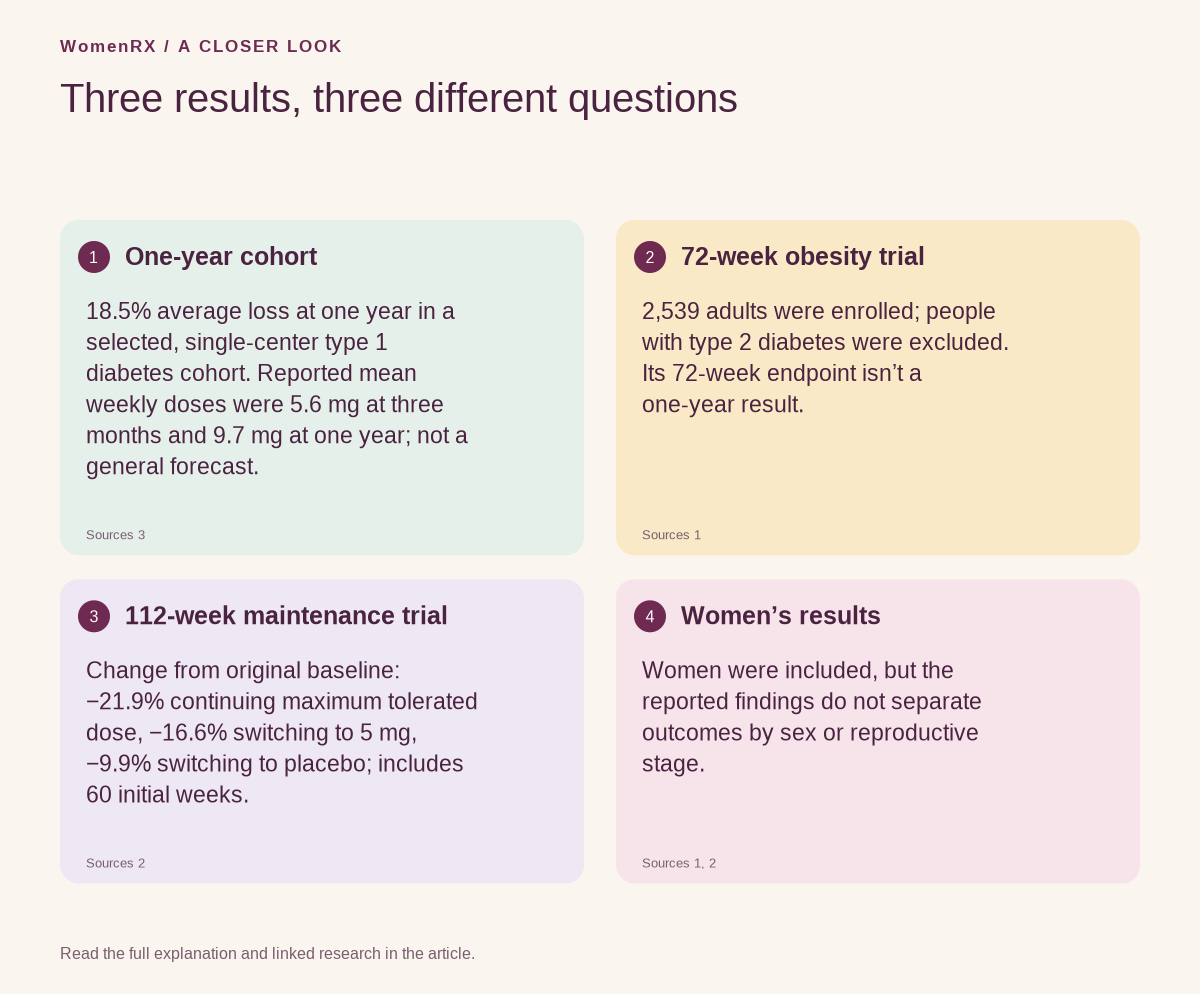
One-year cohort: 18.5% average loss at one year in a selected, single-center type 1 diabetes cohort. Reported mean weekly doses were 5.6 mg at three months and 9.7 mg at one year; not a general forecast.3
72-week obesity trial: 2,539 adults were enrolled; people with type 2 diabetes were excluded. Its 72-week endpoint isn’t a one-year result.1
112-week maintenance trial: Change from original baseline: −21.9% continuing maximum tolerated dose, −16.6% switching to 5 mg, −9.9% switching to placebo; includes 60 initial weeks.2
Women’s results: Women were included, but the reported findings do not separate outcomes by sex or reproductive stage.12
Read the figure as text
These studies can look comparable at first glance, but their populations, time points, and treatment questions differ.- One-year cohort: 18.5% average loss at one year in a selected, single-center type 1 diabetes cohort. Reported mean weekly doses were 5.6 mg at three months and 9.7 mg at one year; not a general forecast.3
- 72-week obesity trial: 2,539 adults were enrolled; people with type 2 diabetes were excluded. Its 72-week endpoint isn’t a one-year result.1
- 112-week maintenance trial: Change from original baseline: −21.9% continuing maximum tolerated dose, −16.6% switching to 5 mg, −9.9% switching to placebo; includes 60 initial weeks.2
- Women’s results: Women were included, but the reported findings do not separate outcomes by sex or reproductive stage.12
More questions, answered
Does 18.5% mean I’ll lose 18.5% in a year?
No. It was the average in a small retrospective study of adults with type 1 diabetes and overweight or obesity, not a prediction for an individual or a general one-year obesity-treatment trial. 3
Did the studies show a different result after menopause?
The reported results don’t break weight loss down by reproductive stage, so they don’t show whether outcomes differ after menopause. 12
Sources you can check
- ZEPBOUND (TIRZEPATIDE) INJECTION, SOLUTION ZEPBOUND (TIRZEPATIDE) INJECTION, SOLUTION ZEPBOUND KWIKPEN (TIRZEPATIDE) INJECTION, SOLUTION [ELI LILLY AND COMPANY] | US prescribing information and patient instructionsAccessed 2026-09-25Return to first citation
- Tirzepatide for maintenance of bodyweight reduction in people with obesity in the USA (SURMOUNT-MAINTAIN): a multicentre, double-blind, randomised, placebo-controlled trial.Horn DB, Aronne LJ, Wharton S, Bays HE, le Roux CW, Srinath R, Gomez-Valderas E, Arad AD, Das S, Dunn JP, Ribeiro A, Glass LC, Lee CJ. · Lancet (London, England) · 2026Return to first citation
- Efficacy and Safety of Tirzepatide in Overweight and Obese Adult Patients with Type 1 Diabetes.Garg SK, Akturk HK, Kaur G, Beatson C, Snell-Bergeon J. · Diabetes technology & therapeutics · 2024Return to first citation