What Zepbound Studies Show About Weight Loss and Side Effects
Zepbound produced substantial average weight loss in 72-week trials, but the results also reflect differences in diabetes status, side effects, and who stayed on treatment.
In a 72-week trial of adults without type 2 diabetes, average weight loss with Zepbound was 15.0% to 20.9%, depending on the assigned dose, versus 3.1% with placebo. A separate trial in adults with type 2 diabetes found smaller averages. Digestive side effects were common. The label also warns of thyroid tumors seen in rats, though whether this risk applies to humans is unknown. Group results aren’t a forecast for you. 1
Start with the right trial
A striking weight-loss story may be real for the person telling it. It still can’t tell you how likely you are to have the same result. The Zepbound trials give a better starting point because they compare groups assigned to tirzepatide or placebo and report outcomes at a defined point in time.
The two main weight-loss trials lasted 72 weeks. Participants had obesity, or overweight with a weight-related condition. Everyone received counseling on a reduced-calorie diet, physical activity, and behavior changes. Study 1 enrolled 2,539 adults without type 2 diabetes; Study 2 enrolled 938 adults with type 2 diabetes. That distinction matters when you compare their results. 1
What the weight-loss numbers actually mean
In Study 1, average weight change at week 72 was a 15.0% loss in the Zepbound 5 mg group, 19.5% in the 10 mg group, and 20.9% in the 15 mg group, compared with 3.1% in the placebo group. These are percentages of starting body weight, not percentages more weight lost than placebo. For example, the difference between the 15 mg and placebo averages was 17.8 percentage points. 1
An average doesn’t show the range of experiences. The study also reported how many people reached a threshold: at least 5% weight loss by week 72 was achieved by 85.1%, 88.9%, and 90.9% of participants in the respective Zepbound groups, versus 34.5% in the placebo group. That tells you more about the spread of responses, though it still doesn’t predict your own result. 1
In Study 2, which enrolled adults with type 2 diabetes, average weight loss at week 72 was 12.8% with 10 mg and 14.7% with 15 mg, versus 3.2% with placebo. Don’t combine these figures into one expectation: the trials enrolled different populations, and Study 2 didn’t have a 5 mg group. 1
Both trials counted everyone randomized in their main weight-loss analyses, but some week-72 weights were missing and estimated using the trials’ stated methods. Participants also stopped taking study drug before the end: in Study 1, that happened for 14.3% to 16.4% of Zepbound-assigned participants, depending on dose, and 26.4% of placebo-assigned participants. Stopping study drug for any reason is not the same measure as stopping because of a side effect. 1
What the side-effect figures show
Nausea, diarrhea, vomiting, and constipation stood out in the combined safety results from Studies 1 and 2. Nausea was reported by 25% to 29% of Zepbound-treated participants, depending on dose, versus 8% on placebo. Diarrhea occurred in 19% to 23% versus 8%; vomiting in 8% to 13% versus 2%; and constipation in 11% to 17% versus 5%. These are group rates over the trials, not symptoms everyone will have. 1
Across those two trials, gastrointestinal reactions as a group occurred in 56% of participants at each Zepbound dose, versus 30% on placebo. Most nausea, vomiting, and diarrhea events occurred while doses were being increased and decreased over time. Severe gastrointestinal reactions were less common: 1.7%, 2.5%, and 3.1% in the 5 mg, 10 mg, and 15 mg groups, respectively, versus 1% on placebo. 1
Side effects also affected whether people could stay on treatment. In the pooled trials, 4.8% to 6.7% of Zepbound-treated participants permanently stopped because of an adverse reaction, depending on dose, versus 3.4% on placebo. Stopping specifically because of a gastrointestinal reaction ranged from 1.9% to 4.3% with Zepbound, versus 0.5% with placebo. Most who stopped Zepbound because of an adverse reaction did so in the first few months because of gastrointestinal problems. 1
The boxed thyroid-tumor warning describes a different kind of evidence: tirzepatide caused thyroid C-cell tumors in rats, but whether it causes them in humans is unknown. Zepbound is contraindicated if you have a personal or family history of medullary thyroid carcinoma, or if you have multiple endocrine neoplasia syndrome type 2 (MEN 2). This isn’t a side-effect rate measured in the weight-loss trials. 1
Persistent vomiting or diarrhea deserves attention because fluid loss can lead to kidney problems. Severe abdominal pain that doesn’t go away, sometimes spreading to the back, needs prompt medical attention; the prescribing information identifies it as a possible sign of pancreatitis. 1
What the results say about women
Women were well represented: 68% of Study 1 participants and 51% of Study 2 participants were female. The prescribing information says weight reduction was observed irrespective of sex, but the main results above are for each full trial population, not separate estimates of average weight loss for women and men. They don’t establish a women-specific amount to expect. 1
There is one useful sex-specific side-effect detail. In the pooled weight-loss trials, hair loss was reported by 7.1% of female Zepbound-treated participants versus 1.3% of female placebo-treated participants. The prescribing information says hair-loss reports in Zepbound-treated participants were associated with weight reduction; it does not mean every woman who loses weight will experience hair loss. 1
If you use an oral hormonal contraceptive, there’s a separate practical consideration: Zepbound’s delayed stomach emptying may reduce its effectiveness. The prescribing information advises switching to a non-oral method or adding a barrier method for four weeks after starting Zepbound and for four weeks after each dose increase. 1
Why an early result isn’t the whole result
The 72-week figures include many months beyond the initial dose-escalation period. An exploratory reanalysis of tirzepatide-treated participants in the same two trials compared people who had lost at least 5% by week 8 with those who had not. Early responders lost more weight by week 72, but people in both groups had meaningful weight reduction. Because this was a post hoc comparison of people with available week-8 weights, it is not a rule for predicting an individual’s eventual result. 2
There’s also a difference between losing weight and maintaining the loss. In a separate withdrawal trial, participants first took Zepbound for 36 weeks. Those who then continued it lost a further average 5.5% over the next 52 weeks, while those switched to placebo regained an average 14.0%, measured from the point of randomization. This describes people who reached that second stage of the trial, not everyone who starts treatment, but it shows why a first-year result and a long-term plan are different questions. 1
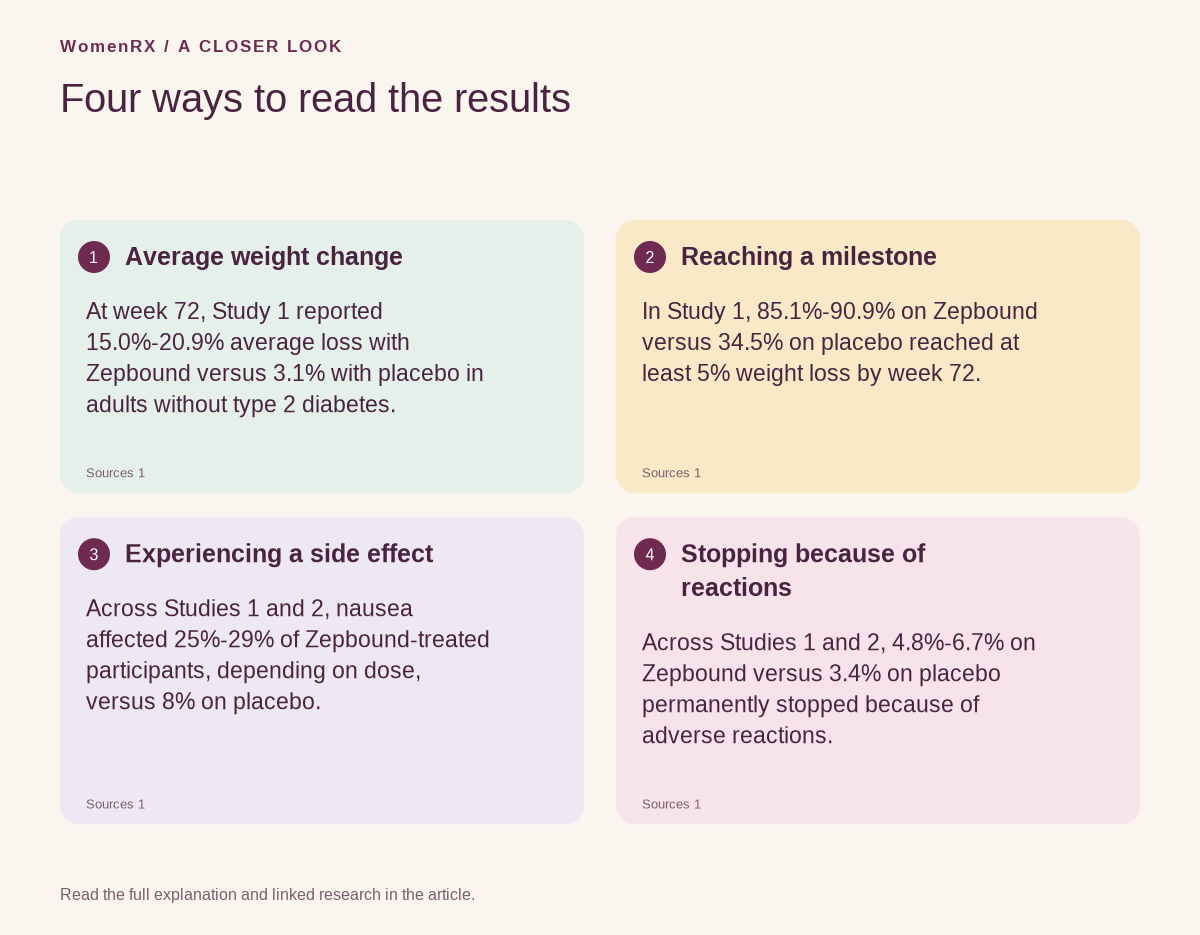
Four ways to read the results
Average weight change: At week 72, Study 1 reported 15.0%-20.9% average loss with Zepbound versus 3.1% with placebo in adults without type 2 diabetes.1
Reaching a milestone: In Study 1, 85.1%-90.9% on Zepbound versus 34.5% on placebo reached at least 5% weight loss by week 72.1
Experiencing a side effect: Across Studies 1 and 2, nausea affected 25%-29% of Zepbound-treated participants, depending on dose, versus 8% on placebo.1
Stopping because of reactions: Across Studies 1 and 2, 4.8%-6.7% on Zepbound versus 3.4% on placebo permanently stopped because of adverse reactions.1
Read the figure as text
These measures answer different questions about the Zepbound studies; none promises an individual outcome.- Average weight change: At week 72, Study 1 reported 15.0%-20.9% average loss with Zepbound versus 3.1% with placebo in adults without type 2 diabetes.1
- Reaching a milestone: In Study 1, 85.1%-90.9% on Zepbound versus 34.5% on placebo reached at least 5% weight loss by week 72.1
- Experiencing a side effect: Across Studies 1 and 2, nausea affected 25%-29% of Zepbound-treated participants, depending on dose, versus 8% on placebo.1
- Stopping because of reactions: Across Studies 1 and 2, 4.8%-6.7% on Zepbound versus 3.4% on placebo permanently stopped because of adverse reactions.1
Sources you can check
- ZEPBOUND (TIRZEPATIDE) INJECTION, SOLUTION ZEPBOUND (TIRZEPATIDE) INJECTION, SOLUTION ZEPBOUND KWIKPEN (TIRZEPATIDE) INJECTION, SOLUTION [ELI LILLY AND COMPANY] | US prescribing information and patient instructionsAccessed 2026-09-25Return to first citation
- Tirzepatide Efficacy and Tolerability According to Early Weight Response: A Post Hoc Analysis of the SURMOUNT-1 and SURMOUNT-2 Trials.Kokkinos A, Thethi T, Lee CJ, Neff LM, Stefanski A, Cao D, Rodriguez A, Bartee A. · Diabetes, obesity & metabolism · 2026Return to first citation