Tirzepatide Side Effects: What May Happen and When to Get Help
Stomach symptoms are common, but their severity, persistence, and effect on drinking help determine what to do next.
Nausea, diarrhea, constipation, and vomiting are common with tirzepatide, particularly while the dose is being increased. Symptoms that are severe or won’t go away deserve a call to your prescriber. Severe abdominal pain that persists calls for stopping the medicine and calling right away; signs of a serious allergic reaction call for immediate medical help. If you become pregnant, stop Zepbound and tell your prescriber promptly. Discuss breastfeeding with them too. 1 2
Tirzepatide, sold as Mounjaro and Zepbound, can cause gastrointestinal side effects. The most useful distinction isn’t simply whether you have a symptom: it’s how severe it is, how it changes, and whether a specific product warning applies. Gastrointestinal reactions can sometimes be severe. 1 2
Your history matters as well. Zepbound and Mounjaro are not recommended for people with severe gastroparesis, a condition in which the stomach empties slowly. And someone who has had a serious allergic reaction to tirzepatide should not use it again. These are reasons to speak with your prescriber before starting or continuing treatment, not reasons to guess what a new symptom means. 1 2
Common stomach symptoms: notice what changes
Nausea, diarrhea, constipation, vomiting, and reduced appetite were among the non-serious side effects reported more often with tirzepatide than with placebo in a review of trials involving people at increased cardiovascular risk. Those findings don’t predict exactly what you’ll experience. 3 In two Zepbound weight-reduction trials, most nausea, vomiting, and diarrhea events occurred while doses were being increased and decreased over time. That pattern isn’t a reason to wait out symptoms that are severe or won’t go away. 1
For example, occasional nausea that doesn’t interfere with drinking is different from repeated vomiting that makes it hard to replace fluids. Zepbound’s Medication Guide says to tell your prescriber about stomach problems that are severe or won’t go away, and to tell them right away if nausea, vomiting, or diarrhea does not go away. 1
In two weight-reduction trials, severe gastrointestinal reactions were reported in 1.7% of participants taking 5 mg, 2.5% taking 10 mg, and 3.1% taking 15 mg of Zepbound, compared with 1% taking placebo. Those trial figures describe groups, not your personal likelihood. 1
Vomiting or diarrhea: take fluid loss seriously
Vomiting or diarrhea that leads to dehydration has been linked to postmarketing reports of acute kidney injury. The prescribing information calls for kidney-function monitoring when side effects could cause fluid loss, especially when treatment starts or the dose increases. Tell your prescriber promptly if nausea, vomiting, or diarrhea won’t go away, or if you’re struggling to drink enough to replace lost fluids. 1 2
Severe abdominal pain: call right away
The Mounjaro and Zepbound Medication Guides say to stop using the medicine and call your healthcare provider right away for severe abdominal pain that won’t go away, with or without nausea or vomiting. The pain may spread from the abdomen to the back. Follow that instruction rather than trying to decide for yourself whether the cause is pancreatitis. 1 2
Gallbladder problems call for a prompt conversation too. Zepbound’s Medication Guide says to tell your healthcare provider right away about possible signs such as upper-abdominal pain, fever, yellowing of the skin or eyes, or clay-colored stools. 1
Signs of a serious allergic reaction: get medical help
Serious allergic reactions have been reported with tirzepatide. Zepbound’s Medication Guide says to stop using it and get medical help right away for symptoms including swelling of the face, lips, tongue, or throat; trouble breathing or swallowing; severe rash or itching; fainting; or a very rapid heartbeat. The Mounjaro prescribing information also directs stopping the medicine and prompt treatment if a hypersensitivity reaction occurs. 1 2
Insulin and sulfonylureas change the picture
If you also use insulin or a sulfonylurea, tirzepatide can increase the risk of low blood sugar, including severe low blood sugar. Sweating, shakiness, confusion, and blurred vision are among the symptoms listed in the Zepbound Medication Guide. Ask your prescriber how to recognize and respond to low blood sugar when using these medicines together. 1 2
Pregnancy, breastfeeding, and side effects in women
If you become pregnant while using Zepbound, tell your prescriber promptly. Its prescribing information says to discontinue Zepbound when pregnancy is recognized: weight loss is not recommended during pregnancy, and human pregnancy data are insufficient to determine the drug’s risk. If you’re breastfeeding or planning to, discuss that with your prescriber as well. A small single-dose study found undetectable or low amounts of tirzepatide in breast milk, but there are no available data on its effects on a breastfed infant or milk production. 1
Side effects shouldn’t all be assumed to differ by sex. In the two Zepbound weight-reduction trials, hair loss was reported more often by female than male participants in both the Zepbound and placebo groups, and the label associates hair loss during Zepbound treatment with weight reduction. That finding doesn’t establish a female-specific pattern for other side effects. An analysis of spontaneous adverse-event reports found differences in reporting of injection-site reactions but could not determine whether women and men actually experience them at different rates. 1 4
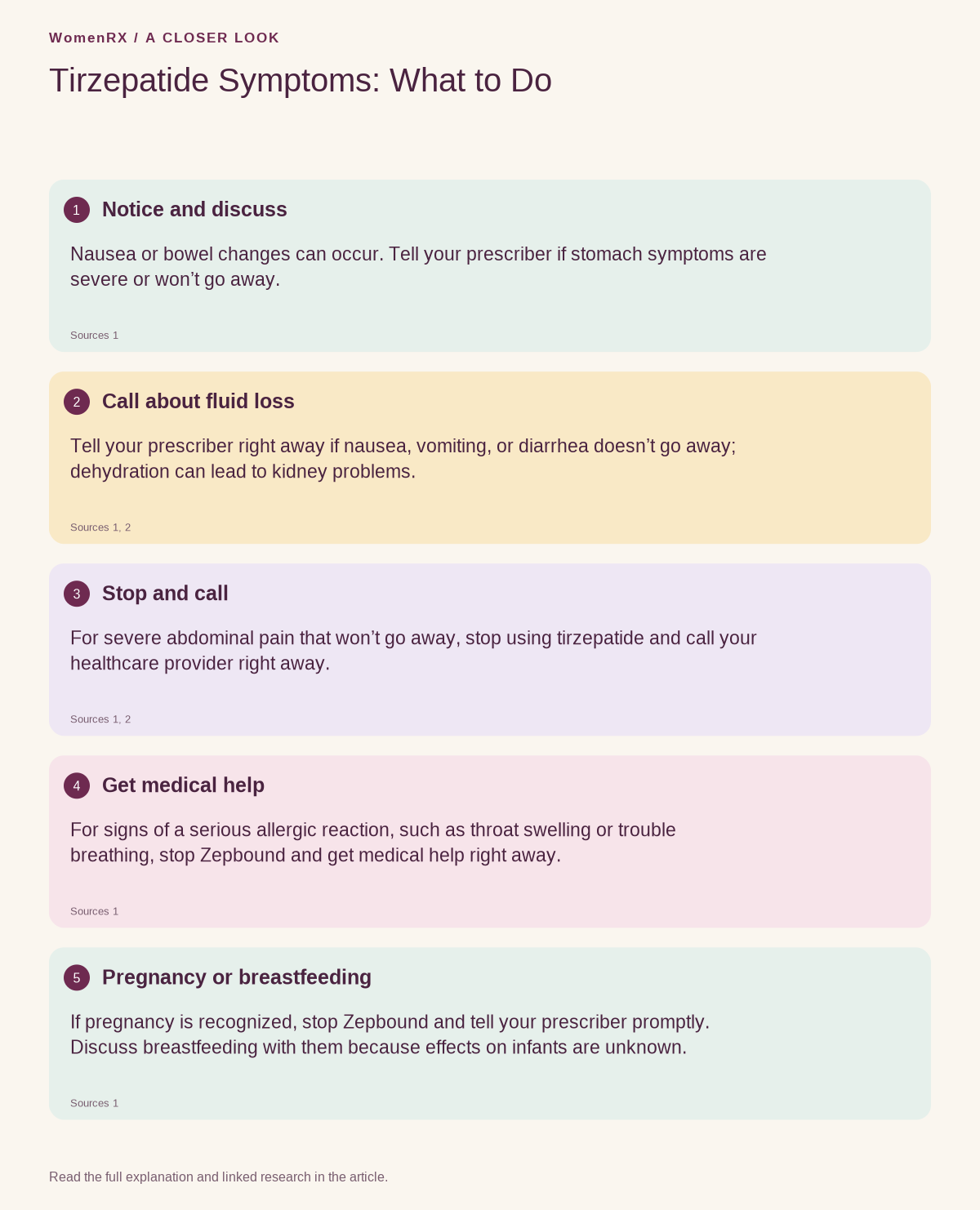
Tirzepatide Symptoms: What to Do
Notice and discuss: Nausea or bowel changes can occur. Tell your prescriber if stomach symptoms are severe or won’t go away.1
Call about fluid loss: Tell your prescriber right away if nausea, vomiting, or diarrhea doesn’t go away; dehydration can lead to kidney problems.12
Stop and call: For severe abdominal pain that won’t go away, stop using tirzepatide and call your healthcare provider right away.12
Get medical help: For signs of a serious allergic reaction, such as throat swelling or trouble breathing, stop Zepbound and get medical help right away.1
Pregnancy or breastfeeding: If pregnancy is recognized, stop Zepbound and tell your prescriber promptly. Discuss breastfeeding with them because effects on infants are unknown.1
Read the figure as text
Sort a symptom by its severity and persistence, rather than assuming every stomach symptom needs the same response.- Notice and discuss: Nausea or bowel changes can occur. Tell your prescriber if stomach symptoms are severe or won’t go away.1
- Call about fluid loss: Tell your prescriber right away if nausea, vomiting, or diarrhea doesn’t go away; dehydration can lead to kidney problems.12
- Stop and call: For severe abdominal pain that won’t go away, stop using tirzepatide and call your healthcare provider right away.12
- Get medical help: For signs of a serious allergic reaction, such as throat swelling or trouble breathing, stop Zepbound and get medical help right away.1
- Pregnancy or breastfeeding: If pregnancy is recognized, stop Zepbound and tell your prescriber promptly. Discuss breastfeeding with them because effects on infants are unknown.1
More questions, answered
Does nausea mean I should stop tirzepatide?
Nausea alone isn’t the stop-and-call symptom described in the Mounjaro and Zepbound Medication Guides. Tell your prescriber if stomach symptoms are severe. Zepbound’s guide says to tell them right away if nausea, vomiting, or diarrhea does not go away, even if you haven’t noticed signs of fluid loss. Severe abdominal pain that won’t go away has a different instruction: stop using the medicine and call right away. 1 2
Sources you can check
- ZEPBOUND (TIRZEPATIDE) INJECTION, SOLUTION ZEPBOUND (TIRZEPATIDE) INJECTION, SOLUTION ZEPBOUND KWIKPEN (TIRZEPATIDE) INJECTION, SOLUTION [ELI LILLY AND COMPANY] | US prescribing information and patient instructionsAccessed 2026-09-25Return to first citation
- MOUNJARO (TIRZEPATIDE) INJECTION, SOLUTION MOUNJARO KWIKPEN (TIRZEPATIDE) INJECTION, SOLUTION [ELI LILLY AND COMPANY] | US prescribing information and patient instructionsAccessed 2026-09-25Return to first citation
- The adverse effects associated with tirzepatide use in patients at increased risk of cardiovascular events: a systematic review with meta-analysis and Trial Sequential Analysis.Sillassen CDB, Faltermeier P, Bjerg JL, Andersen RK, Petersen JJ, Andersen PB, Kamp CB, Karlsson F, Grand J, Dominguez H, Frølich A, Gæde P, Gluud C, Mathiesen O, Jakobsen JC. · BMC medicine · 2026Return to first citation
- Adverse events associated with tirzepatide: a focus on subgroup-specific differences.Yu Z, Qi Y, Gan Q, Wu G, Zhang X, Jiang C, Li J. · BMC pharmacology & toxicology · 2026Return to first citation