How Long Do Tirzepatide Side Effects Usually Last?
Nausea, vomiting, and diarrhea often ease over time; the cited trial results describe that group pattern, not how long symptoms will last for you.
In Zepbound trial reporting, most nausea, vomiting, and diarrhea events occurred during dose escalation and decreased over time. Those group-level findings don’t provide a reliable duration estimate for an individual. If symptoms are severe, persistent, or making it hard to replace fluids, contact your prescriber rather than relying on a general timeline. 1
The short answer: often less over time, not on a set schedule
If nausea or another stomach symptom starts after your first tirzepatide dose or a dose increase, it may improve as treatment continues. In the Zepbound prescribing information, most nausea, vomiting, and diarrhea events occurred during dose escalation and decreased over time. That group-level pattern doesn’t say how many days or weeks symptoms last for a particular person. A symptom that lingers shouldn’t be dismissed just because these effects often ease. 1
Tirzepatide is the active medicine in both Mounjaro and Zepbound. Their prescribing information comes from separate product studies, so it doesn’t establish that side effects last longer with one brand. Neither label provides a precise, universal timeline for an individual. 1 2
Why symptoms may show up again after a dose change
Nausea, vomiting, diarrhea, constipation, and other digestive effects are among the commonly reported problems with tirzepatide and related medicines. Symptoms tend to cluster around starting treatment or increasing the dose. The effect may feel familiar if it returns after a dose change, but that pattern alone can’t tell you how long a new episode will last. 1 6
A 2026 meta-analysis compared nausea and vomiting across earlier-phase trials, which generally had little or no time for dose escalation, with later-phase trials that used escalation schedules. It found evidence consistent with greater tolerance in the later-phase trials, especially when escalation was longer and included more steps. That supports gradual escalation as a way to improve tolerability at the group level; it does not predict an individual’s symptoms or define their duration. 4
Here’s a useful distinction: a trial showing fewer reports later in treatment is not the same as measuring how many days a given person’s nausea lasts. In a real-world study comparing tirzepatide with semaglutide, the reported results provide onset timing but don’t provide an individual symptom-duration estimate. So those results add information about onset, not a countdown to relief. 7
What you can do while symptoms are mild
If symptoms are manageable, notice whether they began after starting or increasing treatment and whether they’re improving, holding steady, or getting worse. Smaller, more frequent meals and adequate hydration are strategies described in a clinical review of medicines in this drug class; they may help with digestive symptoms, but they don’t guarantee relief. 5
Don’t change your dose or escalation plan based on a general timeline. If symptoms are interfering with eating or drinking, aren’t settling, or are getting worse, contact the prescriber who manages your tirzepatide. The product information advises patients to contact their provider about severe or persistent gastrointestinal symptoms, and to promptly report persistent nausea, vomiting, or diarrhea because fluid loss can affect kidney function. 1 2
When symptoms need prompt attention
Vomiting or diarrhea can lead to dehydration, especially when you can’t replace the fluids you’re losing. Feeling very thirsty or dizzy can be signs of dehydration. Confusion or shock are signs that need immediate medical help. 1 3
Persistent or severe abdominal pain, sometimes spreading to the back, needs prompt medical assessment. The Mounjaro and Zepbound labels identify that pattern as a possible sign of pancreatitis, whether or not nausea or vomiting is also present. Don’t assume severe pain is just a side effect that will pass on its own. 1 2
Pregnancy planning is a separate question
This side-effect timeline doesn’t answer what to do if you’re pregnant or planning a pregnancy. That’s a separate prescribing question to raise with the clinician who manages your treatment. The cited time-course findings also don’t establish that women experience a different duration of side effects than men.
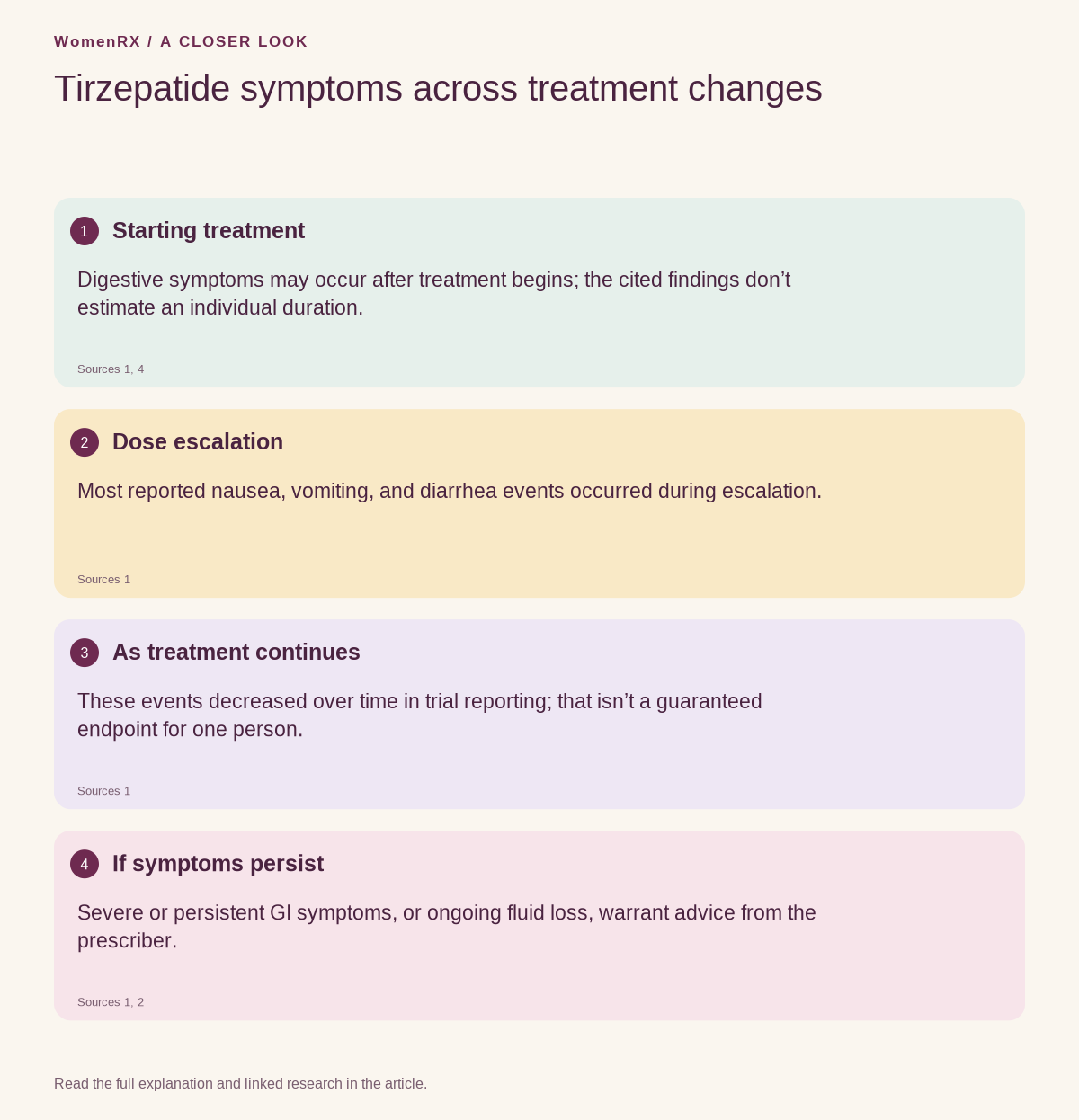
Tirzepatide symptoms across treatment changes
Starting treatment: Digestive symptoms may occur after treatment begins; the cited findings don’t estimate an individual duration.14
Dose escalation: Most reported nausea, vomiting, and diarrhea events occurred during escalation.1
As treatment continues: These events decreased over time in trial reporting; that isn’t a guaranteed endpoint for one person.1
If symptoms persist: Severe or persistent GI symptoms, or ongoing fluid loss, warrant advice from the prescriber.12
Read the figure as text
The Zepbound trial information links many digestive-event reports to dose escalation and describes a decline over time. It reports a group pattern, not a fixed symptom duration for an individual.- Starting treatment: Digestive symptoms may occur after treatment begins; the cited findings don’t estimate an individual duration.14
- Dose escalation: Most reported nausea, vomiting, and diarrhea events occurred during escalation.1
- As treatment continues: These events decreased over time in trial reporting; that isn’t a guaranteed endpoint for one person.1
- If symptoms persist: Severe or persistent GI symptoms, or ongoing fluid loss, warrant advice from the prescriber.12
More questions, answered
Can side effects return after a dose increase?
Digestive symptoms are reported most often during dose escalation, so they may occur around a later increase as well as when treatment begins. The cited findings don’t predict whether they’ll return for you or how long they’ll last. 1
Does a symptom’s duration show how quickly tirzepatide leaves the body?
No. The cited side-effect findings describe when symptoms are reported and how reports change over treatment. They don’t establish that symptom duration is a measure of how quickly the medicine clears.
Sources you can check
- ZEPBOUND (TIRZEPATIDE) INJECTION, SOLUTION ZEPBOUND (TIRZEPATIDE) INJECTION, SOLUTION ZEPBOUND KWIKPEN (TIRZEPATIDE) INJECTION, SOLUTION [ELI LILLY AND COMPANY] | US prescribing information and patient instructionsAccessed 2026-09-25Return to first citation
- MOUNJARO (TIRZEPATIDE) INJECTION, SOLUTION MOUNJARO KWIKPEN (TIRZEPATIDE) INJECTION, SOLUTION [ELI LILLY AND COMPANY] | US prescribing information and patient instructionsAccessed 2026-09-25Return to first citation
- Dehydration: MedlinePlusAccessed 2026-09-25Return to first citation
- Dose-Escalation Regimens for Incretin Mimetics in Type 2 Diabetes Are Associated With Tolerance for Nausea and Vomiting.Nauck MA, Punov V, Kang YM, Lim S. · Diabetes, obesity & metabolism · 2026Return to first citation
- GLP1 and GIP Receptor Agonists: Effects on the Gastrointestinal Tract and Management Strategies for Primary Care Physicians.Saha B, Kamalumpundi V, Codipilly DC. · Mayo Clinic proceedings · 2025Return to first citation
- Safety and Tolerability of Glucagon-Like Peptide-1 Receptor Agonists: A State-of-the-Art Narrative Review.Kunutsor SK, Seidu S. · Drugs · 2026Return to first citation
- Real-World Comparison of Short-Term Adverse Events, Treatment Persistence, and Efficacy of Semaglutide and Tirzepatide: A Nationwide Multicenter Study.Hepşen S, Haymana C, Ertepe Küçükgöde G, Özcan B, Özbaş B, Or Koca A, Aydoğan Bİ, Tura Bahadır Ç, Durcan E, Yumuk V, Toros B, Alphan Üç Z, Önder ÇE, Karaca Karagöz Z, Aşık M, Öztür... · Obesity facts · 2026Return to first citation